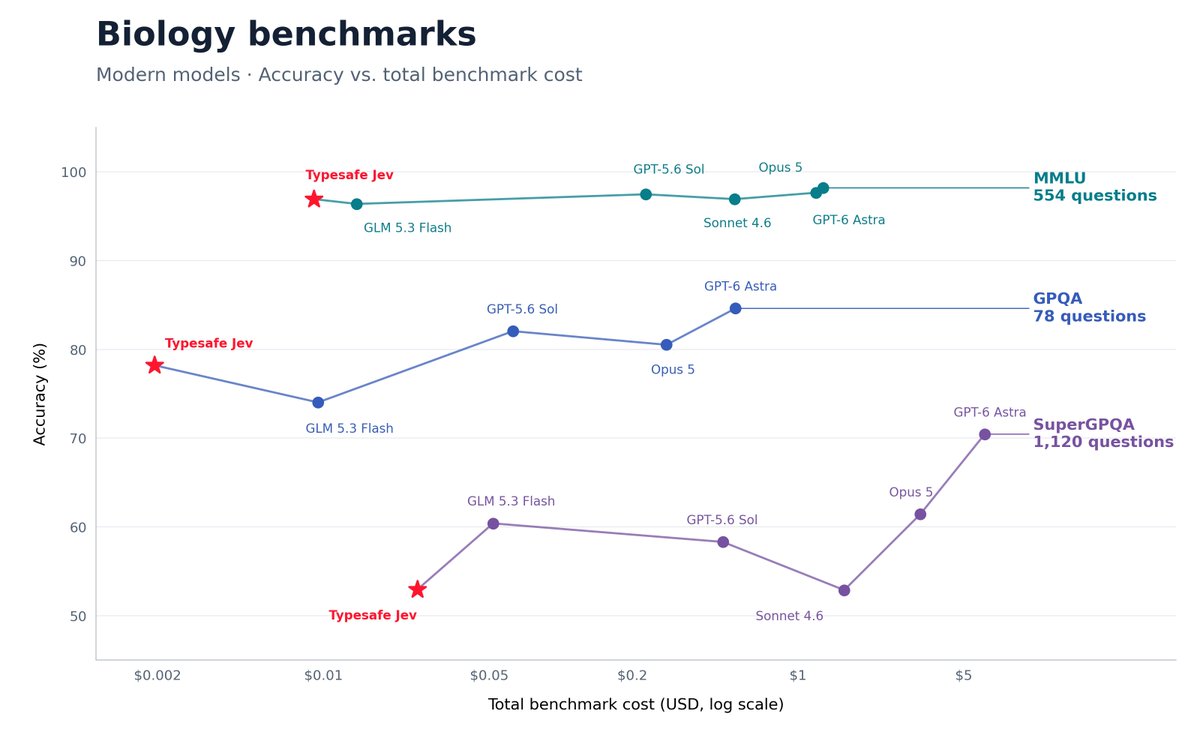
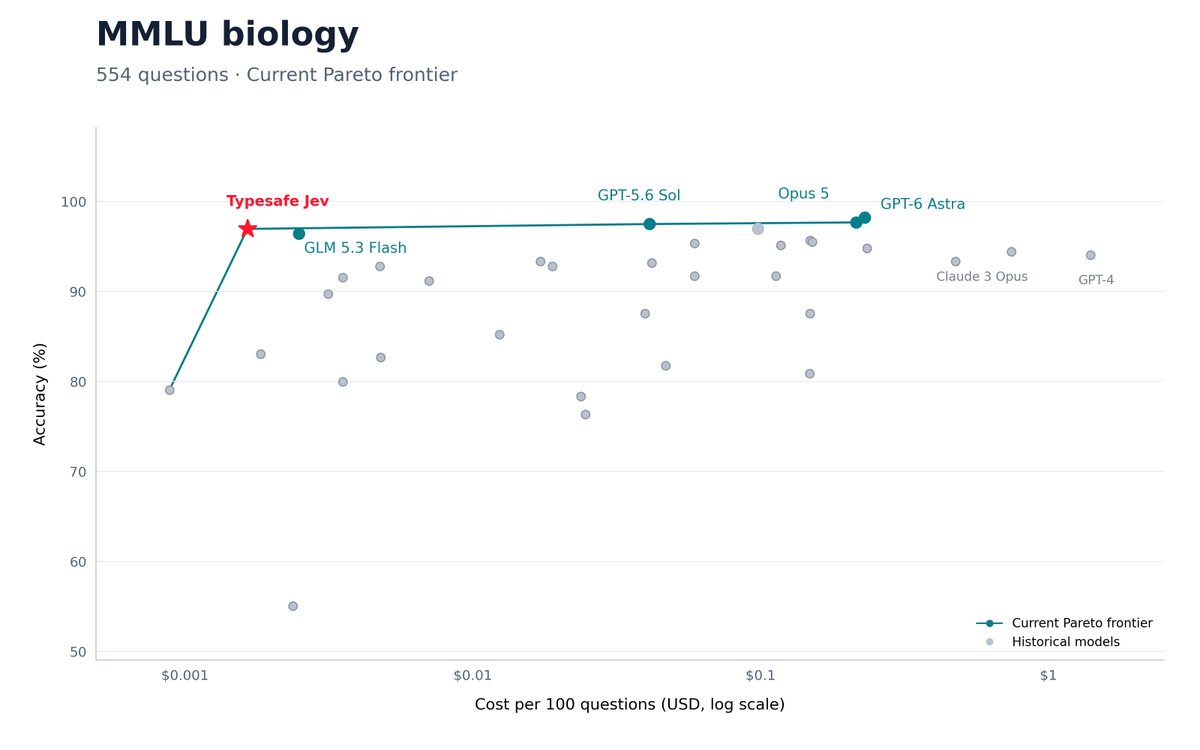
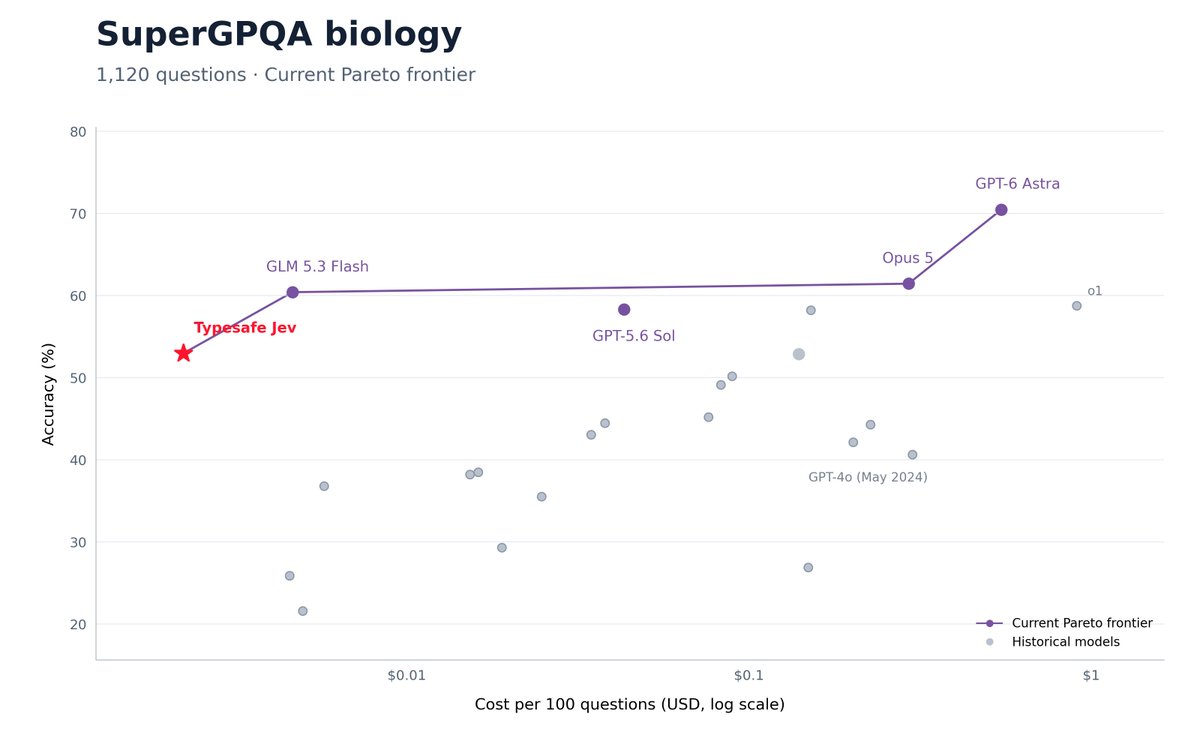
After co-inventing ChatGPT, I kept asking myself: why have superhuman chat models not led to AGI?
I’ve spent the last 2 years in stealth building a new way to train models (RLCD), and a new type of frontier AI model that we are releasing today: Jev
• 20-200x faster
• 40-400x cheaper (w/ output tokens free)
• Frontier composable intelligence optimized for decisions
AFAICT the shortest path to AI-based economic revolution
Single-cell RNA-seq is often characterized as providing comprehensive quantification of cellular transcriptomes.
It doesn't.
The number of distinct gene products (transcript fragments) detected by RNA sequencing in individual cells, is substantially below 20,000.
@slavov_n We have hard statistics on this. The median, across 50 000 GEO datasets, is about 1000 genes/cell, and about 2500 UMIs/cell.
On average, about 10% of all sequenced reads in the FASTQ end up in the cell-filtered count matrix.
https://t.co/QiM2wBjRPf
6/6 Let us know if you're interested in trying out our tools and harness! We're looking for design partners.
The full blogpost, with example questions, can be found here:
https://t.co/SnwwetIRGC
2/6 Our in-house eval suite tests if an LLM can predict follow-up responses to a paper, given only anonymized data.
In other words: can an LLM analyze and interpret a dataset, suggest follow-up experiments, and predict alternative explanations?
5/6 When a paper is not recognized, web search and Firecrawl only provide a modest, insignificant performance increase. When a paper is recognized both with and without search, Firecrawl still improves performance through access to metadata and literature text.
1/6 Frontier models outperform open-weights models on bio/science tasks. We're figuring out which tools and harness can elevate open-weights models to par!
Our first finding shows that access to web or the @firecrawl paper search index improves model performance.
Our API hosts access to 50 000 single-cell datasets, aligned to the same reference genome, easily merge-able, and annotatable with our proprietary annotation model!
https://t.co/dzAhmSVIsF
The 2026 @arcinstitute Virtual Cell Challenge just launched. The grand prize is $100,000, sponsored by @NVIDIA, @10xGenomics, and @UltimaGenomics.
There's a lot of interest in virtual cells these days: ML models of cells that can complement wet lab experiments. (You'll always need the wet lab to validate results, of course. But ML models can in principle search far more efficiently.)
A practical challenge in the field is that benchmarking is quite difficult: cells are very complicated, and it's not a priori obvious how to compare two different models.
So, inspired by the CASP protein folding contest, we're running the Virtual Cell Challenge to create a standardized way for teams around the world to compare the efficacy of different approaches, to spread awareness of what works, and ultimately -- we hope -- to support faster progress overall.
https://t.co/KMUYwidz7r