Poet, C-Linguist, PhD Student in AI. Passionate about (all kind of) chess and languages, can excel only in the latter. He claims: man is inherently good
The #NobelPrizeinPhysics2024 for Hopfield & Hinton rewards plagiarism and incorrect attribution in computer science. It's mostly about Amari's "Hopfield network" and the "Boltzmann Machine."
1. The Lenz-Ising recurrent architecture with neuron-like elements was published in 1925 [L20][I24][I25]. In 1972, Shun-Ichi Amari made it adaptive such that it could learn to associate input patterns with output patterns by changing its connection weights [AMH1]. However, Amari is only briefly cited in the "Scientific Background to the Nobel Prize in Physics 2024." Unfortunately, Amari's net was later called the "Hopfield network." Hopfield republished it 10 years later [AMH2], without citing Amari, not even in later papers.
2. The related Boltzmann Machine paper by Ackley, Hinton, and Sejnowski (1985) [BM] was about learning internal representations in hidden units of neural networks (NNs) [S20]. It didn't cite the first working algorithm for deep learning of internal representations by Ivakhnenko & Lapa (Ukraine, 1965)[DEEP1-2][HIN]. It didn't cite Amari's separate work (1967-68)[GD1-2] on learning internal representations in deep NNs end-to-end through stochastic gradient descent (SGD). Not even the later surveys by the authors [S20][DL3][DLP] nor the "Scientific Background to the Nobel Prize in Physics 2024" mention these origins of deep learning. ([BM] also did not cite relevant prior work by Sherrington & Kirkpatrick [SK75] & Glauber [G63].)
3. The Nobel Committee also lauds Hinton et al.'s 2006 method for layer-wise pretraining of deep NNs (2006) [UN4]. However, this work neither cited the original layer-wise training of deep NNs by Ivakhnenko & Lapa (1965)[DEEP1-2] nor the original work on unsupervised pretraining of deep NNs (1991) [UN0-1][DLP].
4. The "Popular information" says: “At the end of the 1960s, some discouraging theoretical results caused many researchers to suspect that these neural networks would never be of any real use." However, deep learning research was obviously alive and kicking in the 1960s-70s, especially outside of the Anglosphere [DEEP1-2][GD1-3][CNN1][DL1-2][DLP][DLH].
5. Many additional cases of plagiarism and incorrect attribution can be found in the following reference [DLP], which also contains the other references above. One can start with Sec. 3:
[DLP] J. Schmidhuber (2023). How 3 Turing awardees republished key methods and ideas whose creators they failed to credit. Technical Report IDSIA-23-23, Swiss AI Lab IDSIA, 14 Dec 2023. https://t.co/Nz0fjc6kyx
See also the following reference [DLH] for a history of the field:
[DLH] J. Schmidhuber (2022). Annotated History of Modern AI and Deep Learning. Technical Report IDSIA-22-22, IDSIA, Lugano, Switzerland, 2022. Preprint arXiv:2212.11279. https://t.co/Ys0dw5hkF4 (This extends the 2015 award-winning survey https://t.co/7goTtI5Uwv)
@DrJohannesHartl das stimmt. man sollte abr noch 2 schichten tiefer analysieren: die meisten Menschen würden genauso unfreundlich sein, würden sie nicht von social pressure im realen Leben begrenzt. das würde auch nicht ihr wahres "ich" darstellen, da sie Ebenbild Gottes sind
Can #AI not only support but actually drive the future of scientific discovery? We are excited to introduce SciAgents💡🔬, an agentic AI aimed towards scientific discovery through the integration of large-scale knowledge graphs, LLMs, and adversarial interactions between multiple experts. The model is capable of autonomously advancing scientific understanding by exploring novel domains, identifying complex patterns, and uncovering previously unseen connections in vast scientific data, while retrieving new data via literature search. Using graph reasoning, SciAgents identifies interdisciplinary relationships that might otherwise remain hidden, offering a step-by-step strategy for discovery & innovation. The video features an audiotrack generated using 🍓#o1 based on the original paper and design examples, providing an explanation of the work and its implications.
Key elements include:
1⃣Ontological Knowledge Graphs: Structuring and connecting scientific concepts to highlight relationships across fields.
2⃣Multi-Agent Collaboration: AI agents autonomously generate and refine hypotheses, critique research, and evaluate emerging trends.
3⃣Graph-Based Reasoning: Identifying novel material designs, such as mycelium-based composites or silk-pigment blends, informed by both natural and artificial patterns.
SciAgents can be used as an autonomous or collaborative tool to assist human researchers. The system offers a more powerful way to process vast data, providing innovative paths to explore nature-inspired designs or unexpected material properties.
In the field of materials science, for instance, SciAgents has already demonstrated how principles from biology, music, and art can converge to create new biomimetic materials. Through isomorphic mapping, parallels have been drawn between Beethoven’s 9th Symphony and biological structures, pointing to a broader applicability of AI-driven insights across disciplines.
This project allows us to enhance capabilities of researchers, allowing them to explore larger datasets and propose hypotheses grounded in a vast, interconnected web of knowledge.
The agentic system was built using @pyautogen
#AI #ScientificResearch #GraphReasoning #AI4Science #MaterialsScience #InterdisciplinaryResearch #SciAgents #OpenAI @Chi_Wang_
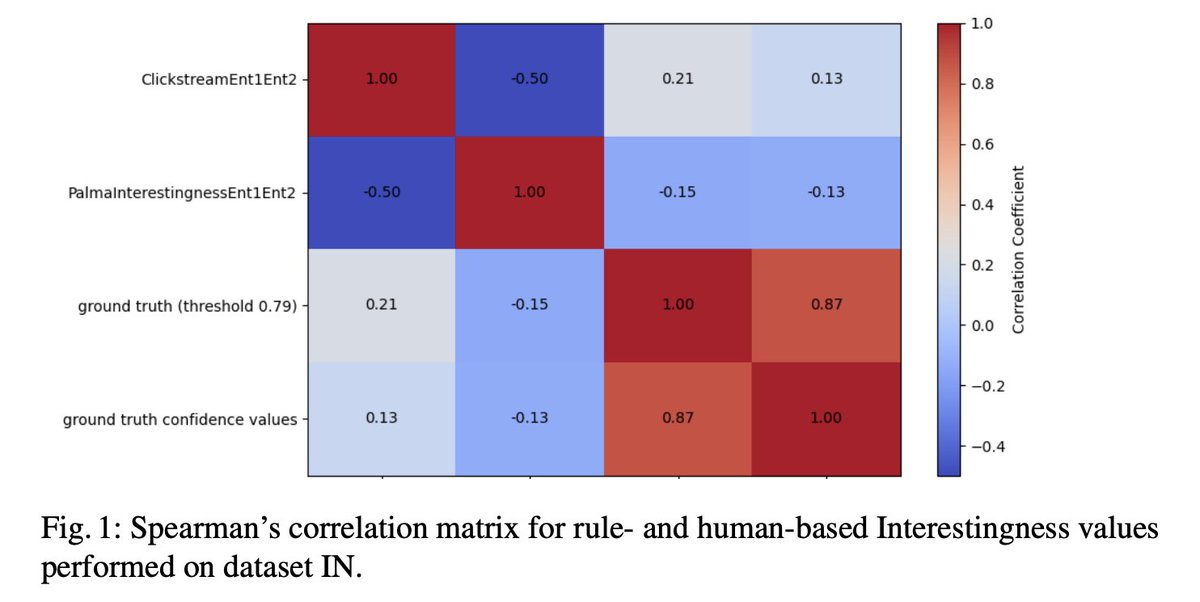
"The WikiWooW Dataset - Harnessing Semantic Similarity and Clickstream-data for Serendipity-based Relation Discovery in Wikipedia"
(Palma 2024)
https://t.co/C0FX0Ors3u
Is there a way to weigh a Knowledge Graph according to the Interestingness of its relationships?
We'll try to answer this and many other questions at:
Semantic Methods for Events and Stories (SEMMES)
Workshop at ESWC 2024
https://t.co/bsYtqHnkRY
"A Christian should avoid unhealthy religiosity: both the feeling of superiority due to virtue, and the feeling of inferiority due to sinfulness. One thing is it to have a complex and another humility; one thing depression and another repentance."
♥️🙏☦️
St. Porphyrios
@DrLoupis well, technically if Germany has still a territory is an undeserved kindness of the Allies, so even the portion shown above is far bigger than how Germany should look like today
@_nasir_ahmad_ 3 But when you give to the needy, do not let your left hand know what your right hand is doing, 4 so that your giving may be in secret. Then your Father, who sees what is done in secret, will reward you
@_nasir_ahmad_ 2 “So when you give to the needy, do not announce it with trumpets, as the hypocrites do in the synagogues and on the streets, to be honored by others. Truly I tell you, they have received their reward in full.
@_nasir_ahmad_ “Be careful not to practice your righteousness in front of others to be seen by them. If you do, you will have no reward from your Father in heaven.
@yoavgo In general, if after not signing something produced yesterday, I would be pointed as a disgrace to humanity, indecent human being, and so on, is mathematical there is nothing benign in the feelings of people producing that document