@jefftomich Yes insolation and thus solar module output goes up as sulfate aerosols go down. I know projections of solar output can be low if they are based on historical insolation data prior to the 1990 Clean Air Act amendments and resulting reductions in SO2.
New reports coming out next week:
Energy & ancillary market reforms are needed in MISO and PJM to level the playing field and allow wind, solar, and battery storage to fairly compete and utilize their full capabilities.
Link to register: https://t.co/TORPHwa9t3
Great article discussing the game-changing provisions in legislation being proposed today to facilitate paying for and permitting electricity transmission, which Grid Strategies estimates will reduce CO2 emissions by hundreds of millions of tons per year.
https://t.co/YBvQpaXfOa
Pass that Motion to Proceed to a bright future on a livable planet! PS, happy to give the Veep a ride if she needs one. Not a problem, her house is right on the way there for me.
@AlexEpstein Wind provides 32% of the electricity for the grid operator in Oklahoma, Nebraska, Kansas, and neighboring states, and power prices there are low and getting lower. Add solar, and our existing nuclear and hydro, and 80% is easy. https://t.co/XAdb09Yshp
@AlexEpstein Wind provides 32% of the electricity for the grid operator in Oklahoma, Nebraska, Kansas, and neighboring states, and power prices there are low and getting lower. Add solar, and our existing nuclear and hydro, and 80% is easy. https://t.co/XAdb09Yshp
#transmission planning is SO important and we KNOW how to do it but it isn't happening? Reasons? Read this report. Solutions? Read this report. Want action? Send a comment in to @FERC in docket RM21-17 by Tuesday. Thread. 1/8 https://t.co/Qndq13LTTZ
“Extreme weather typically only affects a limited area, so expanding the power grid is one of the best ways to protect consumers & national security." - @gogginmichael, Grid Strategies LLC
Learn more about the value of additional transmission:
https://t.co/bUbZWffyS3
@TabakGabe @electronecon The ramp rate number I’ve heard for wind is 10% of nameplate capacity per second, i.e. full ramp in ten seconds. Going up to 100% may be slower. Wind has no minimum load and can tightly follow AGC if it was installed with that capability. For more see https://t.co/nRzZhZ9uke
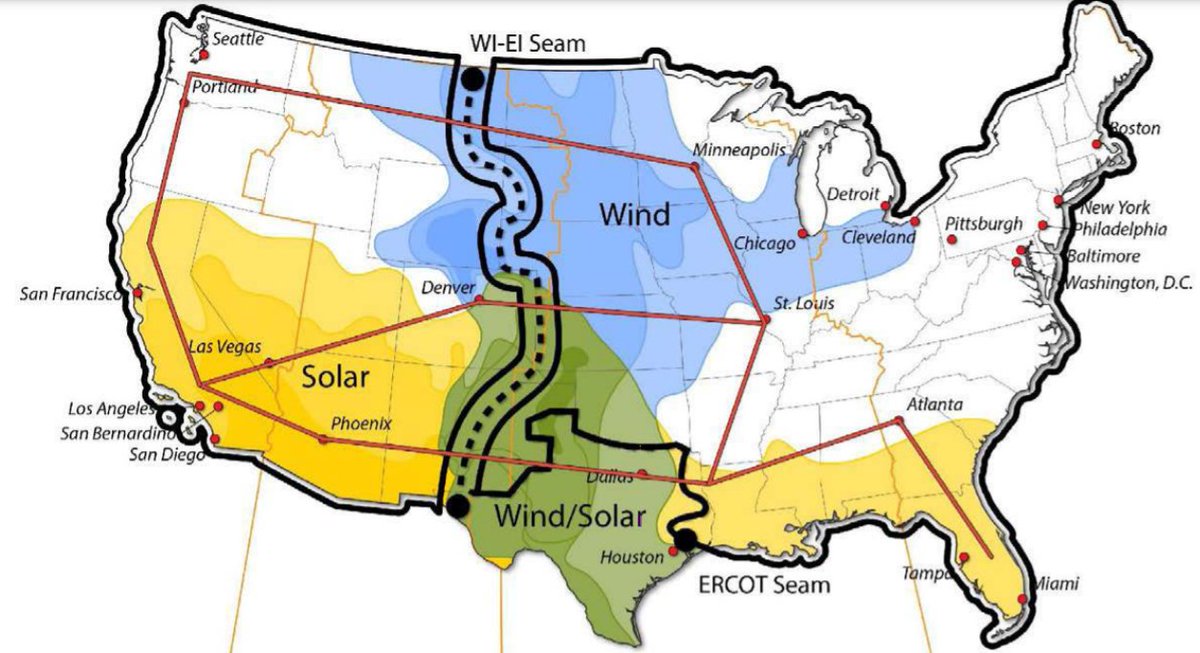
@drvolts@RobGramlichDC@CleanEnergyGrid The DC macrogrid in the NREL Interconnections Seam study cost $29 billion and had a benefit-cost ratio of 1.8:1.
https://t.co/TdNbIgetoH
President Biden: “Our grids are vulnerable to storms, hacks, and catastrophic failures, with tragic results as we saw in Texas and elsewhere during winter storms. (1/2)
@TabakGabe@brendanpierpont @daveregrets @WYOHensley Page 214 (272 in pdf) in Wind Vision report has land use stats for obtaining 20% and 35% of US electricity from wind. They assume 3% of land within the wind plant is actually occupied or transformed, based on USGS satellite analysis.
https://t.co/lPtvKF1jx7
Expanded inter-regional #transmission is essential for delivering a lot of energy across large parts of the country, especially during many difficult-to-predict situations. Read @RobGramlichDC's piece in @UtilityDive here: https://t.co/uD5XDh8VaB