Really excited to see my first contribution to #Bitcoin core being merged today! A small change but hopefully the first step of long journey in open source development!! https://t.co/D2WzDA7mvG
Here is Numzoo: A Math Game with cute AI Animals!
https://t.co/6rSydhWKxD
A small applications built for Hugging Face Build Small hackathon, building something for a someone we know, and using only smalls models. No API.
Test it live here:
https://t.co/LX6ZFwvBKL
🔵 Alain Aspect : La rigueur modeste qui a donné tort (et raison) à Einstein
Dans les années 70, on lui disait que son sujet était "marginal", voire "philosophique".
40 ans plus tard, c'est un Prix Nobel et la base de l'informatique quantique. La carrière d'Alain Aspect est la preuve ultime que la science de rupture ne se pilote pas à court terme.
Décryptage d'un parcours exemplaire 📉📈 👇
1️⃣ Le courage scientifique plutôt que le "génie solitaire"
Alain Aspect (Nobel 2022) est l’anti-star. Dans les années 70, il s'attaque aux inégalités de Bell, un sujet alors jugé "marginal" voire "philosophique" par la physique établie. Il ne cherche pas la gloire, mais la vérité. Sa méthode ? Douter, tester, retester, traquer les failles… jusqu’à obtenir du solide.
👉 https://t.co/oDnegRIJuW
2️⃣ CV (très résumé, très parlant)
Né en 1947 (Agen), professeur à l’Institut d’Optique (Paris-Saclay) et à l’X ; carrière CNRS. Il a transformé un débat théorique en une science expérimentale précise : l'optique quantique.
👉 https://t.co/rdyZclYdkA
3️⃣ Le point de départ : la “question Einstein” (EPR, 1935)
Einstein (avec Podolsky & Rosen) pose une objection brillante : la Mécanique Quantique est-elle “complète” ? Ou manque-t-il des variables cachées “locales” pour expliquer le hasard ? Ce n'était pas une erreur bête, mais un défi fondamental.
👉 https://t.co/JLukhtpTkk
4️⃣ La rigueur, version laboratoire : le coup de maître de 1982
Aspect et son équipe réalisent l'expérience décisive.
💡 Le détail qui change tout : Ils utilisent des analyseurs à "commutation rapide". Ils changent les réglages pendant que les photons volent.
Pourquoi ? Pour empêcher les particules de "se mettre d'accord" avant la mesure.
Résultat : viol des inégalités de Bell. La physique quantique a raison, la localité a tort.
👉 https://t.co/tfFZ4GrLgb
5️⃣ La science ne s’arrête pas au “ça marche” : elle traque ses propres faiblesses
Même après 1982, la communauté continue à tester (loopholes).
Exemple : le test “loophole-free” de 2015 (Delft/Vienne).
Aspect n'a jamais dit "croyez-moi", il a inspiré 40 ans de vérifications supplémentaires. C’est cela, solidifier la connaissance.
👉 https://t.co/xPz2Qwuvqd
6️⃣ Recherche fondamentale : la patience est mère de l'innovation
Le Nobel 2022 récompense des travaux qui ont “débloqué” l’info quantique (cryptographie, calcul). Aspect le martèle : sans cette curiosité fondamentale vieille de 40 ans, ces technologies n'existeraient pas. La rupture demande du temps, pas des slogans.
👉 https://t.co/bFbOQFYESa
7️⃣ Humilité : “Einstein n’a pas perdu, il a vu juste… le problème”
Aspect refuse le storytelling "Einstein était nul". Il explique : Einstein a vu l'intrication avant tout le monde, il en a juste tiré la mauvaise conclusion. Au banquet Nobel, Aspect a remercié Einstein pour avoir posé la question, et Bell pour avoir fourni l'outil pour y répondre. Classe.
👉 https://t.co/Ad2J4PdI3E
8️⃣ Jamais seul : l'hommage à Grangier et Dalibard
Le CNRS rappelle que c'est une victoire collective. Aspect associe systématiquement ses thésards de l'époque, Philippe Grangier et Jean Dalibard, à son succès. Il répète souvent que les échanges critiques avec ses étudiants sont le moteur de sa recherche.
👉 https://t.co/s90eApU8sn
9️⃣ Conclusion
Aspect, c’est la science dans sa forme la plus pure : méthode, modestie, obstination, et collectif.
Dans un monde où l'on confond souvent “opinion forte” et “preuve”, cette rigueur intellectuelle fait un bien fou.
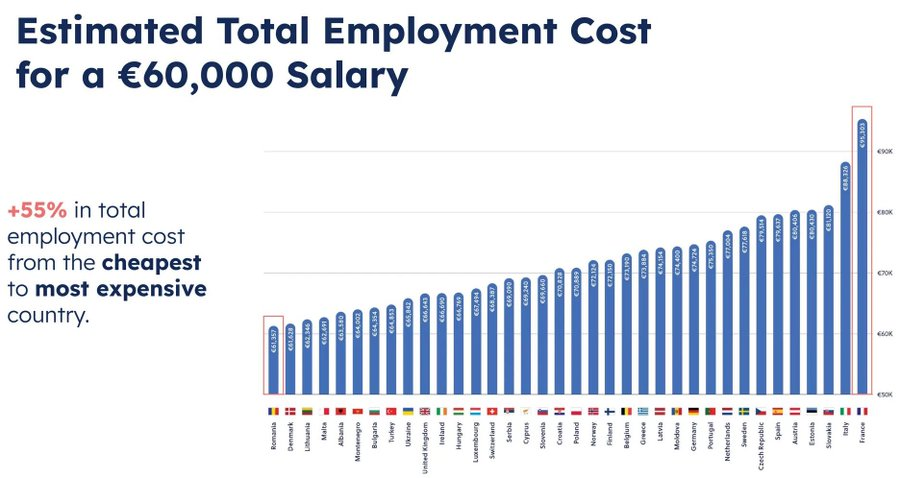
The decline of the EU in one chart... death by taxation.
Total employment costs for a €60k salary:
- France: €35k
- Italy: €28k
- Spain: €20k
This is the employer side of the equation.
On the employee side:
- Income taxes
- VAT on consumption
- And inheritance taxes when you die
How can the EU succeed
when it is suffocating its working class with taxes?
We’re proud to be a day one infrastructure partner of @tempo, supporting their mission of bringing real-world payments onchain.
Starting today, every builder on Tempo can ship gasless, Web2-like experiences at global scale through Gelato’s Paymaster & Bundler.
The result: Stablecoin apps that feel as intuitive as any fintech app.
More than 20 years ago I wrote:
If Robin Hanson is right about decision markets, then perhaps one day, instead of quoting an expert, the NYTimes editorial section will refer to the latest quote on “health care plan A” available in the business pages.
It's happening!
France just beat the world record for nuclear fusion.
In a breakthrough for clean energy pursuits, a nuclear fusion reactor in France has achieved a world-record burn at an astonishing 90 million degrees Fahrenheit (50 million °C) – sustained for over 22 minutes.
On February 12, 2025, the WEST tokamak held a hydrogen plasma steady for 1,337 seconds, shattering the prior mark set mere weeks before by China's EAST.
That's triple the scorching heat of the Sun's core and a full four minutes beyond the previous duration benchmark. Though it didn't produce net energy, this feat highlights our advancing ability to mimic the stellar process that fuels the cosmos.
At its heart, fusion harnesses the power of stars by smashing light atoms like hydrogen into helium, unleashing vast energy in the bargain. In the Sun, this thrives amid crushing gravity and 27 million °F (15 million °C) infernos. Earthbound engineers, lacking such natural compression, rely on devices like WEST to superheat plasma to extreme levels – far beyond solar extremes – while using potent magnetic fields to corral it.
The real hurdle? Preventing the setup from self-destructing under those brutal conditions. WEST's triumph proves we can now stabilize such blistering plasmas for unprecedented stretches, a vital step toward the nearby ITER project, the globe's most ambitious fusion endeavor currently taking shape.
Should ITER and its ilk succeed, fusion promises boundless, eco-friendly power: zero carbon footprint, no meltdown dangers, and minimal long-lived waste.
["French WEST reactor breaks record in nuclear fusion." Advanced Science News, 2025]
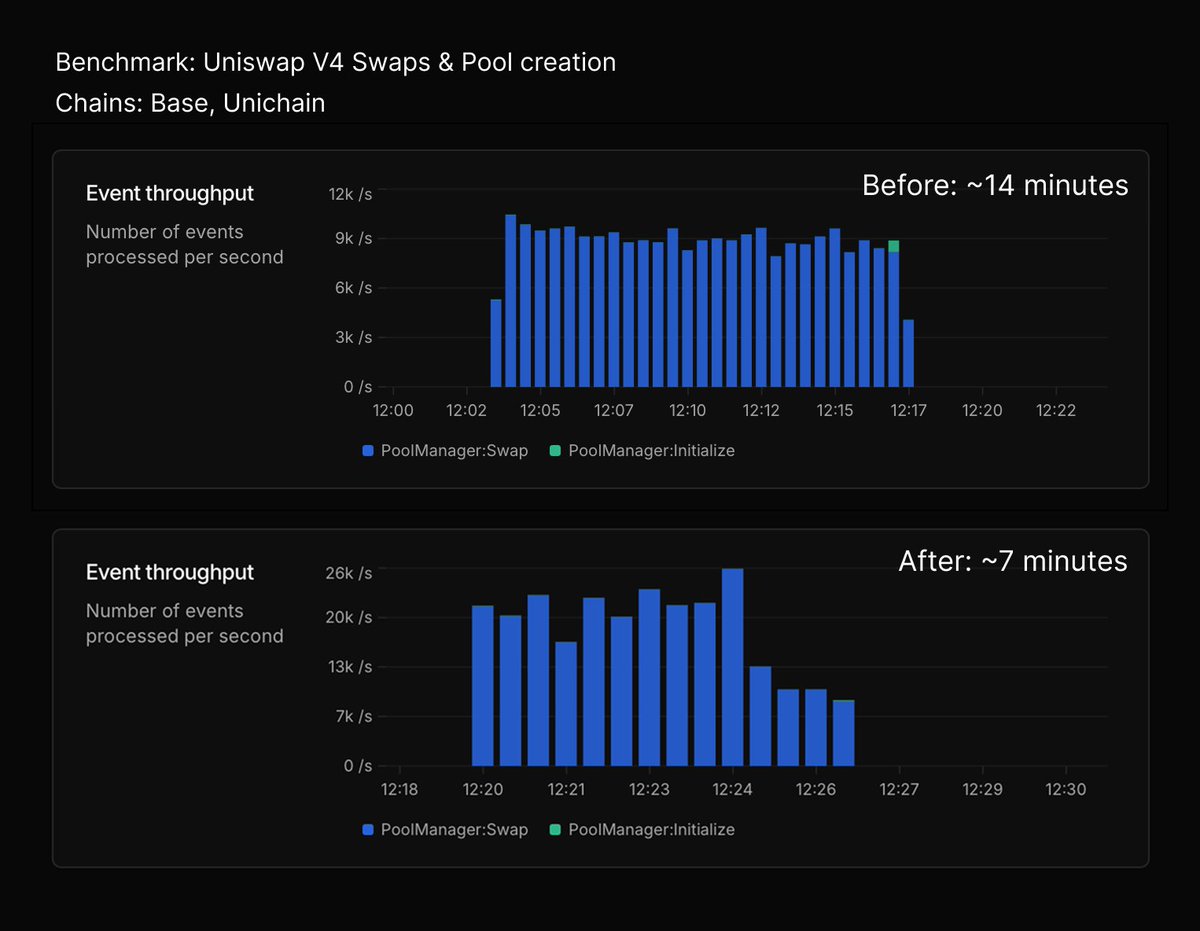
Today's Ponder release introduces a new indexing mode where each chain runs on a separate worker thread.
The new design offers big benefits across indexing & query performance, and paves the way for better caching, reliability, and DX.
Agency > Intelligence
I had this intuitively wrong for decades, I think due to a pervasive cultural veneration of intelligence, various entertainment/media, obsession with IQ etc. Agency is significantly more powerful and significantly more scarce. Are you hiring for agency? Are we educating for agency? Are you acting as if you had 10X agency?
Grok explanation is ~close:
“Agency, as a personality trait, refers to an individual's capacity to take initiative, make decisions, and exert control over their actions and environment. It’s about being proactive rather than reactive—someone with high agency doesn’t just let life happen to them; they shape it. Think of it as a blend of self-efficacy, determination, and a sense of ownership over one’s path.
People with strong agency tend to set goals and pursue them with confidence, even in the face of obstacles. They’re the type to say, “I’ll figure it out,” and then actually do it. On the flip side, someone low in agency might feel more like a passenger in their own life, waiting for external forces—like luck, other people, or circumstances—to dictate what happens next.
It’s not quite the same as assertiveness or ambition, though it can overlap. Agency is quieter, more internal—it’s the belief that you *can* act, paired with the will to follow through. Psychologists often tie it to concepts like locus of control: high-agency folks lean toward an internal locus, feeling they steer their fate, while low-agency folks might lean external, seeing life as something that happens *to* them.”
Ponder 0.14 →
* We redesigned every log line that Ponder emits
* Custom database views
* Offset pagination in GraphQL
* Better performance & reliability across the board
Introducing @Tempo.
At Stripe, we care about high-throughput, low-latency payments use cases. As the use of stablecoins (and crypto more broadly) grows across Stripe, Bridge, and Privy, we found that existing blockchains are not optimized for them.
For example, it's valuable for real-world financial applications that fees be denominated in a fiat currency that makes sense to the user, but existing blockchains denominate their fees in blockchain-specific tokens. Batch transfers are very useful in payments, but much less important in trading. Bitcoin does ~5 TPS; Ethereum does ~20 TPS, some (like Base and Solana) get to ~1k TPS, but Stripe peaks at >10k TPS. And so on.
As such, we decided to incubate Tempo, a new blockchain, in partnership with Paradigm. We think of Tempo as the payments-oriented L1, optimized for high-scale, real-world financial services applications.
Tempo is an independent company, with Stripe and Paradigm as the first investors. To ensure that Tempo serves a broad array of needs, we're excited to be working with Anthropic, Coupang, Deutsche Bank, DoorDash, Lead Bank, Mercury, Nubank, OpenAI, Revolut, Shopify, Standard Chartered, and Visa as initial design partners. We will start with an independent and diverse validator set, and plan to move towards permissionless validation. Tempo will have a built-in stablecoin AMM to enable platform neutrality with respect to different stablecoins, and Stripe itself will of course continue to work with many chains as first-class partners.
We hope that Tempo makes it easier for things like payment acceptance, global payouts, remittances, microtransactions, tokenized deposits, agentic payments, and more, to move onchain.
The Tempo team is 15 people today, led by the terrific @matthuang. If you're interested in building Tempo, get in touch! And if you're interested in partnering, reach out to [email protected].
I think people underestimate @gelatonetwork and how much infra they already power
This powerhouse delivers automation and rollup deployment, making smart contracts run seamlessly and chains scale effortlessly.
Here’s why they stand out:
- Flashblocks enable lightning fast 200ms transaction confirmations on OP Stack
- Gasless Paymaster powers frictionless UX for wallets like Gemini's
- Enterprise grade RaaS deploys custom rollups with 99.99% uptime 😎
In July 2025 they raised $11M led by Dragonfly Capital to supercharge rollup innovation and adoption. 🤝
DeFi builders, this project deserves attention. Huge respect to @hilmarxo, @luis_0x and the team for their incredible work 👏
If you're still using The Graph and want to migrate to Ponder, reach out and we'll help you get started.
Ponder is actively maintained by a world-class team & open-source community, with new releases every week.
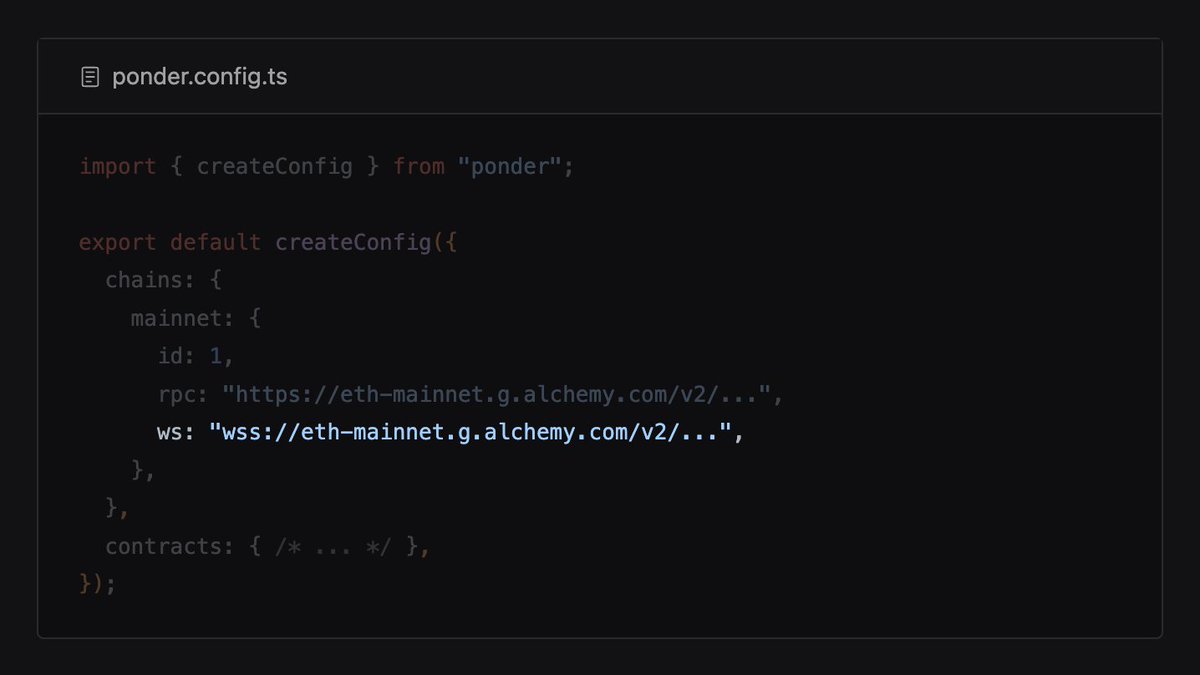
Ponder now supports WebSockets (eth_subscribe) for new block notifications.
Opt-in to improve realtime indexing latency by ~35% and consume fewer RPC credits.
S/o @opaquefeldspar for the excellent work on this.
Ponder has gotten much faster in the past few months.
With features like RPC request speculation and in-memory database logic, we're making progress towards processing 100,000 events per second.
Check out our latest blog for the technical details and what's next.


![Rainmaker1973's tweet photo. France just beat the world record for nuclear fusion.
In a breakthrough for clean energy pursuits, a nuclear fusion reactor in France has achieved a world-record burn at an astonishing 90 million degrees Fahrenheit (50 million °C) – sustained for over 22 minutes.
On February 12, 2025, the WEST tokamak held a hydrogen plasma steady for 1,337 seconds, shattering the prior mark set mere weeks before by China's EAST.
That's triple the scorching heat of the Sun's core and a full four minutes beyond the previous duration benchmark. Though it didn't produce net energy, this feat highlights our advancing ability to mimic the stellar process that fuels the cosmos.
At its heart, fusion harnesses the power of stars by smashing light atoms like hydrogen into helium, unleashing vast energy in the bargain. In the Sun, this thrives amid crushing gravity and 27 million °F (15 million °C) infernos. Earthbound engineers, lacking such natural compression, rely on devices like WEST to superheat plasma to extreme levels – far beyond solar extremes – while using potent magnetic fields to corral it.
The real hurdle? Preventing the setup from self-destructing under those brutal conditions. WEST's triumph proves we can now stabilize such blistering plasmas for unprecedented stretches, a vital step toward the nearby ITER project, the globe's most ambitious fusion endeavor currently taking shape.
Should ITER and its ilk succeed, fusion promises boundless, eco-friendly power: zero carbon footprint, no meltdown dangers, and minimal long-lived waste.
["French WEST reactor breaks record in nuclear fusion." Advanced Science News, 2025]](https://pbs.twimg.com/media/G7Qrd_VX0AEdtk1.png)