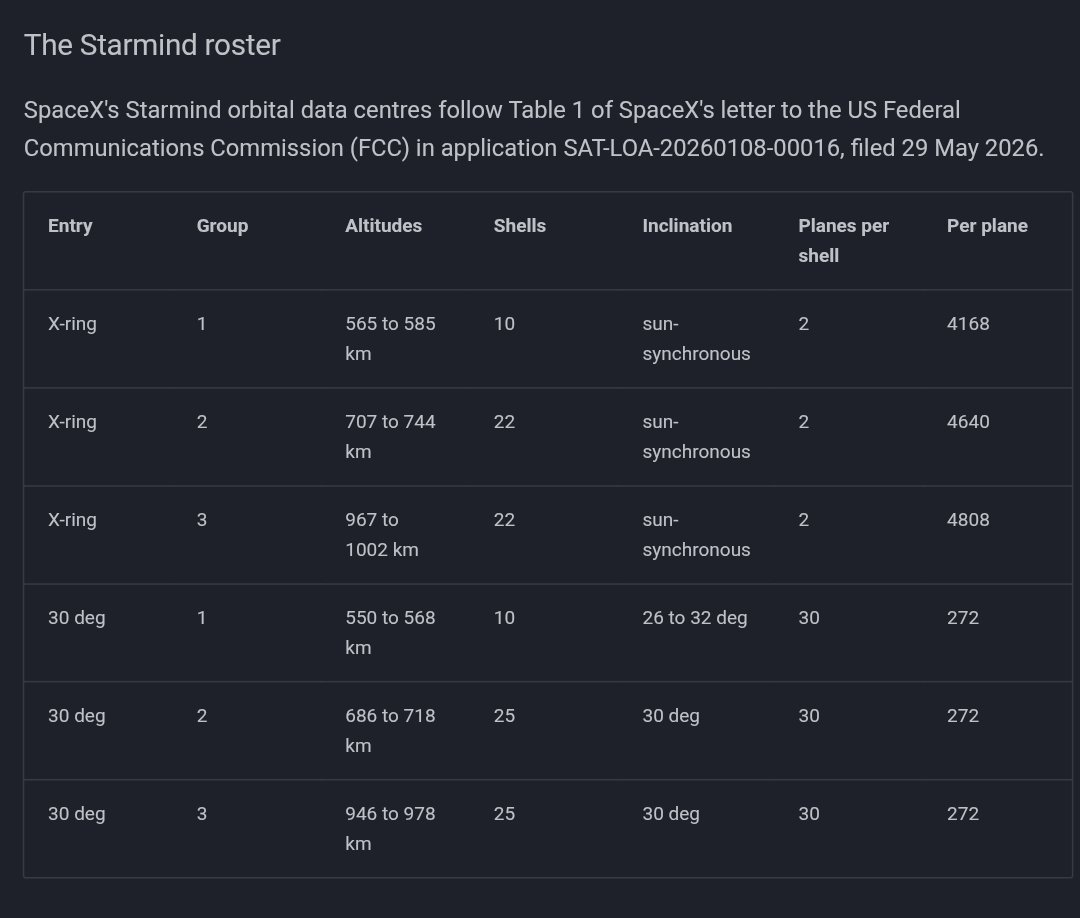
@ophello The sun sync orbits and their J2 precession terms are all modeled, and its not as clear cut as them disappearing soom after sunset/sunrise. In the summer, sure. There will be a lot of scenarios (30 deg sats especially) where there will be direct solar reflections to observers
@ophello Fortunately the sim is real time and the materials are editable as json. The backside darkening will help when they are setting, but in the winter months when they rise in the east they will flare near the anti solar point. The brightest flares are from the panels facing forward
@MrJTWolfe Not true. These sats have large panel areas, bodies, and radiators which will reflect light at broad angles. While the real magnitudes aren't known until they launch, I benchmarked against known satellite flares and the model is geometrically rooted.
https://t.co/uz3xX50lGq
@ophello 1) see pic
2) That bright clustered band is the Reflect Orbital constellation of 5000 sats, also modeled in sim
3) A bit involved, but 3D geometry and material are considered. Dark coatings will help with sat chassis, but panels are the bright part
https://t.co/uvJa11GNia
@awdevv I appreciate it :) ! My opinions are my own, but the simulation behind this I have made impartial and as accurate as I could. Lots of people are at my neck, oddly.
Just an FYI that this isnt just an animation that I eyeballed. There is a full 3D photometric model behind these flare estimates that benchmarks relatively well against existing observations for current satellites.
https://t.co/yhDZVZKbEA
@Graham_117 Depends on the mitigation. The photometry model used here uses actual satellite geometry, materials, pointing, etc. For the existing satellites like Starlink, the model has been benchmarked to existing observations with decent accuracy
https://t.co/yhDZVZJDP2
@DealGlitchAI So there is a pretty robust photometric sat model in this sim. Each point is a StarMind cluster of 8 sats, with a combined panel area greater than the ISS. They will be bright. In sun sync, they will be pronounced during seasonal extreme due to Earth's tilt.
@anonymousIHB J2 (Earth's bulge) can only swing the orbit plane around Earth's spin axis. The Sun moves 23.44° north and south during the year, and nothing in Earth's gravity field follows that. Earth's tilt makes true terminator following impossible without propellant. Maybe with solar sails?
@spartacuszero@AlexanderPayton It is the case. Due to seasonal variations, sun synchronous orbits are only perfectly over the terminator for a small part of the uear.