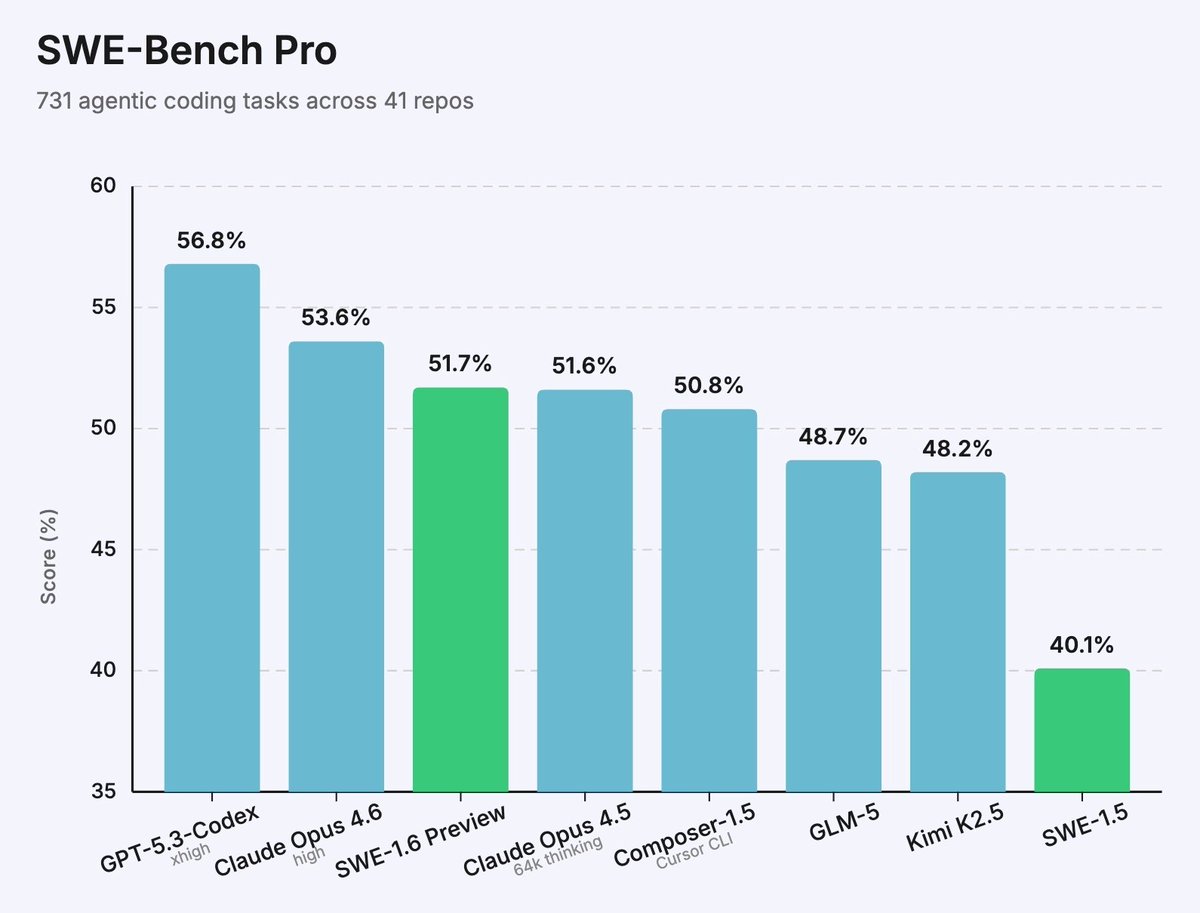
SWE-1.6 is the best alternative solution in the market right now, if you feel the pain the high token cost.
It gets significant boost from SWE 1.5 in terms of problem solving capability and model "user experience",
Please do give it a try.
SWE-1.6 is free for everyone in Windsurf for the next 3 months at 200 tok/s. For paying users, we've partnered with Cerebras to serve the model at 950 tok/s. More technical details about this training and the model are available on our blog here: https://t.co/sRV2Bm9r0W
A key ingredient was a length penalty in our RL reward, which discourages unnecessarily long trajectories. The penalty helped reduce overthinking and looping while implicitly incentivizing parallel tool use. Our ablation shows task solve rate is maintained while assistant turns stay flat; in other words, the model learns to be more efficient without sacrificing capability.
...eliminating parse failures that would otherwise break the agent loop. Without it, even a 0.1% malformed output rate compounds into frequent failures across multi-step agent workflows. 🛠️ 3/3
Weekend random thoughts.
We are in an agentic era, and tool calling is the most critical foundation for communication between LLMs and agents. The JSON Schema of a tool call defines the contract between them. 🧵 1/3 #LLM#AIagents
From this perspective, JSON Schema constrained decoding in inference frameworks is becoming increasingly important — it guarantees that every tool call is structurally valid... 2/3
I have been doing something very similar in the past few months,
Deeper in the core, it is a workflow to manage context of your research and work and share it with agent so that it could help you better! This could also be used as your reference note
LLM Knowledge Bases
Something I'm finding very useful recently: using LLMs to build personal knowledge bases for various topics of research interest. In this way, a large fraction of my recent token throughput is going less into manipulating code, and more into manipulating knowledge (stored as markdown and images). The latest LLMs are quite good at it. So:
Data ingest:
I index source documents (articles, papers, repos, datasets, images, etc.) into a raw/ directory, then I use an LLM to incrementally "compile" a wiki, which is just a collection of .md files in a directory structure. The wiki includes summaries of all the data in raw/, backlinks, and then it categorizes data into concepts, writes articles for them, and links them all. To convert web articles into .md files I like to use the Obsidian Web Clipper extension, and then I also use a hotkey to download all the related images to local so that my LLM can easily reference them.
IDE:
I use Obsidian as the IDE "frontend" where I can view the raw data, the the compiled wiki, and the derived visualizations. Important to note that the LLM writes and maintains all of the data of the wiki, I rarely touch it directly. I've played with a few Obsidian plugins to render and view data in other ways (e.g. Marp for slides).
Q&A:
Where things get interesting is that once your wiki is big enough (e.g. mine on some recent research is ~100 articles and ~400K words), you can ask your LLM agent all kinds of complex questions against the wiki, and it will go off, research the answers, etc. I thought I had to reach for fancy RAG, but the LLM has been pretty good about auto-maintaining index files and brief summaries of all the documents and it reads all the important related data fairly easily at this ~small scale.
Output:
Instead of getting answers in text/terminal, I like to have it render markdown files for me, or slide shows (Marp format), or matplotlib images, all of which I then view again in Obsidian. You can imagine many other visual output formats depending on the query. Often, I end up "filing" the outputs back into the wiki to enhance it for further queries. So my own explorations and queries always "add up" in the knowledge base.
Linting:
I've run some LLM "health checks" over the wiki to e.g. find inconsistent data, impute missing data (with web searchers), find interesting connections for new article candidates, etc., to incrementally clean up the wiki and enhance its overall data integrity. The LLMs are quite good at suggesting further questions to ask and look into.
Extra tools:
I find myself developing additional tools to process the data, e.g. I vibe coded a small and naive search engine over the wiki, which I both use directly (in a web ui), but more often I want to hand it off to an LLM via CLI as a tool for larger queries.
Further explorations:
As the repo grows, the natural desire is to also think about synthetic data generation + finetuning to have your LLM "know" the data in its weights instead of just context windows.
TLDR: raw data from a given number of sources is collected, then compiled by an LLM into a .md wiki, then operated on by various CLIs by the LLM to do Q&A and to incrementally enhance the wiki, and all of it viewable in Obsidian. You rarely ever write or edit the wiki manually, it's the domain of the LLM. I think there is room here for an incredible new product instead of a hacky collection of scripts.
Interesting stat - our enterprise customers have already done more Devin sessions (and more merged Devin PRs) in 2026 than in all of 2025. Not bad for 2-ish months into the year!
We are sharing an early preview of our ongoing SWE-1.6 training run.
It significantly improves upon SWE-1.5 while being post-trained on the same pre-trained model - and it runs equally as fast at 950 tok/s. On SWE-Bench Pro it exceeds top open-source models.
The preview model still exhibits some undesirable behaviors like overthinking and excessive self-verification, which we aim to improve. We are rolling out early access to a small subset of users in Windsurf.
We are sharing an early preview of our ongoing SWE-1.6 training run.
It significantly improves upon SWE-1.5 while being post-trained on the same pre-trained model - and it runs equally as fast at 950 tok/s. On SWE-Bench Pro it exceeds top open-source models.
The preview model still exhibits some undesirable behaviors like overthinking and excessive self-verification, which we aim to improve. We are rolling out early access to a small subset of users in Windsurf.
Introducing Devin 2.2 – the autonomous agent that can test with computer use, self-verify, and auto-fix its work. Try it for free!
We’ve also overhauled Devin from the ground up:
- 3x faster startup
- fully redesigned interface
- computer use + virtual desktop
...and hundreds more UX and functionality improvements.
DeepSeek recently published a series of papers. DeepSeek Math-V2 features self-verification, while mHC proposes 'manifold-controlled multi-head residual connections' as an alternative to Kaiming He's famous ResNet.
The Engram paper highlights the separation of computation and knowledge/memory lookup.
Taking these papers together—along with the previous DSA—builds significant hype for the rumored DeepSeek V4/R2. The architectural innovation here is massive.