Excited to share our latest work from @CeronLab! 🧬🌊 Could we control CRISPR-Cas activity with temperature? By characterizing DO1 Cas9 from the deep ocean (1,500 m), we open new paths for precise biotechnological applications.
🧬🌊 New preprint from our lab: DO1 Cas9, the first Cas9 nuclease characterised from the deep ocean — recovered from a metagenome at 1,500 m in the Atlantic.
❄️Cold-adapted: it cuts DNA efficiently at low temperature, where mesophilic SpCas9 retains only residual activity. 🧵1/4
🧬🌊 New preprint from our lab: DO1 Cas9, the first Cas9 nuclease characterised from the deep ocean — recovered from a metagenome at 1,500 m in the Atlantic.
❄️Cold-adapted: it cuts DNA efficiently at low temperature, where mesophilic SpCas9 retains only residual activity. 🧵1/4
La suplementación con creatina se utiliza ampliamente en los deportes y es cada vez más popular entre las personas que hacen ejercicio. Aunque el papel fisiológico de la creatina ha sido ampliamente estudiado, la biología de la creatina en condiciones patológicas sigue siendo poco conocida.
Este artículo muestra que la suplementación exógena de creatina promueve la metástasis tumoral a través del mecanismo de activación plaquetaria en varios modelos de ratones y humanos.
Para su revisión:
👇👇👇
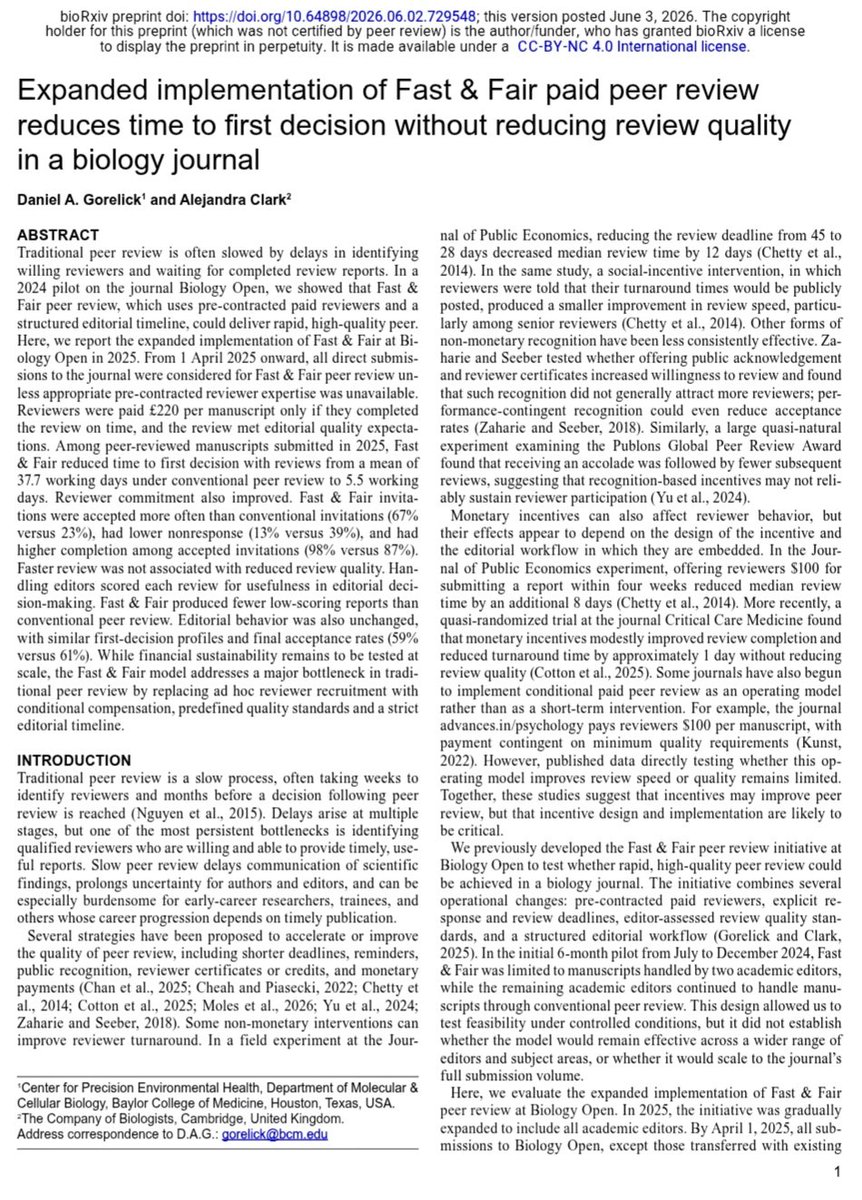
Este preprint en bioRxiv sugiere que la REVISIÓN POR PARES remunerada 📰💵y con plazos estrictos (“Fast & Fair”) puede reducir el tiempo hasta la primera decisión con revisiones de 37,7 a 5,5 días hábiles, sin señales de menor calidad. 🚀🔬
💡 Puntos clave:
✅ Revisores/as pagados (£220) si cumplían plazo y estándares editoriales.
✅ Mayor aceptación de invitaciones: 67% vs 23%.
✅ Menos informes de baja puntuación según editores.
✅ Tasa final de aceptación similar: 59% vs 61%.
🌍👍🏻Un modelo prometedor para agilizar la publicación científica, aunque su sostenibilidad económica a gran escala aún debe evaluarse.
También sería clave estudiar cómo estos pagos afectan la diversidad de revisores/as y posibles barreras geográficas o institucionales.
🔗👇🏻 https://t.co/xng5igVJmM
#CienciaAbierta #PeerReview #RevisiónPorPares #PublicaciónCientífica #BioRxiv #Academia #ComunicaciónCientífica
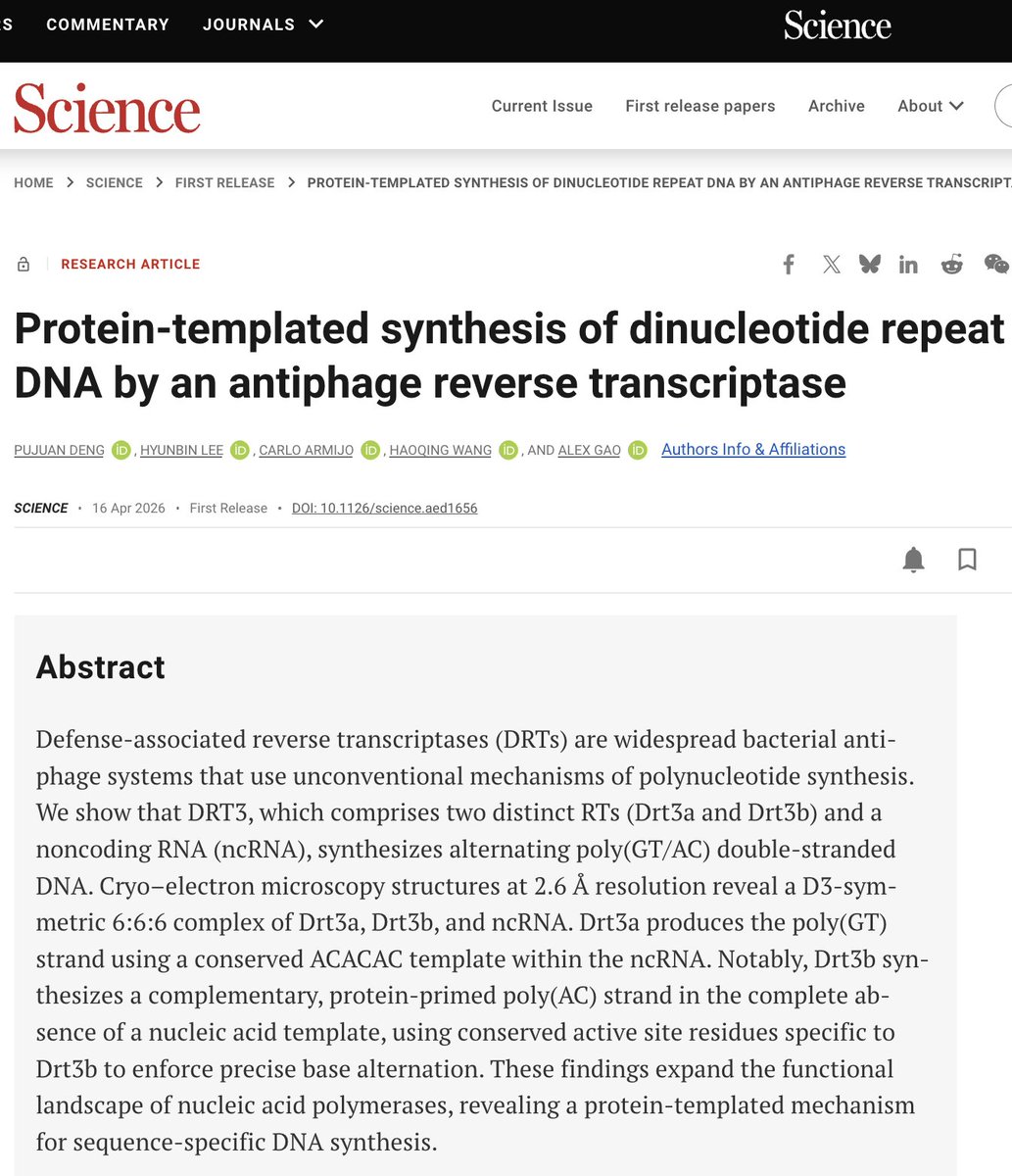
Bacteria are full of diverse molecular tricks. This Science article reports an interesting one that is being misrepresented by news coverage, including the coverage in Science.
The study describes an enzyme complex that synthesizes alternating dinucleotide repeat DNA as part of an immune response. Protein templating DNA is a cool observation, even if the sequence is only a repeating dinucleotide.
The headline-grabbing takeaway is the mechanism of the Drt3b subunit. While its partner, Drt3a, uses a canonical RNA template (reverse transcription), Drt3b synthesizes the complementary strand in the absence of a nucleic acid template. Instead, it uses specific amino acid residues (a glutamate and an arginine) to stabilize and "select" the incoming dNTPs.
It is tempting to view this as a radical shift in our understanding of information transfer, a "protein-templated" genetic sequence. However, we should be cautious with the "paradigm shift" narrative.
Why this isn't "rewriting" the Genetic Code:
Despite claims in the news coverage, this finding does not represent a new form of hereditary information transfer. This is not a protein "reading" itself to create a complex message; rather, it is a highly specialized structural constraint. The protein is essentially a "stuttering" machine, physically keyed to produce a simple, repetitive sequence. The "information" is hard-coded into the protein's fold to perform a single, specific defensive task, rather than acting as a general-purpose template for diverse genetic messages.
The Parallel to tmRNA:
This observation is not entirely unprecedented when we look at how bacteria handle biochemical "dead ends." It reminds me of transfer-messenger RNA (tmRNA). In trans-translation, when a ribosome stalls on a broken mRNA, the tmRNA molecule steps in to provide both the tRNA component and a short mRNA "tag" to rescue the ribosome:
- The "Non-Standard" Template: Much like tmRNA provides an external sequence to fix a stalled process, the DRT3 ncRNA and the Drt3b protein provide "internal" instructions to create DNA where no genomic template exists.
- Specialized Rescue: Both mechanisms are niche "emergency" responses, one for proteostasis (tmRNA) and one for viral defense (DRT3).
In the end, this discovery doesn't replace our understanding of the genetic code; it expands the "toolbox" of how cells can synthesize polynucleotides when the standard rules don't apply. It is a beautiful reminder that in the microbial world, if a chemical shortcut is possible, evolution has likely found it.
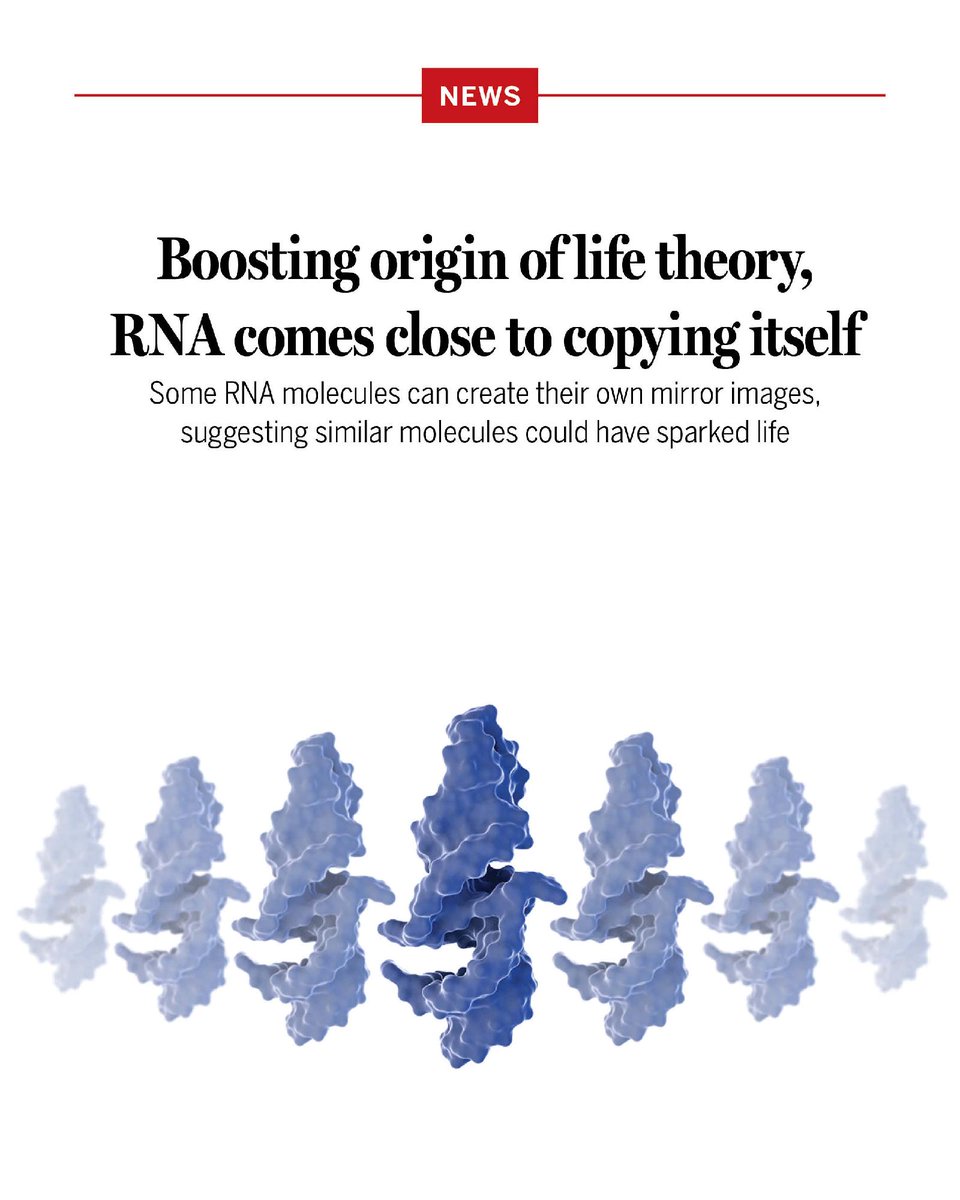
Today RNA may seem overshadowed by its glamorous cousin DNA, but many scientists think RNA molecules were the star players in the origin of life. By both storing genetic information and copying themselves, they might have touched off the march of evolution that produced increasingly complex life forms.
So far, researchers haven’t found RNAs that can replicate themselves, a key feature of living things. But they now have something close.
In a new paper, researchers report creating RNAs that can generate a sort of mirror image of themselves and use that template to generate the original. Learn more: https://t.co/lYjYdSD8X5
📣 SynBYSS 2026 Registration and Abstract Submission are Open! 🎉
Join us at @the_prbb, 8-11 June 2026 for the The 2nd International SynBYSS Conference!
🌐 More information: https://t.co/OECVyiaVVa
@JCVenterInst@UPFbiomed@Moon_Synth_Bio@marcguellc
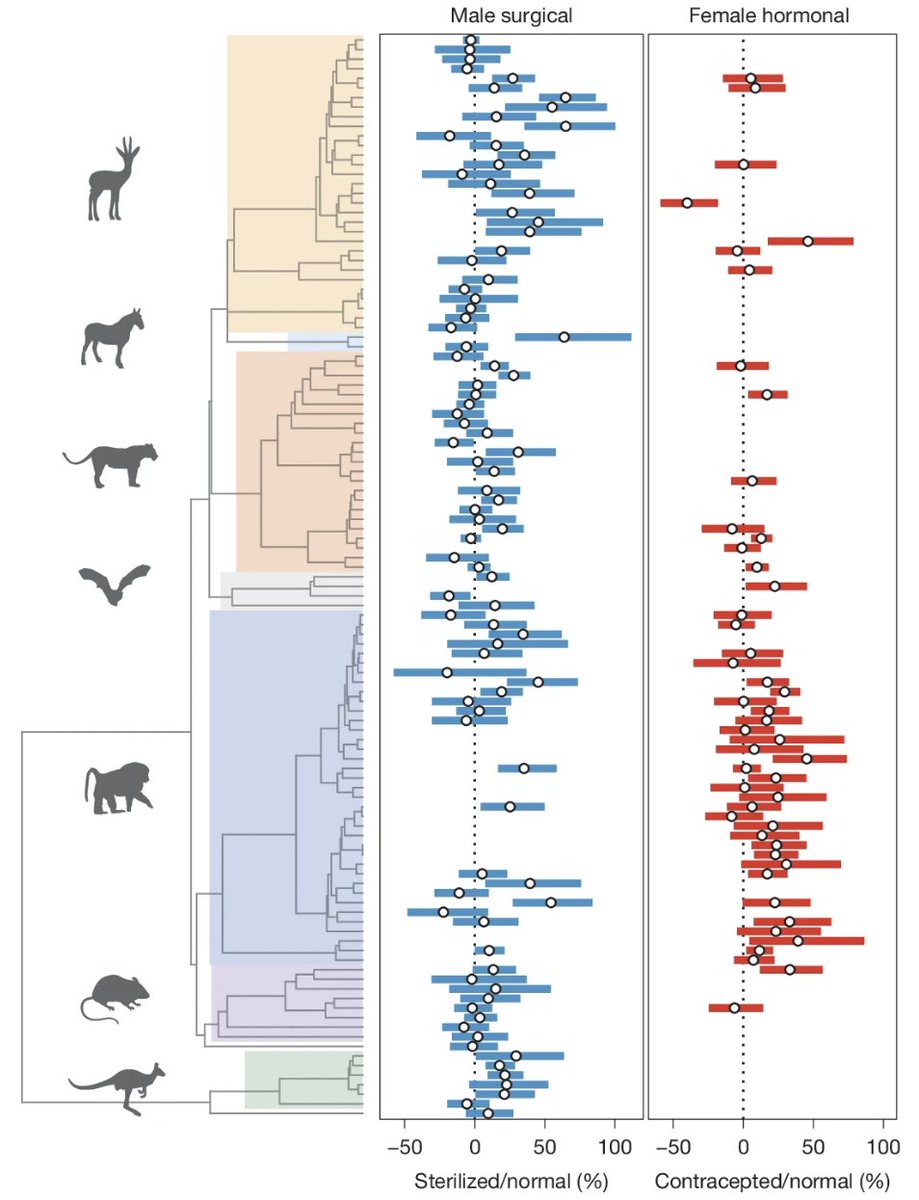
Massive new @Nature study: castration increases lifespan across vertebrates (zoo mammals, rodents, wild animals).
This aligns with historical human data: Korean eunuchs lived 14-19 years longer than their peers.
Your move, @Bryan_Johnson.
We are very sorry to share that we have confirmed reports of two deceased victims from the active shooting situation at the Barus & Holley engineering building. There are eight additional victims in critical, but stable condition at the hospital. There remains a shelter in place order. https://t.co/mwhwoxv2Cv
BrownUAlert: 10th update, Law enforcement agencies have established a perimeter around a portion of Brown’s campus. Please view the map and instructions: https://t.co/Qm87sy5aVT. The shelter-in-place remains ongoing.
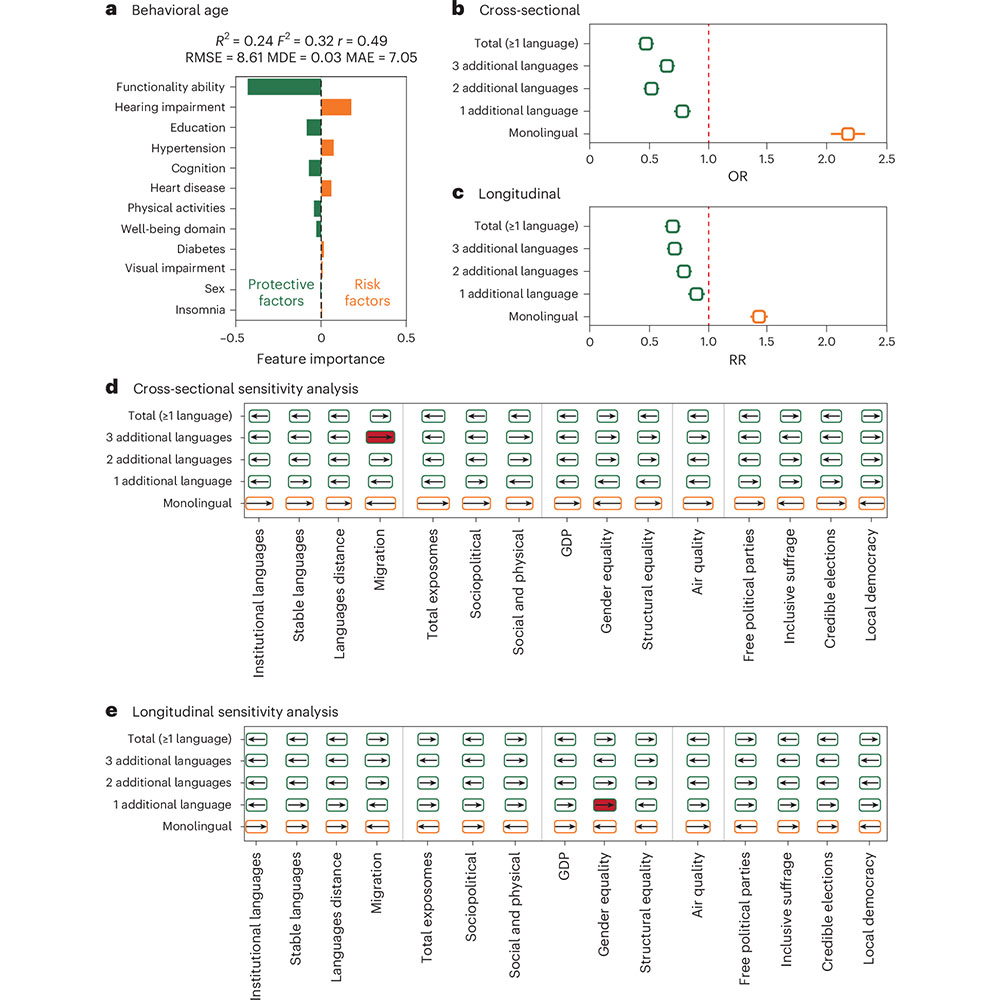
Multilingualism is associated with a reduced risk of accelerated ageing, according to data from more than 86,000 people across 27 European countries published in Nature Aging. https://t.co/RluwRIbTUg
📣🤝🏻Anunciamos que FPUInvestiga dará voz al colectivo predoc en la próxima reunión con Ministerio de Ciencia, Innovación y Universidades en 2 semanas.
🗓En un inicio nos emplazaron para ayer 21 de octubre, pero hubo un cambio de última hora del que no tenemos explicación alguna.
⚠️Y una semana más seguimos sin ninguna resolución definitiva:
👉249 días desde la provisional de estancias (FPU22 y posteriores)
👉129 días desde la provisional FPU24
👉96 días desde la resolución provisional de EEBB y TT 2025
¡RESOLUCIONES YA! ¡CIFRAS VERGONZOSAS! @CienciaGob
Very happy to report today bioprospecting and AI-generation of high performance gene writers @NatureBiotech@Synbio_Lab_UPF@Integra_Tx@UPFBarcelona
https://t.co/AwfMVdR7qy
READ/WRITE tech fueled DNA molecular technologies development. Extremely exciting to see how AI starts to enable to 'SPEAK' the language of life. Enabling the generation of synthetic diversity is a fundamental step for future synthetic evolution which opens new horizons in engineering biology.