Took 2 weeks off vibe coding and vibe marketing to Japan.
Reflecting on one of the memorable moments of getting blessed under freezing cold waterfall by the gyojas of Shipporyuji Temple.
New experience unlocked...
I can't believe how fun building a company is right now is.
The weird part is it doesn't feel like work anymore. New AI models/tools/repos keep coming out making the impossible possible.
My ONLY anxiety is making sure I don't waste this precious moment and keeping up with the updates of all the new tools/AI models.
AI is creating the greatest platform shift of all time.
And, I've learned to never let a good platform shift go to waste.
I was living in Silicon Valley around for the mobile era. I remember the feeling of "you can just build an app and put it in the store and people find it."
That lasted maybe 4 years before the gold rush ended and distribution got hard.
I'm getting that same feeling right now but bigger. The difference is I'm older, I know what a window looks like, and I know they close.
I love building right now. Maybe you do too. Trying not to take it for granted. I'm excited for Monday. Can't wait.
My partners and I are up at midnight most nights now sending each other screenshots saying "look what this can do." Nobody asks anyone to do this. We just can't stop. Something drops, someone builds something with it in 2 hours, and the group chat goes off. It feels like we're getting away with something.
Some of the greatest companies of the next decade will be started in 2026. I'm sure of it. And it'll be fun.
I feel like a kid again. Genuinely giddy.
@gregisenberg 80/20 rule. These companies discovered the initial 80% of the breakthroughs in 20% of time. The next 20% breakthrough will take 80% of time.
@tuakdotsol@Bybit_Official@okx Definitely lots of hidden talent in MY. Come for those talent and not just for the labour force cost advantage. And don't forget, the super awesome variety of food...
This guy made $260K off one AI agent workflow.
The whole thing runs on a virtual focus group of 13 AI personas trained to be his customers.
He pastes any ad or sales page in, they critique it, the system rewrites it, and a prediction engine picks the winner before he spends a dollar on traffic.
@IMJustinBrooke came on the pod to walk us through it.
Here's what I learned:
1) He built a virtual focus group. 13 AI personas critique your ad in parallel, a copywriter agent rewrites it three ways, a prediction engine picks the winner. 13 cents per run.
2) The accuracy is academically validated. Harvard, Stanford, and the NYT have published studies on this. NYT clocked it at 92% accuracy versus human focus groups.
3) Multiple personas beat one ICP. Every copy book preaches one persona. The math says otherwise. Same room of buyers has men, women, young, old, local, software. The mix is the point.
4) The personas are not prompts. They're 1,400 word dossiers with demographics, pain points, empathy maps, and decision making process. Skip the dossier work and you get garbage.
5) Wash everything before it ships. Every ad, sales page, LinkedIn post, tweet. A top 1% copywriter charges $500 an ad. This is 13 cents.
6) "Embody" beats "pretend" as a prompt verb. Machines hear "pretend" as fake-be-this-thing. They hear "embody" as become it.
7) The copywriter agent formats output like an internal team email. Quoted feedback, brief insights, three rewrites. Way more useful than the default AI report format.
8) Each persona votes yes or no on buying. His Black Friday offer scored 7 yeses out of 13. Did $36,000 in revenue. The nos were the wrong-fit personas anyway.
9) It doubles as a copywriting school. The rewrites sometimes contain bullets better than yours and you just steal them. Justin has 20 years in direct response and openly admits the AI catches him slipping.
10) Where to start: build the personas first. Take a weekend, use Claude deep research, write 5 to 13 real dossiers with empathy maps. The prompt is the easy part.
His 2 key takeaways:
1) Prediction before deployment is the next layer of marketing. Just like we all added tracking to our ads, virtual testing before spend will be the new default.
2) The ROI is instant. SEO and content agents pay back in months. This one tells you tomorrow if your ad got better.
Justin is doing this at a level most marketers are not. Go follow @IMJustinBrooke.
Full video below.
https://t.co/d1WoI9ghjE
(Also available on the Build With AI podcast wherever you get your pods)
This week, I spent 8 hours reading 50+ articles about AI.
And I learned more in 1 day than most will in an entire year.
Highly recommend you read these 8:
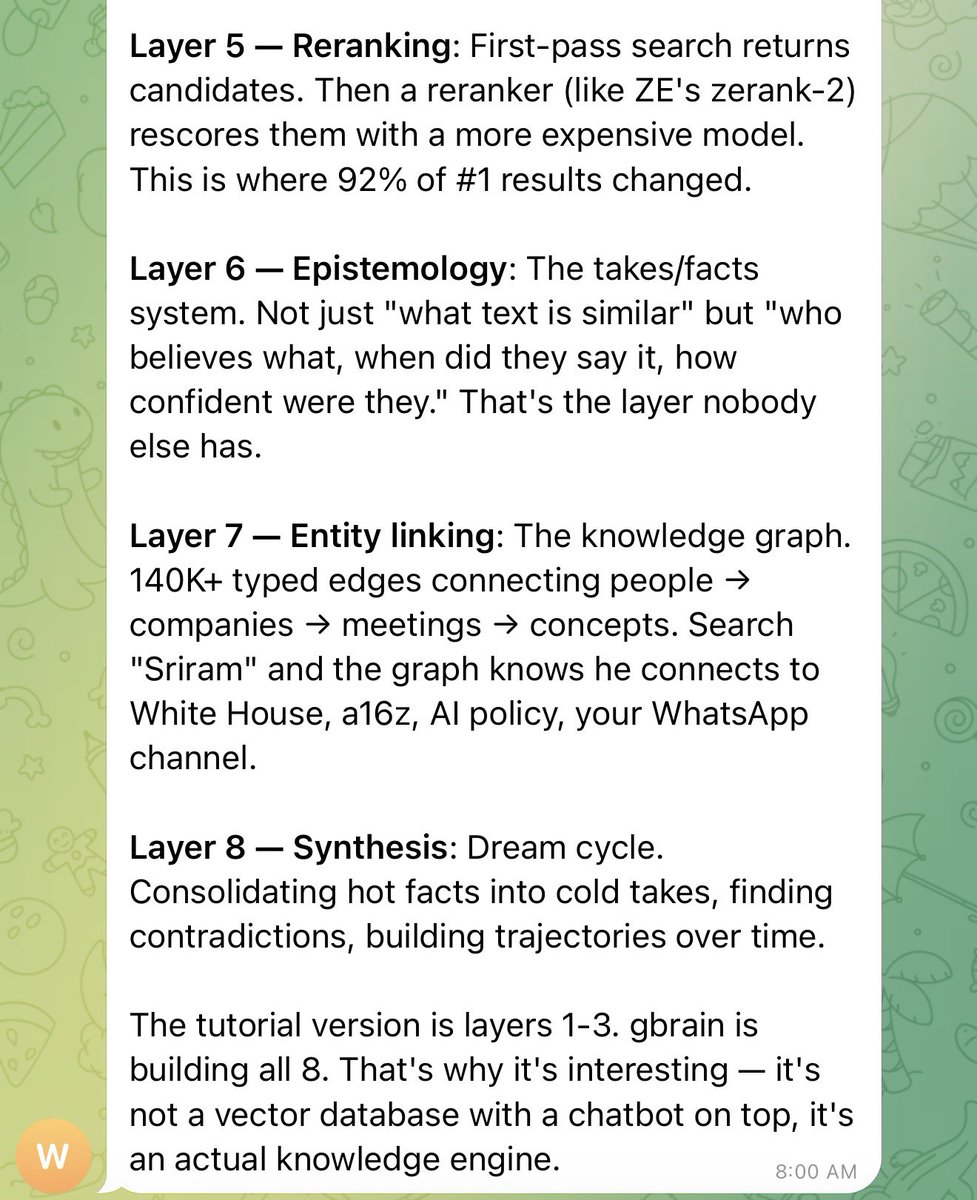
What is GBrain? My open source project is a knowledge system, not RAG in a box.
It gives agents 8 layers that work together to improve memory in a way that makes your already smart OpenClaw or Hermes Agent feel clairvoyant about who you are.
Personal AI becomes possible.
Great keynote with lots of insights of what is possible if you continue to tinker with AI and just do it. Get your hands dirty rather than reading endless comments from those who didn't even try.
Liked the 1 of the key message in here
"Real value is created when everyone who understand their work, are provided with AI tools that transform how they get their job done; or even better, re-engineer their entire workflow"
We're entering a new era of software where a single person, working with AI agents, can build products that previously required entire teams.
In this episode of the @LightconePod, they break down the rise of AI coding agents, "tokenmaxxing", and the emerging workflows behind tools like Claude Code and OpenClaw. They discuss why AI systems today feel less like productivity tools and more like collaborators, why the future of AI should be personal and user-controlled, and how founders are starting to build software in completely new ways.
00:00 — Will you control your AI?
00:47 — Coding again after 13 years
01:56 — Rebuilding a startup with Claude Code
05:50 — Software that thinks like a journalist
07:09 — The rise of “tokenmaxxing”
10:07 — The accidental creation of GStack
14:21 — The workflow behind 400x output
20:59 — Thin Harness, Fat Skills
24:35 — AI agents are like Ferraris
27:12 — The future of personal AI
38:37 — Buying back time with tokens
Been running OpenClaw, Codex and Claude Code for the last 4 months.
Pretty happy building apps and marketing processes with 2 AI Agents that I have set up on the Mac Mini.
Looking at setting up a 3rd agent now with Hermes on a VPS after seeing great experiences by @AlexFinn and @IMJustinBrooke
I'm launching a marketplace for Vibe-Coded apps + AI Skills 👉 think AppSumo for people building with Claude/Codex in a weekend.
Looking for early beta partners, DM me or leave comment.
Will get exposure to 1 million peeps.
My 30+ observations on the greatest opportunities in AI agents right now:
And some ideas that are keeping me up at night.
1. The new buyer on the internet is an AI agent. Imagine billions of new customers showing up with money to spend but they only shop via MCP. That's what's happening. No MCP server means you're invisible to the fastest growing buyer on the internet.
2. Every franchise system in America (30,000+) needs an agent layer and none of them have one. One founder per franchise vertical. That's 30,000 businesses waiting.
3. Everyone said "distribution is the only moat" a year ago. Now I'd add that the only moat is distribution plus memory. The company that has your audience AND your agent's accumulated context is impossible to leave.
4. Consumer mobile is more interesting than it's been since 2012. Apps can finally DO things for you instead of showing you things. The next wave of $100M apps are being built right now.
5. The most interesting startup nobody has built is an agent marketplace where you rent access to someone else's trained agent. A recruiter spent 6 months training a sourcing agent on healthcare hiring. That agent is worth renting to every other healthcare recruiter on earth. The agent itself becomes the product.
6. A sorta strange phenomenon that's happening right now is agents are developing preferences. Give the same agent the same task 100 times and it starts developing patterns in how it approaches it. Nobody is studying this yet. But the agents that develop good patterns are worth more than the ones that don't. That's a new kind of asset.
7. Dead internet theory is about to become dead SaaS theory. Half the apps you use will quietly replace their support team, their onboarding team, and their content team with agents. You won't notice for months. Then you'll realize you haven't talked to a human at that company in a year.
8. The most valuable data in the world right now is sitting in the support tickets of small or mid tier SaaS companies. Every ticket is a customer telling you exactly what to build next. Mine this.
9. The most interesting pricing problem nobody has solved is how do you price a product when your costs change every time OpenAI or Anthropic updates their model pricing? Your margins can swing 40% overnight based on a decision made in San Francisco. The company that builds dynamic pricing infrastructure for agent-based businesses solves a problem every AI company has.
10. The best AI products feel like they're reading your mind. The worst ones feel like filling out a form with extra steps.
11. An interesting arbitrage I've noticed lately is hiring a human VA for $20/hour to supervise an AI agent that does $200/hour work. The human just checks the output.
12. The managed AI agent business is becoming the new agency model. $5k/month per client. You build it, run it, maintain it. The client gets a digital employee they never have to think about. This will be a $50 B+ category.
13. The first "shadow agent" scandals are about to drop. Employees running personal agents on company infrastructure without telling anyone. Using company API keys. Agents accessing internal docs. IT departments have little visibility into this right now. Lots of opportunity to build companies here. Definitely a painkiller not a vitamin type of business.
14. Right now there are probably millions of agents running on autopilot that their creators forgot about. Still burning tokens. Still sending emails. Still scraping websites. Still costing money. The "find and kill your zombie agents" tool is a product that writes itself.
15. Companies are starting to hire based on someone's agent portfolio instead of their resume. "Show me 3 agents you built that are running right now." It's REALLY early but it's starting.
16. Your Slack archive is a product. Every company's internal Slack has thousands of messages explaining how they actually do things. The company that lets you point an agent at your Slack history and auto-generate SOPs and agents from it will be enormous.
17. We're watching the cost of intelligence fall faster than the cost of distribution. Which means distribution is now the expensive thing.
18. The most underrated asset a human can have in 2026: the ability to sit in a room with another human, make eye contact, and have a real conversation. As AI handles more of the transactional stuff, the humans who can do the relational stuff become disproportionately valuable. The soft skills people used to dismiss as fluffy are becoming the hard skills. The hard skills people spent decades acquiring are becoming the soft ones.
19. There are MANY huge companies to be built around the fact that most people's agents are running on their personal laptops which they also use to browse the internet, check email, and download random files. The attack surface is enormous. One compromised Chrome extension and your agent's API keys, customer data, and workflows are exposed.
20. There's a new type of burnout forming that doesn't have a name. It's not from working too hard. It's from context switching between human work and agent work 50 times a day. Reviewing agent output, correcting it, approving it, reviewing again. The mental load of supervising agents is different from the mental load of doing the work yourself. Some founders are telling me they were less tired when they did everything manually because at least the cognitive pattern was consistent.
21. The cheapest form of market research: search "[your industry] spreadsheet template" on Google. Whatever people are tracking manually is your product.
22. Half the YC companies pivoted within 8 weeks of demo day. Not because they failed. Because agents let them test 5 ideas in the time it used to take to test one. The concept of "committing to an idea" is dissolving. Serial pivoting is becoming the default because 1) AI lets you move fast 2) the world is moving fast.
23. The loneliest job in tech right now is being the only person at your company who understands what the agents are doing. You can't explain it to your boss. You can't hand it off to a colleague. If you leave, everything breaks. You've become a single point of failure for an entire automated system. That person needs a title, a team, and a backup plan. Most companies haven't figured this out yet.
24. Your browser history is the most valuable training data you own and you're giving it away for free. Every site you visit, every product you research, every competitor you study, every pricing page you screenshot. That behavioral data, structured and fed to an agent, would make it understand your business better than any onboarding call. The company that lets you turn your browser history into agent context builds something nobody can replicate.
25. Everyone is building AI wrappers. Nobody is building AI unwrappers. The tool that takes an AI-generated document and tells you which parts a human wrote and which parts were generated.
26. Stripe just became the most important company in the agent economy and they barely had to do anything. Every agent that sells something needs Stripe. Every agent that buys something needs Stripe. They're the payment rail for the entire agentic internet by default.
27. The most undervalued API in the world right now is the US Postal Service address verification API. It's practically free. Every local business lead gen agent needs it. Every real estate agent needs it. Every direct mail agent needs it. Boring government infrastructure is quietly becoming the backbone of agent-native businesses.
28. The concept of "business hours" is for humans. Your agent closed a deal in Tokyo at 3am, processed the payment, sent the onboarding email, and updated the CRM before your alarm went off.
29. What happens when agents start recommending other agents? Your research agent finds that a competitor's sales agent is better and suggests you switch. Agent referral networks are forming organically. The first agent affiliate program is probably 6 months away.
30. Cal dotcom closed their source code. That's the canary. When open source companies start closing up, it means agents were cloning their product too easily. Every open source company is quietly asking the same question right now.
31. "AI for pet groomers" sounds like a joke and that's exactly why it will work. 150,000 of them in America. Zero tech. All scheduling by phone or IG DMs. The joke ideas always win.
32. The thing that will seem most obvious in hindsight: we spent 2025-2026 arguing about which model is best while the entire value was in the orchestration layer. The model is the CPU. Nobody buys a computer based on the CPU anymore. They buy it based on what they can do with it. Makes so much sense in hindsight. What else will be obvious in hindsight?
I'll share more notes soon.
I can't sleep with all that's going on. Maybe you too.
What an incredible time to be building.