I’m truly humbled to be re-elected for a fourth season to the @Optimism Milestones & Metrics Council! 🔴✨
It's hard to put into words what this continued trust from the community means to me. Thank you, sincerely, to everyone who has supported and believed in this work. 🥹🙏❤️
A big congratulations to my fellow council members, @0xPumbi of @SEEDGov and @brichis_. I’m excited to work alongside you both and our lead, @juanbug, to serve the Collective and help build a more transparent and impactful ecosystem for the entire community.🤝
@tallyxyz Sad to see you guys shutting down. Thank you to the entire Tally team for all your contributions to decentralized governance over the past five years.
We need more DAOs - but different and better DAOs.
The original drive to build Ethereum was heavily inspired by decentralized autonomous organizations: systems of code and rules that lived on decentralized networks that could manage resources and direct activity, more efficiently and more robustly than traditional governments and corporations could.
Since then, the concept of DAOs has migrated to essentially referring to a treasury controlled by token holder voting - a design which "works", hence why it got copied so much, but a design which is inefficient, vulnerable to capture, and fails utterly at the goal of mitigating the weaknesses of human politics. As a result, many have become cynical about DAOs.
But we need DAOs.
* We need DAOs to create better oracles. Today, decentralized stablecoins, prediction markets, and other basic building blocks of defi are built on oracle designs that we are not satisfied with. If the oracle is token based, whales can manipulate the answer on a subjective issue and it becomes difficult to counteract them. Fundamentally, a token-based oracle cannot have a cost of attack higher than its market cap, which in turn means it cannot secure assets without extracting rent higher than the discount rate. And if the oracle uses human curation, then it's not very decentralized. The problem here is not greed. The problem is that we have bad oracle designs, we need better ones, and bootstrapping them is not just a technical problem but also a social problem.
* We need DAOs for onchain dispute resolution, a necessary component of many types of more advanced smart contract use cases (eg. insurance). This is the same type of problem as price oracles, but even more subjective, and so even harder to get right.
* We need DAOs to maintain lists. This includes: lists of applications known to be secure or not scams, lists of canonical interfaces, lists of token contract addresses, and much more.
* We need DAOs to get projects off the ground quickly. If you have a group of people, who all want something done and are willing to contribute some funds (perhaps in exchange for benefits), then how do you manage this, especially if the task is too short-duration for legal entities to be worth it?
* We need DAOs to do long-term project maintenance. If the original team of a project disappears, how can a community keep going, and how can new people coming in get the funding they need?
One framework that I use to analyze this is "convex vs concave" from https://t.co/1BrMsUAKWK . If the DAO is solving a concave problem, then it is in an environment where, if faced with two possible courses of action, a compromise is better than a coin flip. Hence, you want systems that maximize robustness by averaging (or rather, medianing) in input from many sources, and protect against capture and financial attacks. If the DAO is solving a convex problem, then you want the ability to make decisive choices and follow through on them. In this case, leaders can be good, and the job of the decentralized process should be to keep the leaders in check.
For all of this to work, we need to solve two problems: privacy, and decision fatigue. Without privacy, governance becomes a social game (see https://t.co/uMXcuzQNjM ). And if people have to make decisions every week, for the first month you see excited participation, but over time willingness to participate, and even to stay informed, declines.
I see modern technology as opening the door to a renaissance here. Specifically:
* ZK (and in some cases MPC/FHE, though these should be used only when ZK along cannot solve the problem) for privacy
* AI to solve decision fatigue
* Consensus-finding communication tools (like https://t.co/Nzord32Ub1, but going further)
AI must be used carefully: we must *not* put full-size deepseek (or worse, GPT 5.2) in charge of a DAO and call it a day. Rather, AI must be put in thoughtfully, as something that scales and enhances human intention and judgement, rather than replacing it. This could be done at DAO level (eg. see how https://t.co/pCHI7Mlo2m works), or at individual level (user-controlled local LLMs that vote on their behalf).
It is important to think about the "DAO stack" as also including the communication layer, hence the need for forums and platforms specially designed for the purpose. A multisig plus well-designed consensus-finding tools can easily beat idealized collusion-resistant quadratic funding plus crypto twitter.
But in all cases, we need new designs. Projects that need new oracles and want to build their own should see that as 50% of their job, not 10%.
Projects working on new governance designs should build with ZK and AI in mind, and they should treat the communication layer as 50% of their job, not 10%.
This is how we can ensure the decentralization and robustness of the Ethereum base layer also applies to the world that gets built on top.
A proposal for the next chapter of Optimism 🔴
The Optimism Foundation is putting forward a proposal to align the OP token with growing Superchain demand by directing 50% of incoming Superchain revenue to regular OP buybacks
Happy new year everyone! In November last year, I wrote about the changes we were making to refocus the team on what comes next for crypto.
Today, the @Optimism Foundation is proposing a token buyback. The goal is to unify the broader ecosystem outside of just our internal teams to prepare for the next wave of adoption.
Here’s where we are today: The Superchain is globally adopted infrastructure. It processes 13% of all blockchain transactions, with 61.4% of L2 fee market share.
Foundation and Labs are not solely responsible for this success. Legends like @base, @unichain, @inkonchain, @worldcoin, @Celo, @build_on_bob, @zora, @modenetwork and @Soneium chose the OP Stack and their growth demanded that we scale the infrastructure to support them. We are here today because our partners and integrators rolled up their sleeves and built together with us.
The OP token has historically had no tie to the performance of the Superchain, and we’d like to change that. OP should be an incentive alignment mechanism to unify all of us who are working towards the shared goal of innovating on the OP Stack and accelerating Superchain growth.
Every OP Chain contributes sequencer revenue to Optimism. In the past twelve months, Optimism has collected 5,868 ETH. This proposal directs 50% of incoming revenue to buy OP tokens monthly for the next year. OP tokens bought through this program flow back into the token treasury ecosystem. Governance retains oversight over buyback parameters and treasury management. The remaining ETH will be actively managed by the Foundation to fund operations, and grow the Superchain.
If approved, this proposal will transition OP from a pure governance token to a token tightly aligned with network growth. When an enterprise builds a new chain, the utility of the token increases and OP benefits. When builders choose the Superchain, the flywheel accelerates. Every transaction expands the base from which buybacks operate.
The governance proposal moves to vote on January 22. If approved, buybacks begin in February. We will be hosting a Twitter space with myself, @karl_dot_tech & @ben_chain on Jan 12th, 12pm EST for all your questions.
This program starts small and scales as we scale, and the role of the OP token will continue to evolve. But the direction is clear: the OP Stack is becoming the standard for the next generation of financial systems. This change aligns the OP token with that momentum, ensuring those building the most important financial infrastructure in crypto capture its impact.
This is a new era for OP, and the first of many announcements to come on our plans for 2026. Looking forward to the discussion!
Been waiting for something like this! Huge thanks to @bbeats1 for kickstarting the gov/acc initiative. We need more governance experiments, especially ones that allow anyone to contribute value and get recognized for it. Creating a true positive flywheel. Looking forward to those workshops and community case studies to accelerate governance tgt!🤝
Inspired by @VitalikButerin's d/acc work & the general trend of 'gov is dead so why bother' this year, I want to introduce gov/acc
gov/acc is an open research program focused on outlining the problems we're facing in web3, as a starting point for accelerating gov R&D
🧵👇
ZKsync’s $ZK Token Proposal Part II: Coordination as the New Economy 🔄
@gluk64 from @zksync highlights a core problem in global finance. Payments, securities, treasury, and compliance all run on isolated messaging systems that can’t verify each other, leading to massive coordination costs.
ZKsync introduces a shared cryptographic layer that lets institutions coordinate directly across chains without intermediaries. Interop becomes infrastructure, not a feature.
Why it matters
🔹 Faster and cheaper coordination across financial networks
🔸 Less dependence on trusted middlemen
🔹 Clear path for institutional blockchain adoption
🔸 Potential token utility through interop verification fees
Full article below 👇🏻
Excited to announce the launch of Merify by curiaLab! 🚀
Addressing fragmented DAO contributions with verifiable, portable reputation scores from onchain/offchain activity.
Our stack: Unifies identities, indexes votes/posts, evaluates via customizable Merit Scores, and integrates for rewards and different initiatives.
More details coming soon…
Today, I’m incredibly excited to make my first proposal to Uniswap governance on behalf of @Uniswap alongside @devinawalsh and @nkennethk
This proposal turns on protocol fees and aligns incentives across the Uniswap ecosystem
Uniswap has been my passion and singular focus for the past 8 years. What started as a small side project is now global financial infrastructure powering thousands of applications with ~$1.8 trillion in annual trading
UNI launched in 2020, but for the past 5 years Labs has been unable to meaningfully participate in Uniswap governance, and has been greatly restricted in the ways it can build value for the Uniswap community. That ends today!
This restriction was in great part due to a hostile regulatory environment that cost thousands of hours and tens of millions in legal fees. Fortunately, the regulatory environment has shifted
This proposal comes from a strong desire to see the Uniswap protocol win as the global decentralized exchange for tokenized value
At a high level, the proposal:
1. Turns on protocol fees and uses them to burn UNI
2. Sends @unichain sequencer fees to the UNI burn
3. Burns 100M UNI from the treasury representing the protocol fees that could have been burned if fees were turned on at token launch
4. Introduces Protocol Fee Discount Auctions, a new way to improve LP outcomes and internalize MEV to the protocol
5. Introduces "aggregator hooks” which will turns Uniswap v4 into an onchain aggregator that collects protocol fees on external liquidity sources
6. Focus Labs on driving protocol growth and adoption, including a contractual agreement to only pursue initiatives that align with Uniswap governance interests
^ As part of this, Labs will stop collecting fees on its interface, wallet, and API to supercharge distribution and adoption of the Uniswap protocol
7. Moves Foundation employees to Labs with a shared goal of accelerating protocol growth, under a growth fund from the treasury
8. Move governance-owned Unisocks liquidity to v4 on Unichain and burn the LP position
I believe Uniswap protocol can be the primary place tokens are traded. This proposal sets the stage for the next decade of its growth
@Uniswap will ship relentlessly over the coming years and supercharge the ecosystem of developers, LPs, and traders building on top
I'm so grateful to the community that has made this all possible, and excited for what's next
🦄
1/ $SUMR is going live! heres everything you need to know☀️
The latest update from @summerfinance_ highlights Governance V2, a major step toward aligning staking, governance, and protocol incentives under one unified system.
Here’s an overview of the ongoing progress for the Lazy Summer ecosystem 🧵
1/ Obol proposes a new staking rewards phase and prepares for revenue sharing 💚
The latest proposal from @Obol_Collective aims to extend staking rewards for 2 more months while setting the foundation for a future revenue-sharing model that ties yield directly to real network activity.
📍 Key Points
💰137,500 $OBOL per month (half of OIP-1 rate)
⏳Duration: 2 months (Nov 16, 2025 → mid-Jan 2026)
🔁Transition phase toward sustainable, revenue-backed yield
Here’s what the proposal means for Stakers 🧵
New @Safe mobile app just dropped. 🌟
The goal is to make this the preferred (and most secure) way to sign on your multisig. Hardware wallet support coming very soon and much more on the horizon.
Security Council Elections are live on @Optimism 🔴
Voting for Cohort A of the Optimism Security Council is now underway and will remain open until October 23, 2025.
Delegates are selecting 7 members who will safeguard protocol integrity, oversee upgrade approvals, and ensure the long-term security of the Superchain.
The election uses an approval voting model, enabling delegates to endorse multiple qualified candidates.
This marks another milestone in Optimism’s journey toward resilient, community-driven @OptimismGov
🗳️ Cast your vote now at https://t.co/lyEHDyXL8q
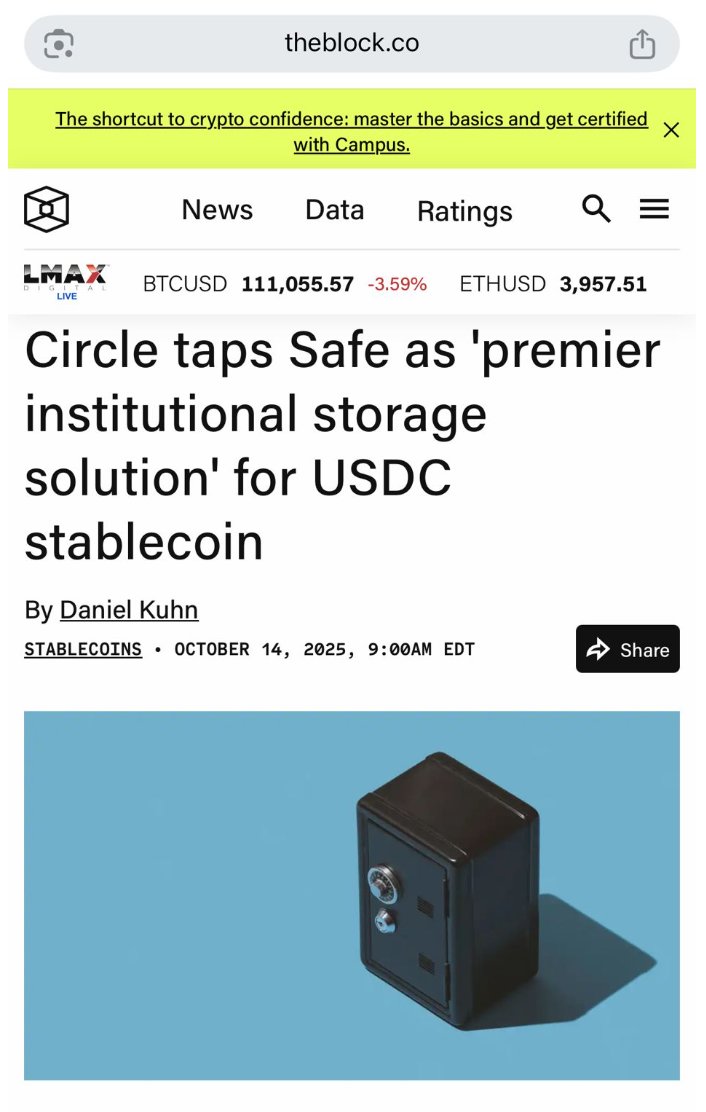
yesterday we announced our strategic partnership with @circle to establish Safe as the premier institutional home for USDC in self-custody
here's a summary of coverage we saw in the press 🧵
@DanielGKuhn breaks down the numbers: Safe has already processed $25B in USDC transfers in 2025 alone—on pace to double 2024 volume.
The data tells the story institutions have been choosing.
https://t.co/kUGEgFznHA | @theblock__