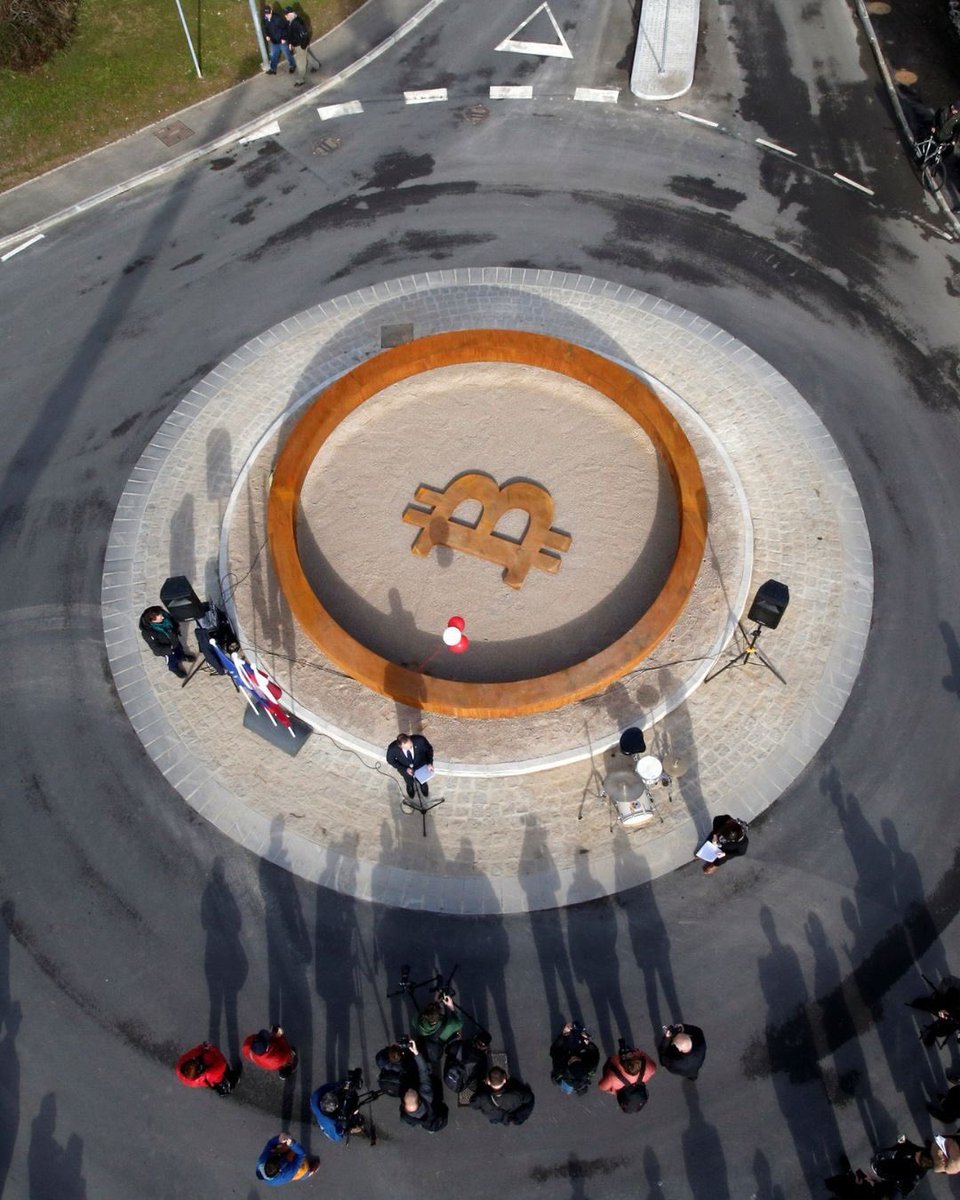
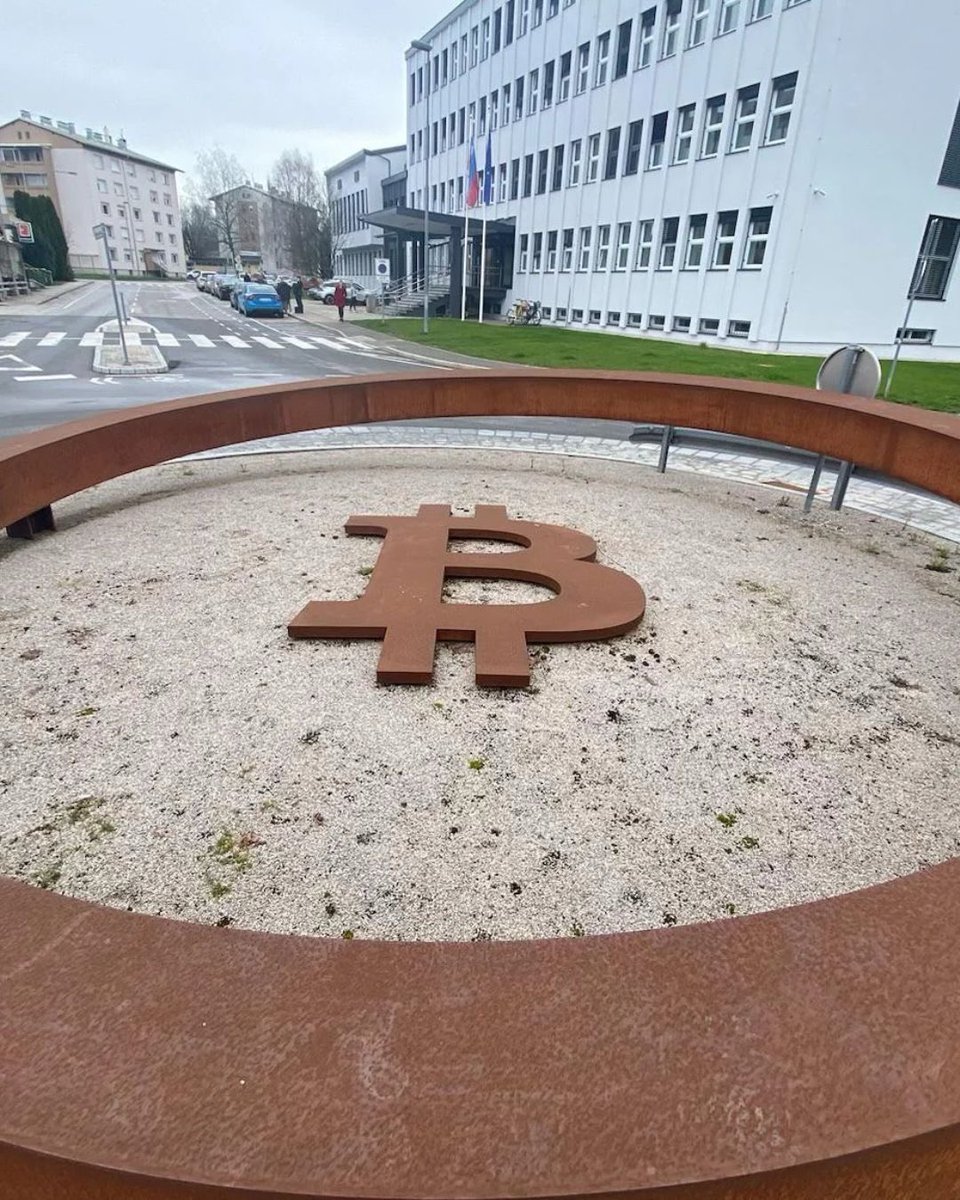
“Why yes, I would love to trade my spices for your goods, for we have both journeyed far and toiled hard.
However we must of course first complete these AML KYC forms for politicians, for surely commerce cannot work without them. It is for our own protection.”
15 years ago, if you did the responsible thing & bought $10,000 of 'risk-free' long-term Treasuries, you'd have $11,072 today.
If instead you spent $9,995 on drugs & $5 on bitcoin, you'd have $42,778 today.
bitcoin is such a mindfuck that it took me 10 years to learn the following:
- a wallet doesn't hold any bitcoin
- a utxo cannot be moved, it can only be created or destroyed
- addresses do not send or receive anything
- a private key does not contain bitcoin and does not encrypt bitcoin
- there are no accounts or balances
- btc doesn't exist, there are only sats
the rabbit hole never ends
One QR to rule them all, One QR to find them, One QR to bring them all, and in the sovereignty bind them
- onchain silent payments (automatically creates addresses for you under the hood for full privacy, BIP352)
- lightning payments, reusable (BOLT12)
- and Cashu!
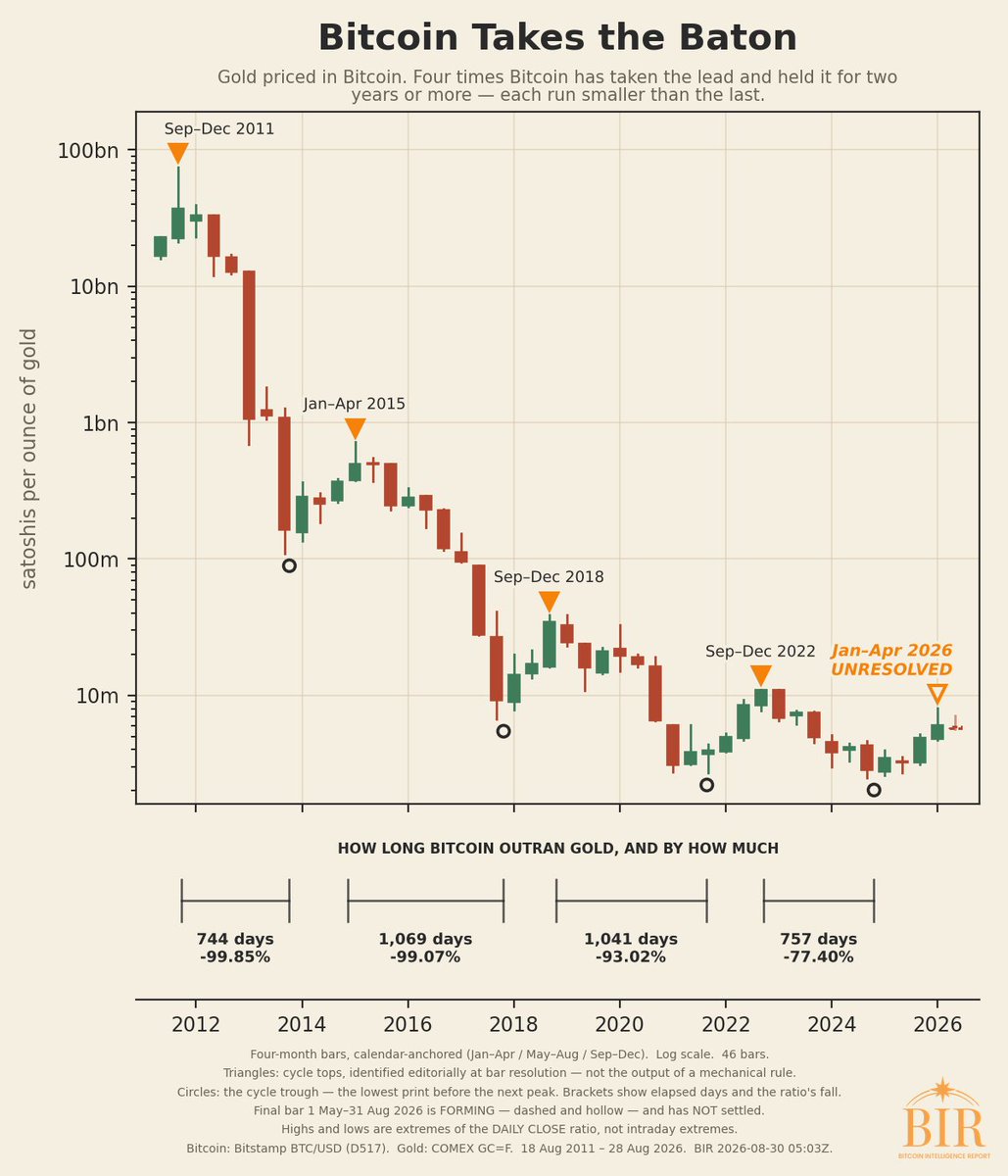
Most people price Bitcoin in dollars.
Almost nobody prices gold in Bitcoin.
That is a mistake.
This chart shows something remarkable:
Four times since 2011, gold had its run against Bitcoin.
Four times, that run ended.
And when it ended, Bitcoin took the baton and outran gold for two years or more.
Now the fifth setup is forming.
Will history repeat? I say yes and its two year plus run has just gotten started.
I broke the full signal down in yesterday’s issue of the Bitcoin Intelligence Report.
Read it here: https://t.co/YbYLPileJP
Bitcoin Industrial complex = FIC = MIC = Deep State Fabians.
John D. Rockefeller told Congress when they broke Standard Oil up he would bankrupt America. He was not lying. And his plan was Fabian brilliant.
How did the USA become captured?
In 1892 the British Government appointed Alfred de Rothschild to represent Britain at the International Monetary Conference in Brussels. He had already spent twenty years as a director of the Bank of England.A private banker was given the authority to speak for the British Empire on how the international financial system should be structured.The government handed a core sovereign function to a member of the most powerful private banking family in the world. Alfred de Rothschild was the official British voice at the table where the rules for global money were being written.The Rothschild network did not just influence governments from behind the scenes. It was routinely allowed to carry out sovereign functions in the name of the state. The idea that there was a clear line between private banking power and government authority did not hold in practice. They were permitted to act as extensions of the state itself on matters of fundamental importance.
How does these facts link to the Treaty of Versailles?
The Treaty created exactly the kind of complex international financial problems where such expertise was needed. In other words, what happened in 1892 was a Fabian precursor of what was to come by planning WW1.
The 1892 Agreement made public-private financial integration a seemingly normal state of affairs in this era. That meant its real purpose coul dbe used down the road for the Fabians planning it.
The 1892 appointment exemplified how Britain (and other powers) blended private banking power with state functions on monetary and international finance matters. The Bank of England itself remained a privately owned institution (with private shareholders) until nationalization in 1946; its directors (Rothschilds) and the wider City networks advised governments on debt, currency, and international payments. This blurred line persisted into the post-WWI period. In 1914, this agreement was why Britain went off the gold standard to fight this war.
Reparations, inter-Allied war debts, currency stabilization, and the attempt to restore the gold standard required technical input from bankers and central banks. The Bank of England (under Governor Montagu Norman) played a significant role in post-war monetary diplomacy, including the 1922 Genoa Conference and Britain’s 1925 farcical return to gold at the pre-war parity.
The Rothschild family had direct experience with large post-war indemnities. After the 1870–71 Franco-Prussian War, the French Rothschilds (especially Alphonse) helped negotiate and finance France’s rapid payment of the 5 billion franc indemnity to Germany, enabling early evacuation of occupied territory. This was one of the largest financial operations of the 19th century and involved close coordination with governments at the preliminary peace talks (held at Versailles in 1871). By 1914–1919, the Rothschilds remained important in war financing (e.g., Allied loans and acceptances), but their relative dominance had declined compared to the 19th century. American banks (notably J.P. Morgan) took a larger role in post-WWI arrangements under the advisory powers of John D. Rockefeller.
The Fabian reparations burden proved unworkable in its original form (Keyes and Dulles brothers), leading to the Dawes Plan (1924) and Young Plan (1929). These involved expert committees of bankers and financiers, new loans to Germany (the Dawes Loan), and mechanisms to facilitate transfers. While not led by Rothschilds, they followed the same Rockefeller Morgan model of using private financial expertise for sovereign/international obligations. Central banks and banking houses helped structure these “commercialized” solutions.
Keynes served as a senior Treasury official on the British delegation at the Paris Peace Conference.
He strongly opposed the harsh reparations demands and was rebuffed by the Rothschilds behind the scenes who needed harsh reparations to get the world to enter another war to try to recover allodial title back for the Crown they lost in the American and Bolshevik Revolutions. This lead the Rothschild Family to the Transfer Agreement idea. Keynes favored more moderate terms to enable German recovery and European reconstruction. Two young americans linked to the Rockefellers, Morgan, and Carnegie were assisting Keynes.
John Foster Dulles (often called "Foster"):He was a young lawyer from the Wall Street firm Sullivan & Cromwell. At Versailles, he served as legal counsel to the U.S. delegation on reparations, working closely with Bernard Baruch and other deeply American Zionists. He helped draft Article 231 (the so-called "war guilt" clause). This was a compromise he proposed: it affirmed Germany's responsibility in principle (to satisfy Allied political demands) but explicitly limited actual liability to what Germany could realistically pay, aiming to restrain excessive claims. Dulles argued on legal grounds against including full war costs (pensions, etc.) and pushed to moderate French maximalist demands. He feared crushing reparations would backfire economically and politically. Once the Rothschild's enacted this plan the Dulles brothers began to conspire with American Zionists who linked covertly to the Rothschild's clan who crafted the Balfour declaration. The victors write the history books and U.S. records were written to suit his own later reflections to hide his Fabianism so the historical record showed he viewed Versailles as a flawed, overly punitive treaty and drew lessons about the need for magnanimity in peace settlements (which influenced his later work on the 1951 Treaty of San Francisco with Japan).
Today in 2026 Saylor and Adma Back are now part of their team. When you buy STRC or any of Back's products you are supporting the Deep State taking your freedom.
NEW WEBSITE OFFERS A FULL VISUAL EXPLANATION OF HOW BITCOIN WORKS
https://t.co/08wGXP1u5i turns the Bitcoin network into an interactive machine, showing how each part of the system works together.
From wallets and transactions to the mempool, mining, blocks, and difficulty adjustments, the site offers a visual walkthrough of Bitcoin from start to finish.
It's been a rough couple of weeks for us working to build open-source Bitcoin products focused on privacy and self-custody. For me it has been a transformative experience.
The path forward has never been more clear.
No surrender. No compromise. All in.
Victory or death.
gained a ton of new insights working in bitcoin red team 🟥 that i wish i could share without vague posting. but this is what i got anon.
- we’re experiencing a massive collision between decades of human open source slop against 2 weeks of kimi k3 (not good)
- everything is broken, bitcoin is burning
- bitcoin is becoming stronger through this
- bitcoin is the obvious first target but the rest of the world will follow shortly
- sometimes old things need to burn so new things can grow on healthy soil
- humans should never code in c (just stop)
- lightning is complicated and is more broken than the average (sorry)
- verification is free. we used to complain about slop PRs. then about slop security audits. if you can’t handle the information overload, stop complaining and use AI to sort through it.
- those projects that started AI audits months ago are in a completely different position than those who didn’t
- projects need their own AI audit pipeline going into the future
- the burden for a developer to keep software safe and secure is pretty stressful and not for everyone. it has become a lot more stressful now.
- unmaintained projects are most probably broken, don’t rely on them. i’d rather one-shot it myself with a modern AI
- multiple concurrent, diverse human approaches have proven to be the best vulnerability search method
- external red teaming will probably have to continue forever
- we’ve basically completed a basic scan of virtually the entirety of bitcoin open source. the low hanging fruit is done.
- we’ve reported a ton of real critical and high vulnerabilities. project maintainers across the board have validated our findings.
- response speed is very different across projects and shows how healthy each project is. i recommend acting fast these days.
- red team etiquette matters. if you don’t disclose responsibly, boast on twitter about your findings on a particular project, or make indications about the nature of particular findings, you’ve disqualified yourself as a serious security researcher. trust is the most important factor in this game. if you lose it, it’s very hard to win it back.
- did i mention that humans should not code in c?
love you all.