Rector, Deakin University Lancaster University Indonesia (DLI) Bandung, Indonesia, Prof Global Islamic Politics, Deakin U, Views expressed are entirely personal
Wow! Just finished "Messy Jobs" by @lugaricano, Jin Li and Yanhui Wu, and I've been recommending it to everyone around me since.
It's about AI, jobs and the future economy and society
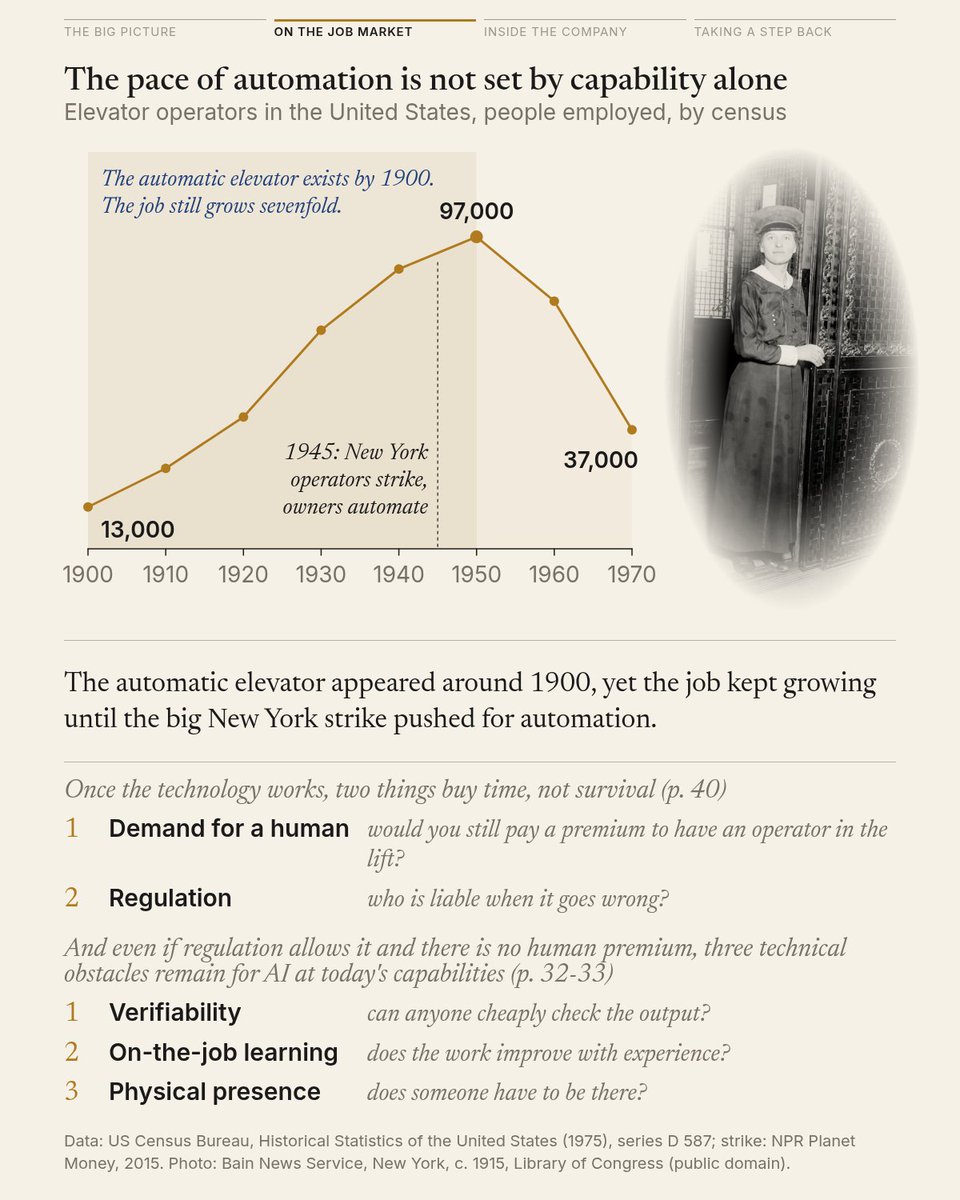
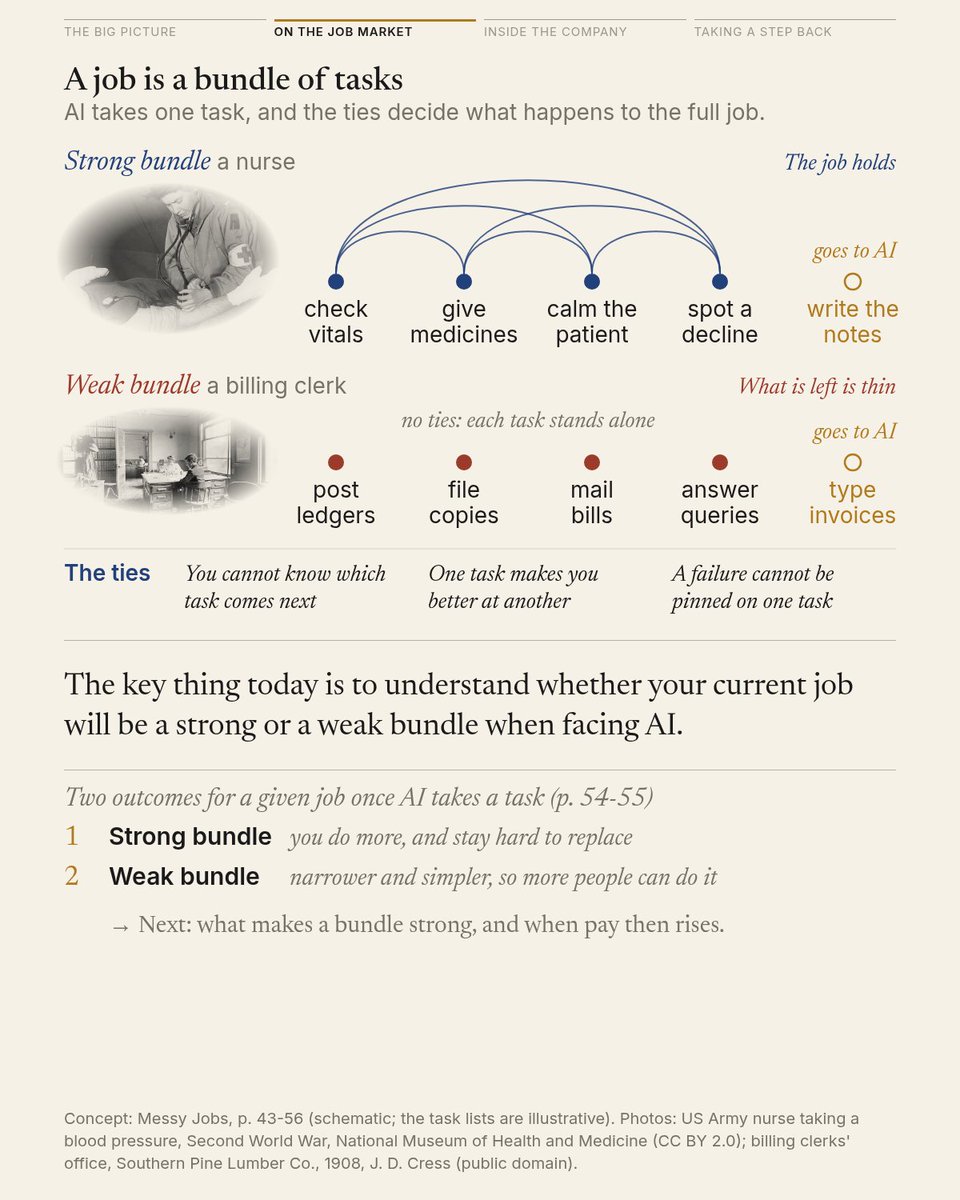
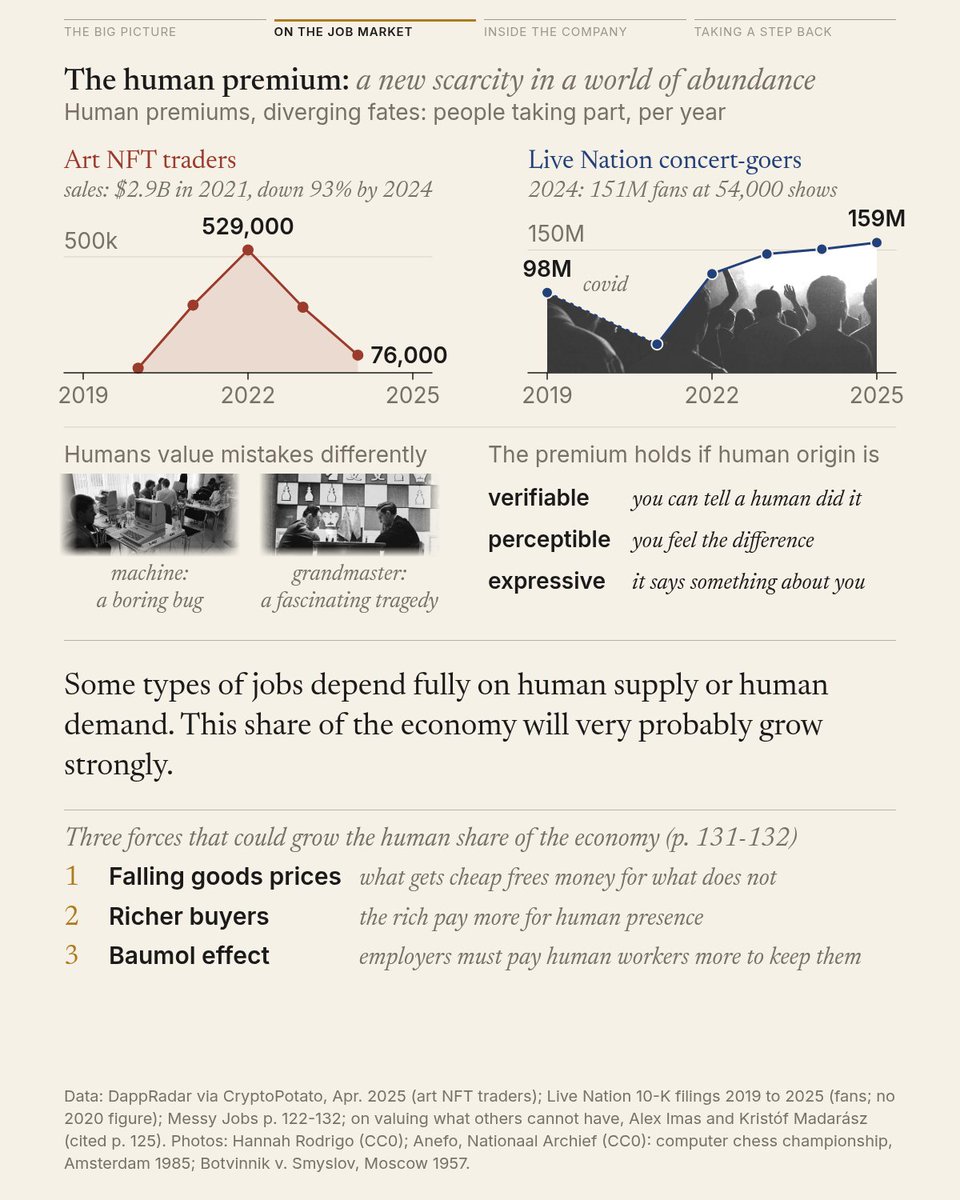
Here's the core of the book and my notes in 15 cards as a primer but you should totally read the whole thing 🧵
In the VIC postmortem I’m seeing people looking at the influence of media and social media on voter perceptions.
We can correlate vote shifts back to demographics, and demographics to media consumption habits - and get a reasonable inference of what’s been influential.
The largest vote share gain was One Nation - and interestingly it came from Labor in the city, and Liberal/Nats rurally.
Demographically, the One Nation votes that shifted were less likely to have these traits:
Bachelor degree or higher: -0.86
Professionals: -0.82
Higher median household income: -0.58
Born overseas: -0.53
Renting: -0.47
(Areas with more of these voters were HIGHLY unlikely to shift from Labor to One Nation. In seats like Kew, for example, nearly two thirds of Labor voters shifted to the Liberals instead.)
The demographics that shifted hardest were:
Cert III/IV quals: +0.84
Tradies, labourers, drivers: +0.73
Aged 65+: +0.32
Aged 45–64: +0.28
Own home outright: +0.24
That profile tracks back to Facebook. Facebook news use is up 6-7 points among 45-64s, and it's the most relied-on social platform for news for 56% of regional Australians, against 36% in the cities.
This aligns with something Redbridge’s Alex Fein noted when conducting focus groups of One Nation voters:
“It is taking far too many of us far too long to cotton on to what is happening, and now there is a momentum that has our focus group participants telling us about chats at the pub, conversations with workmates, and family discussions, all of which discuss the talking points seeded by the information operation. The consistency of what participants tell us they like about Hanson, whom they simply refer to as ‘Pauline’, as though she were a friend, is itself a tell.”
Where I see media as having a bigger role is in developing trustworthy and shareable content. A media headline about an unfunded election commitment (for example) comes with pre-loaded credibility that a post doesn’t carry.
The perceived credibility of the channel formerly known as SkyNews, and its impact on rural votes (where the channel is broadcast on free to air TV) is also potentially significant here.
However independent ratings data breakdowns aren’t available - so we can’t correlate it back to influence in specific regions.
Plus surveys suggest only ~4% of regional folk rely on it for news - compared with ~56% for Facebook. And Sky’s total annual viewership in regional Victoria (including occasional viewers) runs to [very roughly] 740k.
Among people who report relying on Sky for news, there’s not enough to account for the One Nation swing alone and you’d need to say it’s “tv + [a lot of] chats with mates” to get the effect. Among all including occasional viewers, it would need to be highly effective at political persuasion - about 1-in-2 annual viewers - to deliver that result. (For the sake of comparison, deep canvassing shifts about 1-in-10 voters attitudes, old (1990’s era, so old media landscape) study on the impact of Fox News pointed to 3-8%, and most campaign comms has no discernible effect.)
This suggests the effect size (number of regional votes shifted) was larger than what the TV news channel could deliver alone.
So it’s likely Facebook that is more influential than [Sky]News24 on both city and rural votes.
Anecdotally, campaigns of all persuasions where average people posted on their timelines about a positive personal connection to a candidate tended to do better in both Federal 2022 and State 2026. This could be the cart leading the horse though - as people tend not to talk about risky or non-viable candidates.
Chances are growing for the formation of an Eisenkot-led gov't, possibly even this week.
- Lieberman stopped ruling out the participation of Arab parties (likely the Islamist Raam Party) in the gov't. Notably, one of the reasons Lieberman implicitly used to justify the change in his position is Netanyahu's gross abuse of power through planting evidence with the Israeli Police & use of his hand-picked loyalist head of the Shin Bet to carry out groundless arrests of Arab political activists. https://t.co/bNyZNFp3RX
- The leader of Raam, Mansour Abbas, is set to declare that Hamas is a terrorist organization in a program to be broadcast on Saturday night. This is a pre-condition that Eisenkot set for any party joining his gov (Raam meets the 3 other conditions) https://t.co/F8vUHg243N
- Due to the shift in Lieberman's position, Bennet is now the main holdout to a gov't with Raam and ultra-orthodox United Torah Judaism. He prefers a gov't with the Likud with Eisenkot serving as PM. However, this holdout is less dangerous than it appears because: 1. Bennet's hand is weak, as at least 2 members of his party (7 seats out of the 12 of the joint list with Yesh Atid) won't agree to form any gov't with Netanyahu.
2. Netanyahu's conditions for such a "unity gov" are utterly unacceptable to any current opposition leader (e.g. no formal investigative committee for Oct 7th failures).
3. Bennet knows his political career would be dead if he he's blamed for the failure to form a gov't that would oust Netanyahu. https://t.co/qfQUn5WXPW
“What this means for America’s enormous military–industrial complex is plain: Any country that spends too much time and money chasing the most advanced and expensive war-fighting technology will struggle against one that can create agile armaments on the cheap.”
Latest in @TheAtlantic . To understand the future of most wars, do not look at how the USA fought Iran, look at the way the Houthis are fighting Saudi Arabia. Gift link. https://t.co/xc4GeQF0fx
Elon Musk insists that no one died after he slashed humanitarian aid. So I went to the field in South Sudan -- where the cuts left one clinic I visited with no antibiotics, no running water, no aspirin, no hand sanitizer -- and found the graveyards filling because of his recklessness.
Moms die in childbirth, kids from malnutrition and everyone from lack of access to medical care. One of the greatest American programs was PEPFAR, which saved lives of people with HIV/AIDS with medicines costing just 12 cents a day. Now AIDS orphans are dying because of the way Musk cut the community health workers who made the system work.
I had invited Musk to come on a trip like this to see the consequences of aid cuts. He declined. But I renew my offer: Elon, I'm happy to travel with you to look at aid programs so you can push reform -- necessary! -- without killing hundreds of thousands of children.
And I hope that Democrats, who have been powerful critics of aid cuts, will use their new power in the new Congress not just to criticize Trump on this point but also to restore and revitalize lifesaving and transformative aid.
Here's a gift link to my column: https://t.co/3OOTDogQIp Thoughts welcome.
What a fascinating night in #VicVotes
Never before has “there’s no such thing as a safe seat” been truer.
The most complex count we’ve seen in Victoria in perhaps the past 75 years.
Looks like 41 complex counts, where the VEC’s predicted 2CP doesn’t match the likely 2CP leaders. (= Nearly half the parliament with difficult-to-predict results.)
26 seats where 3rd and 2nd are within 3%
16 seats in doubt
On some back of the envelope numbers, Victoria is looking at a likely 17 seat Coalition majority.
But also the lowest _winning_ government party/coalition primary vote since 1943 at 34.9% (as I write).
That’s lower than the Coalition primary vote in the “Danslide” election result of 2018, and only marginally higher than the similar post-COVID loss of 2022.
(After postals it’s likely to land SLIGHTLY higher - perhaps 36-37%? That’s still a winning result that reflects several recent losing results though. To find similar winning Coalition lows you have to go back to the Bolte era (1955-1970) during a period when the DLP and Country Party split both Labor and Liberal votes. Albeit Bolte governed outside of a Coalition. The Bolte Liberal + Country votes combined would be ~6-11 pts above the 2026 result.)
Raf Epstein final thoughts on ABC’s broadcast were to reflect on Wilson’s speech: “I realise that you have lent us your vote. We don't own it…”
Compared to 1992’s result (which swung the Coalition to power on a very similar seat majority, and saw 52% - or 1 in 2 - Victorians vote Coalition), this time it’s barely 1-in-3.
The combined major party primary vote currently sits around 53%.
(We’re not quite below the threshold of 50% but we’re not far off - and the trend of the declining major party vote continues once more, seeing a former government’s primary tanking and an incoming government’s primary fairly flat. What’s notable here is the scale of the drop.)
What this means in practice is preferences are becoming increasingly consequential.
I think it’ll be interesting to watch preference flows as it’s likely 3rd and 4th and 5th preferences will decide seats in ways that first preferences used to.
Functionally, the 17 seat majority looks like it will sit on a 0-4.5% margin - and could be wiped out with a 5% uniform swing.
And that swing could happen without shifting a single primary vote - just shifting 2nd, 3rd, 4th and 5th preferences.
A change of government is a harder ask though. It’s not entirely clear who the Opposition will be yet…
Greens are looking at 7-10 seats (likely 8),
Labor 6-14 (currently looking at roughly 8),
One Nation 2-8 (currently 4)
…and the path for any of the three going from ~8 seats to 45 in a single term contest is huge.
On some back of the envelope numbers, it would take a ~8% uniform swing to land directly in the laps of Labor and Greens to shift the ~29 seats to change government.
A ~5% shift in primary, plus a ~7% shift on preferences, would deliver those seats too.
In the context of the ~19% drop in Labor primary vote and ~20% increase in One Nation primary vote (in ~10 months!) that we saw this election suggests those sort of electoral shifts can’t be discounted outright anymore.
When Labor President Wayne Swan noted post-2025 that the Labor vote was “wide but shallow”, he was speaking of his own party - but about a type of electoral volatility that exists across the board.
The low primary votes for all parties, and extremely high shifts in votes I think speak to a deep dissatisfaction with circumstances, and perhaps an impatience in willingness to accept delays in change.
Very interesting, very volatile electoral environment.
I think the biggest risk electorally is reading results through a historic lens, as we are in unprecedented times with this volatility.
Against a tricky, potentially hostile upper house, it’s shaping up to be a very difficult 4 years of government in Victoria.
I have been thinking a lot about the intersection of AI and Academia. Namely, "what are we (research universities) even doing in a world of AI?" Why have PhDs? Why have faculty?
I think the answer was captured by what we can call "The Harper Test".
The Harper Test is in reference to the @UChicago's first President, William Rainey Harper. Harper connected the fundamental mission of the University to "investigation". He wrote in 1892, that:
“the chief purpose of graduate work is not to stock the student’s mind with knowledge of what has already been accomplished in a given field, but rather so to train him that he himself may be able to push out along new lines of investigation.”
Indeed, Harper repeatedly connected the word “investigation” to the fundamental mission of universities. His choice of the word "investigation" was a profound insight that is critical for thinking about the university today.
The heart of "investigation" is not solely to uncover facts or generate new ideas. It is "understanding". More precisely, it is "human understanding". When you investigate something, you are trying to make it understandable to others. You are piecing together a story about certain facts and new ideas (you are not just saying "what" something is, but why it is or why it came into being).
AIs are conveyors and even curators of human understanding, but they are NOT themselves the ultimate source of human understanding. Making anything intelligible to humans will always require...humans: humans who seek understanding; humans who learn how to establish understanding; and humans who can express that understanding. Ideally, we want humans who can do all three. Universities remain the best institutions for immersing humans in an environment where all three are the pursued simultaneously.
AI can assist in all of those endeavors (I myself have already benefited from such assistance) But what the AI does must ultimately contribute to human understanding and be understandable to humans (e.g. it's not good enough if an LLM "solves" a problem but that solution can't be understood by humans). Otherwise, in the words of Harper, it has offered a failed investigation. It has failed the "Harper Test"
I have just casually discovered a new hallucination!
Let’s be clear. I know AI models are getting better and better. I myself pay for a subscription to one of the top models (Astra 6.2 Ultra), and I use it for long-horizon projects.
Right now, I’m using it to help finalize a technical revision of a research paper. The job is to go through a very long response letter and check that we’ve addressed every reviewer comment, that the quotes are accurate, and so on.
Astra did a pretty good job for a while. Then things got weird.
First, it said we hadn’t addressed a reviewer’s comment.
But we had!
When I pushed back, Astra said it had mistakenly checked an earlier version of the response letter, not the most recent one.
The next error was more subtle.
Astra double-checked a statistical test and told me our result was wrong.
But it was not!
It turned out Astra had run a slightly different test.
Its explanation?
That was the test we had incorrectly specified in an earlier draft.
Then came my favorite.
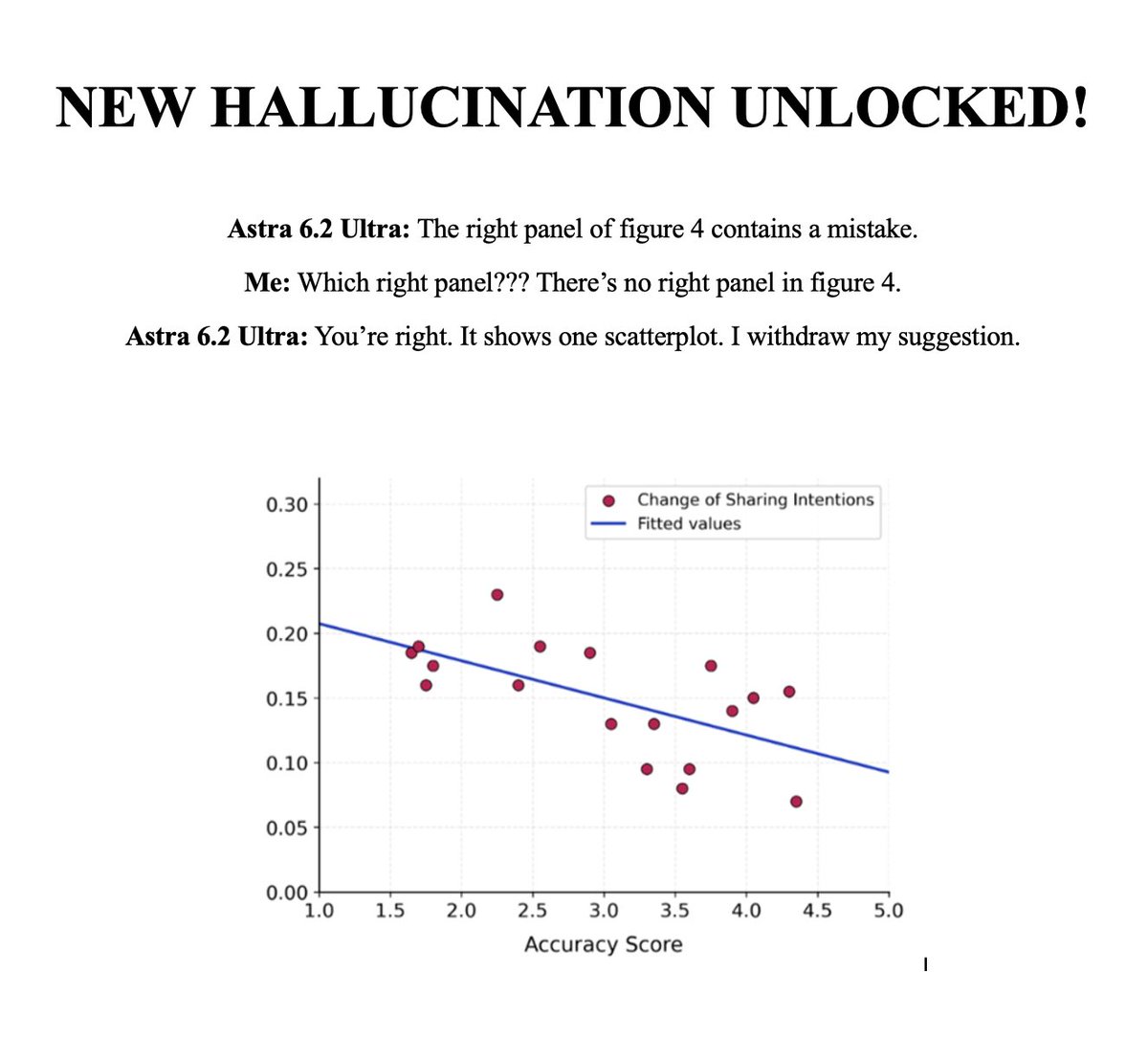
Astra found an error in the second panel of a figure.
But the figure had only one panel!
This time, Astra blamed the crop.
My sense is that, as these models get more powerful, the obvious hallucinations are getting rarer.
If you ask a straightforward question, models rarely hallucinates.
But on long-horizon projects, errors are still common and can be much harder to spot.
And that’s the risk.
The less often models hallucinate on simple questions, the more we trust them with harder, higher-stakes tasks.
My recommendation?
Remain VERY critical when you use advanced models. They’re certainly helpful, and I think they save time overall.
But you still need to double-check everything.
India produces huge numbers of university graduates but struggles to create enough suitable jobs for them. So when young Indians move overseas, it's not all bad news for India. They ease pressure on the job market and send billions home. India received US$135 billion in remittances in FY2025! Source: https://t.co/O6a6aIvjbF
Every Malaysian pledges "Kepercayaan kepada Tuhan" in the Rukun Negara.
Because we use the same word—"God" or "Tuhan"—we assume everyone is talking about the exact same thing.
In reality, different faiths here are referring to completely different cosmic categories:🧵👇
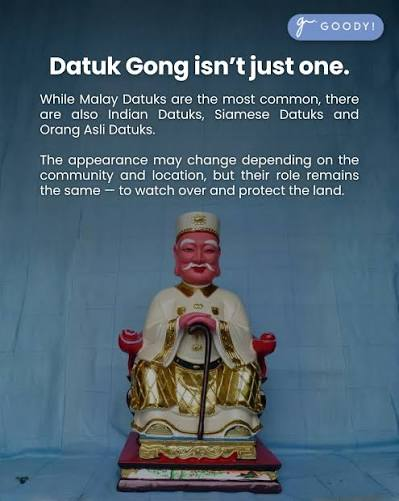
Many non-Chinese Malaysians walk past a Datuk Gong shrine or a noisy street temple festival and immediately assume two things:
1. It’s "devil worship" or idol worship.
2. Outsiders aren't welcome to watch.
Both assumptions miss the actual story. Let’s break it down: 🧵👇
“supporters are empowered to insult &mistreat the groups they regard as inferior…This is why far-right politics has historically appealed to groups who feel that their social status is on the decline, promising to restore their place in a lost hierarchy—to make them great again”
"In MAGA, contempt trickles down from the top.
"Trump treats his own supporters as inferiors—insulting them, breaking promises, selling them worthless trinkets, refusing to be held accountable.
"In turn, his supporters are empowered to mistreat the groups they regard as inferior...
https://t.co/Pbz2Wgr5wt
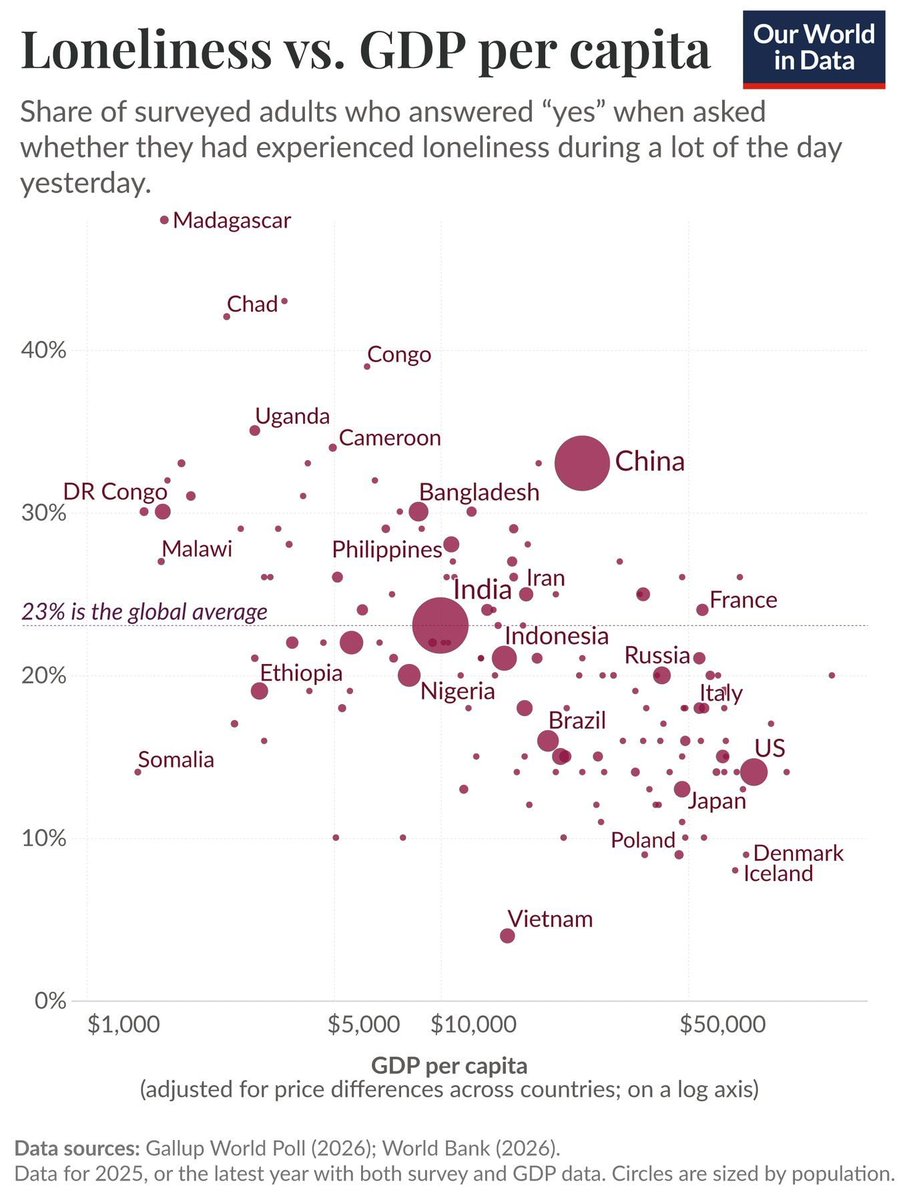
On any given day, more than one in five adults in the world — 23% — spend much of it feeling lonely.
We know this from the Gallup World Poll, which in 2025 asked around 1,000 people aged 15 and older in each of about 140 countries: “Did you experience loneliness during a lot of the day yesterday?” Each country's sample is designed to be nationally representative, and together these countries are home to 95% of the world’s adults.
The chart shows that loneliness (on the vertical axis) is more common in poorer countries. In countries where GDP per capita (on the horizontal axis) is below $5,000, on average 28% of adults felt lonely for much of the previous day. Where it is above $40,000, the average was 16%.
Gallup reports that the same is true within countries: people who say that they find it difficult to get by on their income are more than twice as likely to feel lonely as those who say they live comfortably on their present income (32% vs. 15%).
(written by @MaxCRoser)
Given Indonesian society’s well-known cult obsession with prestigious academic credentials, we can expect the influence of Taruna Nusantara high school over Indonesian politics to grow considerably stronger in the years to come.
https://t.co/GKydkVBjm4