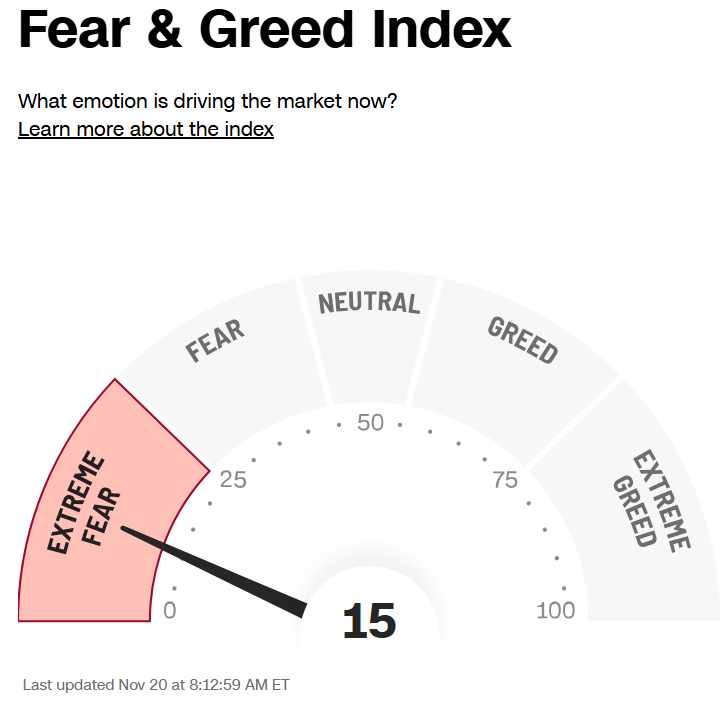
The S&P is down 6 consecutive sessions, the longest losing streak since April 2024. A 7th fall today would make it the longest run of declines since the pandemic slump began in February 2020.
US traffic deaths per 100M miles traveled have fallen from over 20 in the 1920s to 1.5 today.
Decades of engineering improvements, safer cars, and better roads make driving today much safer than in the past.
Technology is almost down 20%, yet the S&P 500 is only about 6% away from new highs.
This is extremely rare, as other times $XLK was down 20% saw the S&P 500 way lower.
I believe the @nvidia board is not acting in the best interest of shareholders nor in a manner consistent with their fiduciary duties.
What we know is that the board fired Jensen or forced his resignation for violating company policy and/or in response to the accusation of an affair with a spy.
They did so without careful consideration of the impact on the company, its customers, its shareholders or other stakeholders.
They rushed to judgment without the benefit of careful due diligence or even with a basic understanding of the facts.
How do we know this?
We know this by how quickly Jensen was fired and how little was known at the time of his firing.
It takes time to convene a board meeting. There was time, maybe, for one Zoom.
And this is a decision that should have been made by a board sitting in person and carefully deliberating the facts once they are known.
And they should have slept on the decision and met again the day after to discuss the facts, the risks and the other implications of their decision.
The timing and lack of information did not allow for careful board deliberation.
While boards can fire a CEO for an inappropriate relationship with a subordinate, it should not be an automatic decision. That is why we have boards comprised of humans and not agents.
A board should consider whether or not such a relationship was consensual or whether it was an abuse of power dynamics. And a board has to consider what the impact of the firing is on all stakeholders.
If I were in this board, I would not have rushed to judgment based on articles in the media. I would have made sure the board had all of the facts so it could make a careful and informed decision.
Boards of Delaware companies have a duty of care which means they must make informed, prudent and good faith decisions. This clearly did not happen here.
What law firm is advising this board?
Or is the board even taken good legal advice?
It doesn’t look like it.
And now the board is compounding its failures by insisting that there is no possibility for Jensen’s return as CEO.
Why is it in the best interest of the company to foreclose the possibility of Jensen’s return and to do so before all of the facts are known? This is yet another breach of their duty of care.
Furthermore, the board has launched an investigation whose scope is unknown. Investigations can be extremely damaging to a company and should be carefully targeted to address whatever facts need to be known rather than be overly broad in scope.
In short, this looks like a series of major governance failures by directors that panicked due to headlines in the media. They likely felt compelled to do something because they were afraid of looking bad in the media, not because it was the right thing for them company.
They couldn’t stand the heat.
The board’s conduct here is shocking for a company of this scale and importance to our country and the world at large, particularly at this moment in history.
1/ Palo Alto Networks ($PANW) just dropped a massive Q1 FY27 beat-and-raise alongside a $4.5B AI acquisition—sending the stock surging ~20% in 24 hours ($371 after-hours) and sparking a sector-wide rally across $HACK and $BUG 🚀🧵
---
2/ The Q1 Numbers (Beat & Raise):
• Revenue: $3.44B (+39% YoY vs. $3.31B est.)
• Non-GAAP EPS: $1.05 (vs. $0.97 est.)
• NGS ARR: $9.73B (+66% YoY — largest beat in company history)
• Total RPO: $21.0B (+35% YoY)
• Adj. FCF: $1.9B (56% margin)
• FY27 Revenue Guide: Raised to $14.52B–$14.57B
---
3/ The $4.5B AI Power Play:
PANW is acquiring ex-OpenAI startup Applied Compute in an all-stock deal to own secure post-training and inference for enterprise open-weight models.
Instead of just guarding the network perimeter, PANW is moving directly into the AI model runtime layer—trading ~100–200 bps of near-term margin for massive platform stickiness.
---
4/ The Cyber ETF Ripple ($HACK & $BUG):
AI-driven threat budgets are lifting the entire group:
• $BUG surged +7.7% to $46.56 on Nov. 18 (and hit $48.50 after-hours, +4.2%) with PANW (~6% weight) and peers like $CRWD, $ZS, and $NET catching sympathy bids.
• $HACK is riding the same tailwind as enterprise security consolidation accelerates into 2027.
---
5/ The Investor Takeaway & Risks to Watch:
After its post-earnings surge to ~$370, $PANW trades at ~87x forward non-GAAP EPS ($4.26–$4.30 FY27 guide)—leaving little room for execution stumbles.
Key watchpoints:
• Gross Margin Pressure: Non-GAAP gross margin dipped 170 bps YoY to 75.2% on higher hardware costs and SaaS mix shifts.
• M&A Dilution: Integrating Applied Compute will shave ~100 bps off FY27 operating margins and ~200 bps in FY28, while GAAP operating income compressed to $96M due to $622M in stock-based comp.
Anthropic’s IPO ($ANT) is officially the largest stock market debut in history—and the numbers buried in the S-1 filing are almost hard to comprehend.
Here is a breakdown of the 7 most shocking numbers and investor takeaways from the filing 🧵👇
---
1/ The Largest IPO Ever
Anthropic priced at $83/share (above its $70–$78 range), raising $81.31 billion—eclipsing SpaceX and Saudi Aramco.
Factor in a concurrent $26B private placement + $100B+ already on the balance sheet, and Anthropic is sitting on a ~$200 billion cash war chest.
---
2/ A $1.5 Trillion Valuation
At $83/share, Anthropic debuts at ~$1.1T basic and $1.5T fully diluted.
In May 2021, its Series A valued the company at $623M. That is a 2,400x valuation jump in just 5.5 years.
---
3/ Nearly $1 Trillion in Compute IOUs
The wildest line item in the S-1: $895B to $901B in future compute and infrastructure commitments, with $447.5B due before 2030.
Major minimum commitments:
• Google: $114.5B
• Amazon: $110B
• Microsoft: $44.9B
• SpaceX AI unit: up to $120.5B
---
4/ Hyper-Growth Revenue
Anthropic’s revenue trajectory is vertical:
• Q1 2023: $0
• 2024: $400M
• 2025: $4.6B
• First 9 mos of 2026: $33.24B
Q1 2026 alone beat all of 2025, and annualized run rate crossed $65B this summer. Customers paying $100K+/yr jumped nearly 8x in 9 months (1,500 → 11,900+).
---
5/ The $104B "Loss" Illusion
Headline numbers show a $104.0B GAAP net loss in the first 9 months of 2026.
In reality, $94.3B of that is a non-cash accounting charge from revaluing convertible notes/SAFEs pre-IPO. Meanwhile, compute costs dropped from 251% of revenue (Q1 '25) to 48% (Q2 '26), briefly turning Q2 GAAP operating income positive ($974M).
---
6/ The Public Benefit Equity Pledge
As a Delaware Public Benefit Corp, Anthropic locked 5% of its equity (~$55B–$75B) into a public-good fund.
The twist in the charter: every time the stock rises 50%, another 2% of equity automatically gets added to the fund.
---
7/ The Investor Takeaway
At a $1.5T fully diluted valuation, $ANT is pricing at ~18.5x its $81B annualized revenue run rate—a steep multiple that already bakes in massive future scale.
While H1 2026 showed an impressive $3.45B in positive free cash flow (thanks to renting compute rather than heavy upfront CapEx), the real test is margin durability: Q3 compute expenses jumped 77% QoQ, outpacing 47% revenue growth.
With $447.5B in compute commitments due before 2030, Anthropic cannot afford a demand slowdown—or its free cash flow engine could quickly invert.
The average stock in the S&P 500 is up 12.3% YTD vs the index up 7.2%
Really, it is all about October, as the avg stock was up 5%, with the index negative
The best consumer datapoint in Disney’s earnings was hiding in the ticket line.
$DIS drew 4% more guests to its parks globally in Q4, even after stripping out the extra week. And once they got through the gates, they spent more. Spending per guest rose 4% at U.S. parks and 5% internationally.
Disney’s Experiences segment, which includes parks and cruises, posted record revenue of $10.1B and operating income of $2.25B, up 20% as reported.
For all the debate about the consumer, Disney is drawing more people in and getting them to spend more once they’re there.
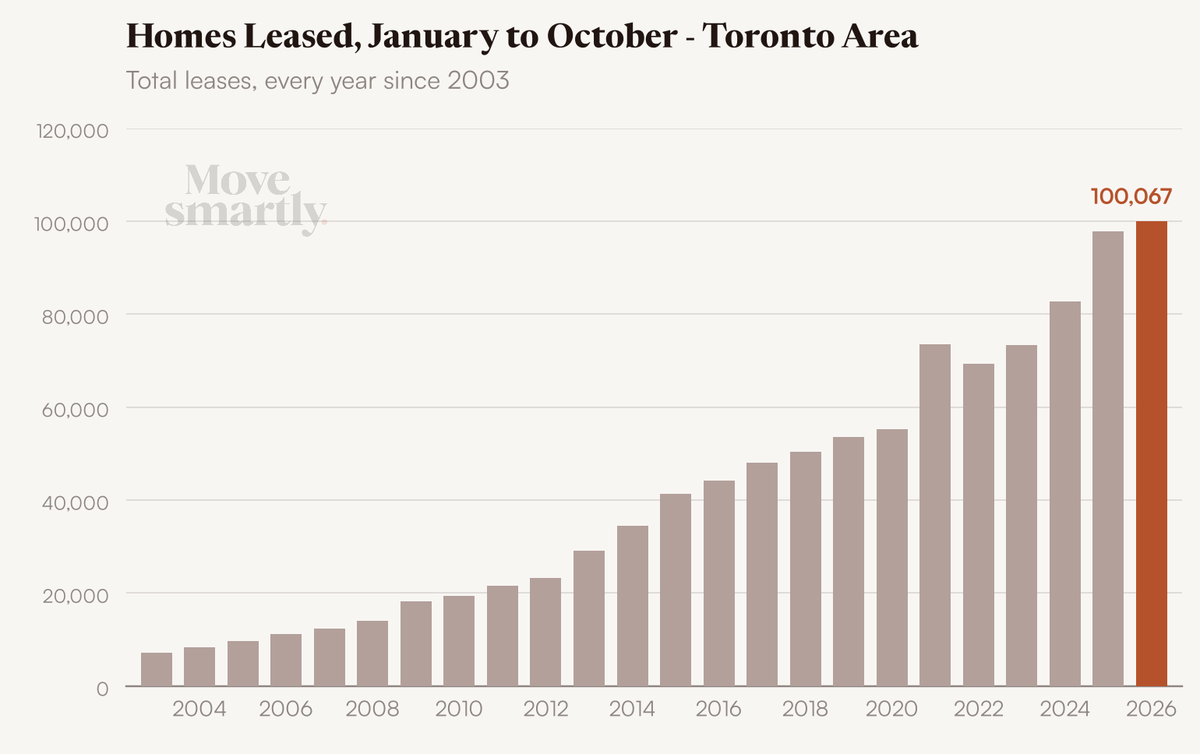
We can see that in the rental data.
There were 100,067 homes leased through the MLS over the same ten months, the most on record in our data, which goes back to 2003.
That's more than double the number leased in 2016 6/
Remarkable breadth in today’s rally despite NVDA falling ~5.4%.
Nasdaq-100 +3.45%, S&P 500 +2.47%.
If NVDA had simply matched SMH (+4.7%), the Nasdaq-100 would be up ~4.3% and S&P 500 ~3.2%!
⚠️ Hypothetical, holding all other stocks constant—not a forecast.
Green shoots! 🌱. Not closing prices.
Is the AI trade shifting from picks and shovels ($NCLD, $SMH) to early adopters and users of a.i ($EBAY, $REAL, $ABNB)?
I’m watching who can use AI to sell more or spend less. $ABNB is already showing it: support cost per booking fell >17% YoY, helped by AI.
Airbnb ($ABNB) may be a perfect example of the next wave of AI winners: companies USING AI, not just building its infrastructure.
Q3 revenue +19%, bookings +21%, EBITDA +22%.
AI now resolves ~40% of support issues, cutting costs per booking by 17%.
Real operating leverage. Real green shoots. 🌱 $QQQ
☕ $SWP.TO Swiss Water breaking out to new 52-week highs following impressive Q3 results!
📈 Volumes +16%
📈 Adjusted EBITDA +50%
📈 Record capacity utilization
📈 15% capacity expansion planned
Growing demand for chemical-free decaf, improving profitability and an active share buyback. A compelling long-term consumer growth story hiding in plain sight. Bullish!
I'll be holding a Reddit AMA on Nov. 4 talking about stocks, markets, economics and what the midterm election results mean for investors. See you there!
https://t.co/dNwqSUq84v
What if the stock market is healthier than the headlines suggest?
Through Oct. 29: • 77% of S&P 500 stocks UP in October • Equal-weight S&P 500 +5.7% • Energy +11.8%, Healthcare +9.3% • 66% above their 50-day MA
Mega-cap tech is masking a remarkable broadening of market strength. $SPY $RSP $QQQ $MAGS $QQQE