and here's my @Uare_ai overview of my latest issue of What's 🔥 in AI/Infra
Getting better and better every week - you can also chat with my AI about robots, slide decks etc here:
https://t.co/SqG9ldAI1I
One of my favorite events of the year.
@PartnerLeaders Catalyst celebrates its 5th year in NYC on Aug 25th & 26th.
This closing keynote will touch on where we are in the decade of the ecosystem (just passed the halfway mark) and provide a glimpse forward to the 20-year AI era.
Hosted a dinner last night with a group of IT leaders of large enterprises around agent adoption in the enterprise. Some quick notes:
* Change management remains one of the biggest topics for driving workflow transformation. Still most processes need to be upgraded to modern operating models to work with agents, which is a mix of technology, data, and human process change. Lots of emphasis on getting data (structured and unstructured) into a setup that can work with agents properly.
* IT teams are finding increasing success embedding full engineers into the business functions (essentially internal FDE) that go and implement agents into the internal workflows. There’s so much technical work to be done to make agents successful, that they can accelerate months or quarters of failed experiments by having someone technical in the workflow early.
* Consensus that the tech function is becoming more important than ever. It’s clear that the business could only expect automation to affect a minority of the business before (e.g. ERP) but now it can impact all of knowledge work. This means IT is becoming a more central role to the workflows across the company.
* Workflows are cross functional, and getting agents to work cross functionally is a complicated data modeling and permissions issue. Single users don’t have access to this. Which means you need to have agentic systems take on their own roles and have their own privileges, which is non-trivial given agents can’t keep things secure on their own.
* Huge variance in budgets between coding work and the rest of knowledge work. Some companies had a $1,000 a month budget for developers, and others had much higher amounts (like $5,000) that were merely triggers to notify the team vs. block them. Far smaller budgets for non-coding work at the moment.
* More companies are building their own multimodel systems for routing workloads by task to frontier and lower cost models. Lots of energy around open weights models, but still more in experimentation instead of at scale usage (some companies can’t due to perceived Chinese issue).
* Clear sense that all enterprise software must be headless in the future. Relief that they don’t need to train employees on hundreds of different apps. However, clear frustration with the traditional vendors that don’t play extremely nice (technically or cost wise) with agents in a headless fashion. Huge warning for existing software vendors.
* Mythos or mythos level-models are finding more and more sophsiticated security risks. The chaining together of vulnerabilities is what’s novel right now, and companies are coming up with long backlogs of what they need to go patch quickly.
Even more discussed, but just a few of the hottest topics.
Something Sam learned with Parker Conrad is the importance of creating a demand-rich GTM environment.
When you don't have enough leads, every deal is too precious, so targets can be easily be missed and more importantly reps might try to close bad-fit deals.
Negotiation. Meetings. Focus. In the AI era, these 3 levers separate high performers from everyone else. On #DisrupTV, @RWang0 & @ValaAfshar talk with Brian Doyle, Dr. Rebecca Hinds & Dr. Igor Ryabenkiy about outcome-based selling, killing “meeting debt,” and why ruthless focus builds unicorns https://t.co/PUSwtpzh39
I’ve always enjoyed learning about different business best practices, strategy documents, and ways of thinking through a company game plan. One example I’ve seen more frequently over the last year is the concept of “right to win.”
Right to win is the idea of understanding your competitive positioning and what makes your product distinct from competitors. It is often broken down into a table with three columns. The first column is the capability or functionality provided. The second column is why it matters, which articulates why this particular capability or functionality is needed by the market and your specific customer base. The third column is why your competitors struggle with it. Here, the goal is to describe why other competing products in the market have a hard time doing the same thing.
Put more simply, the framework is: the capability, why it matters, and why competitors struggle with it.
My general approach to competition is to be competitor aware and customer obsessed. Even when obsessing over customers, there are often competitive new deals where, in order to win the business, you have to articulate how your product is different from others in the market. Merely being competitor aware doesn’t solve the entire issue. You really have to understand what makes your product unique and how that connects with the prospect and their goals.
The right to win strategy should be used to align team members, investors, partners, and advisors. Many entrepreneurs even include a right to win slide in their investor updates or board decks. It’s a great way to communicate the product strategy internally in the context of competition.
For entrepreneurs, my recommendation is to think through this right to win idea and use it to consistently deliver a winning strategy against the competition. Competition is what makes free markets such an incredible way to produce the best products. Regularly revisiting your right to win strategy and updating it in the context of the market is something every entrepreneur should do.
When Growth Slows, Is It Sales' Fault or the Product's Fault? In the Age AI Age, the answer has changed.
This question has caused more office fights, blame games, and fired VPs than almost anything else in B2B.
Growth decelerates. The board asks questions. And the finger pointing starts.
Sales says the product isn't competitive. Product + Eng say sales needs to close what we shipped. The CEO fires the VP of Sales, hires a new one, and hopes for the best.
Here's the thing: until about 18 months ago, the answer >was< often sales.
Why? Because B2B products were mostly static. You'd add features, fix tech debt, catch up to competitors, and every few years add a new module. The core product didn't change much year to year.
In that world, sales and marketing's job was to jam more people into the funnel and get more of them to buy. If growth slowed, it was usually an execution problem. I wrote years ago about how a great VP of Sales doubled our sales in 90 days at EchoSign. No product changes. Just better sales leadership, better process, better hiring, better accountability. That's still true. A great VPS or CRO can absolutely double your sales.
But the world those playbooks were built for was a world where products stayed essentially the same for years.
That world is gone.
Claude is literally 100x better than it was 12 months ago. Cursor went from $100M to $2B ARR in roughly 14 months. Products that were competitive last year are getting lapped by competitors shipping weekly.
Today, if your growth is slowing, the first question isn't "do we have the right VP of Sales?" It's "is our product still competitive?"
In a market where the best companies are releasing major updates every few weeks, going 6-12 months between meaningful product improvements is a death sentence. Your sales team will feel it before your dashboards show it. Win rates start dropping. Competitive losses tick up. And no amount of sales process optimization will fix a product that fell behind.
Fire your VP of Sales if you want. But if your product isn't as competitive as it was 6-18 months ago, I doubt it will help.
Product velocity is the new growth lever. Get that right, and a great VPS can work their magic on top of it. Get it wrong, and no amount of sales talent saves you.
The hottest areas of the #AI trade will be in the memory market, says Constellation’s Ray Wang https://t.co/TMAFHughvH @CNBC@SquawkCNBC@beckyquick@rwang0 of @constellationr discusses the state of the tech sector, what to expect from Micron’s quarterly earnings results this week, and more.
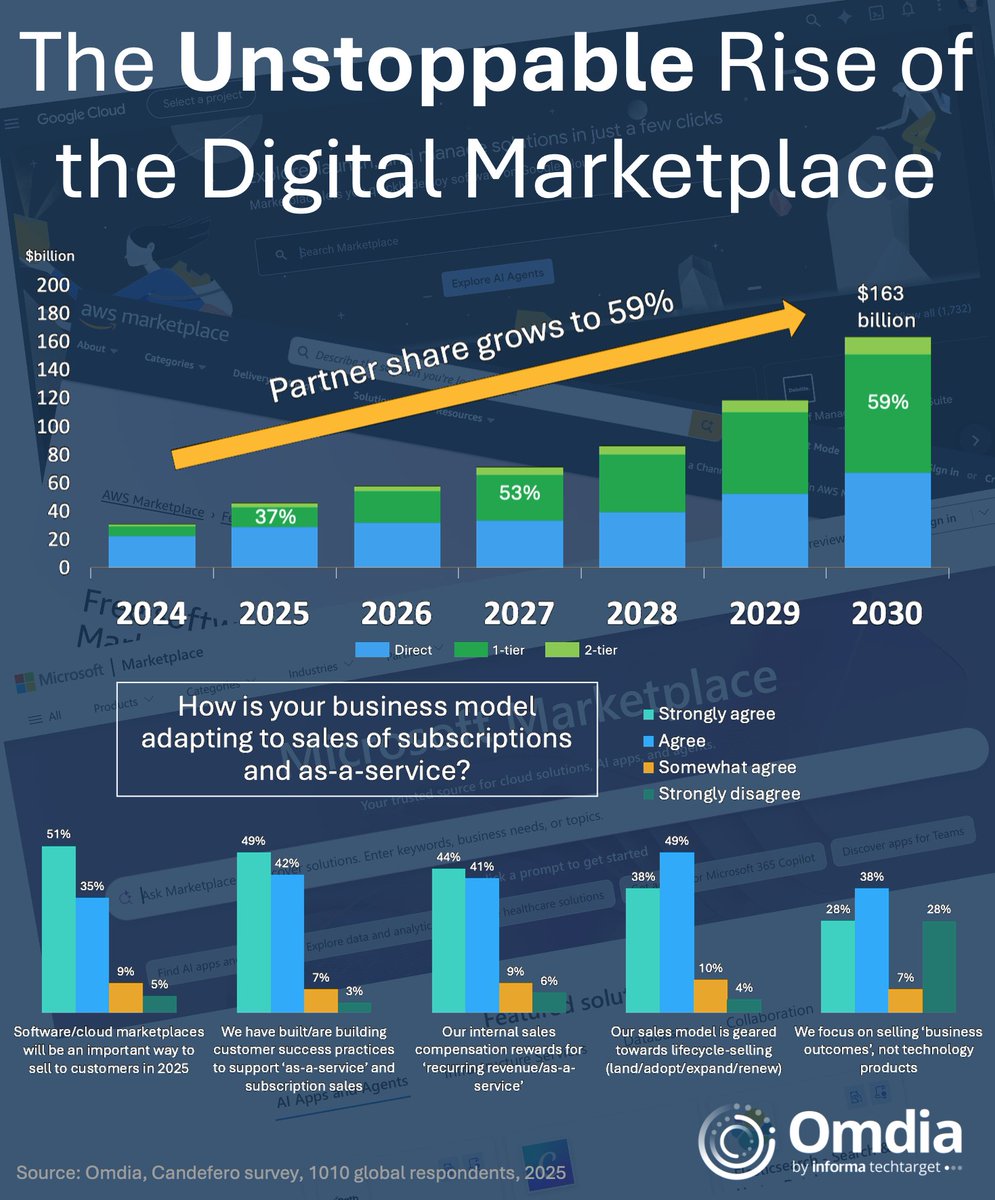
As the combined backlog for #CloudWars hyperscalers (@Oracle, @Microsoft, @GoogleCloud, @awscloud) hits $2.1 trillion, we're seeing unprecedented innovation not just in tech but also go-to-market models, biz models, and more. Watch today's Minute. https://t.co/aeIzKYw9iH
Hot take: Marketplaces with become the central control plane of the entire customer journey during the AI-era.
Not your sales CRM software
Not your marketing automation software
Not your customer success software
And not your partner management software
Last month, I was talking to an entrepreneur about his upcoming fundraising round, and he shared an approach that I hadn't heard before. His ultimate goal for the funding round was to secure a lead VC from a national, brand-name firm combined with a strong regional fund.
My curiosity piqued, so I asked him why. He told me it comes down to getting the best of both worlds.
Here is why this hybrid strategy makes so much sense for growing startups.
What the National Brand Brings to the Table
For the national firm, the entrepreneur was looking for macro-level advantages. When you bring a top-tier national firm onto your cap table, you gain access to resources that smaller firms simply cannot replicate:
Instant Cachet: Broad brand recognition that immediately validates your company to the rest of the market.
Deep Pockets: The financial reserves required to comfortably anchor subsequent funding rounds as you scale.
Specialized Resources: Dedicated operating partners, industry-specific expertise, and connections to related portfolio companies.
Network Perks: High-level ecosystem benefits, including exclusive CEO summits and regular founder get-togethers.
Why the Regional Firm is Indispensable
Knowing those massive national benefits, I then asked why he wanted a strong regional firm as well. His answer was brilliant. Since his company was not based in one of the main venture capital hubs, and he intended to keep growing the business exactly where he was, he needed local muscle.
A strong regional firm provides the boots-on-the-ground advantages that a distant national firm might miss:
Hyper-Local Networks: Deep roots in the local ecosystem, including connections to regional vendors, partners, and corporate allies.
The Talent Back-Channel: Regional firms have worked with hundreds, if not thousands, of professionals across their local portfolio companies over the years. They know the talent pool intimately.
Recruiting Power: When you need to scale your team locally, a regional VC can actively help you vet and recruit top-tier talent, from executives to early-stage employees.
The Takeaway for Founders
Thinking more about this approach, it really resonated with me. A national brand-name firm brings the prestige and macro resources, while a strong regional firm drives local execution and relationships.
Most of the time, entrepreneurs do not have the luxury of choosing between multiple ideal firms. When you are raising money, you often have to take the best deal available to keep the lights on.
However, if you are in a position to shape your round, this approach is highly worth considering. My recommendation to founders is to think deeply about what you actually need from a capital partner. Consider a strategy that combines two different firms, allowing each to bring their unique strengths, resources, and talents to the table.
.@OpenAI continues to capitalize on its booming business and momentum in the enterprise #AI space, with two new initiatives: OpenAI Partner Network and OpenAI Deployment Company.
Learn more in today's #CloudWars Minute. https://t.co/FZx4HPcIsQ
Jensen Huang on why he rarely fires people and will instead “torture them into greatness”
Jensen once told Stripe founder Patrick Collison that he didn’t like firing people and seldomly did it. When asked to elaborate on this, Jensen responds:
“I’d rather improve you than give up on you. When you fire somebody, a lot of people will say ‘it wasn’t your fault,’ or ‘I made the wrong choice.’ But I used to clean bathrooms and now I’m the CEO of a company. I think you can learn it. There are a lot of things in life that I think you can learn and you just have to be given the opportunity to learn it… I don’t like giving up on people because I think they can improve.”
He continues:
“It’s kind of tongue in cheek, but people know I’d rather torture them into greatness. I’d rather torture you into greatness because I believe in you. And I think that coaches that really believe in their team torture them into greatness. Oftentimes they’re so close. Greatness will sometimes come in one day with an ‘I got it!’ — that feeling that you didn’t get it yesterday and all of a sudden one day something clicks. Could you imagine giving up that moment right before you got it? I don’t want you to give up on that, so I’ll just keep torturing you.”
Source: @stripe (May 2024)
The CEO of Goldman Sachs is taking the other side on the pessimistic takes on AI and jobs.
If you looked at what work looked like a few decades ago and saw how much faster everything is or easier it is to produce the same thing as before - even before AI - you’d certainly have been convinced there’d be no jobs left.
What happens is we constantly just demand more from everything. Instead of automating a task and delivering the same value proposition, but cheaper, we just expect more from the overall product or service. Because some players in the market decides to do more with the automation, and it raises everyone’s expectations. So those that don’t respond can’t compete.
We get more financial analysis from analysts. We get much more comprehensive legal advice. We get more tailored financial services offerings. We get better software in niches we never thought we could automate. Our healthcare providers offer more tests and deeper medical advice. This just goes on and on.
When you move from believing the world is static and you’ll have a better view of how jobs evolve due to AI.
54% of Anthropic's new enterprise logos in 2026 came through self-serve.
Self-serve enterprise. Real ACV. Real terms of service. No AE in the loop.
Anthropic's Head of Industries Eleanor Dorfman walked through at SaaStr AI 2026 last week how they rebuilt the entire sales org in 30 days after Claude Opus 4.6 broke their demand curve in December.
👉The constraint: couldn't 3x or 4x the sales team fast enough without lowering the recruiting bar.
The thesis: don't buy a new stack. Thread Claude through the one you already have.
What they kept:
1⃣ Clay for enrichment
2⃣LeanData for routing
3⃣ @salesforce as system of record
4⃣@Gong_io for call coaching
5⃣Ironclad for contracts
6⃣@slackhq for everything else
What they added: Claude as the connective tissue between all six.
The four moves:
1/ Killed the PLG vs SLG orthodoxy. Launched enterprise self-serve in January. Intercom Fin guides the buyer through the journey. Now 54% of new enterprise logos.
2/ Threaded Claude through the existing stack. Every AE starts the day with a "morning brief" Skill that pulls context from Gmail, Gong, Slack, Salesforce, @intercom, Greenhouse.
3/ Made Slack the front door for every support function. Slack ticket in, Jira ticket out. Claude triages and resolves inline if it matches precedent. Escalates with full context if not.
4/ Codified what the best reps do as Skills. Every new rep gets a sales plug-in with 5 Skills: morning brief, call prep, customer follow-up, competitive intel, create-an-asset.
Anthropic didn't replace anything. They invested in the stack they already had and let Claude be the seam between everything.
Most companies will spend 2026 evaluating AI-native sales platforms. But Anthropic did it with its current stack + Claude.
Almost none of it required new software.
The hyperscalers are making the biggest bet in corporate history. By 2031, the big 5 (Amazon, Microsoft, Google, Meta, Oracle) will have put $8T into AI capex. That's roughly parallel to the entire U.S. defense budget over the same period.
The question is what has to be true on the demand side for that bet to pay off. @silicon_samuel and I did the math.
Value is rotating up the stack. A >$36T unlock is happening ...and it's going to be a wild ride.
https://t.co/kCl0T9tcUr
AI is creating one of the largest infrastructure investment cycles of our lifetimes.
Our new roadmap covers six areas of enabling technology in the data center stack that address the interconnected challenges in AI’s energy layer:
🔹 Permitting & site selection
🔹 Power generation
🔹 Transmission & power conversion
🔹 Software and orchestration
🔹 Construction, maintenance, & labor
🔹 Cooling technologies
Learn our view of the current landscape + the leaders we’ve backed 👉 https://t.co/2hpqICHk4g