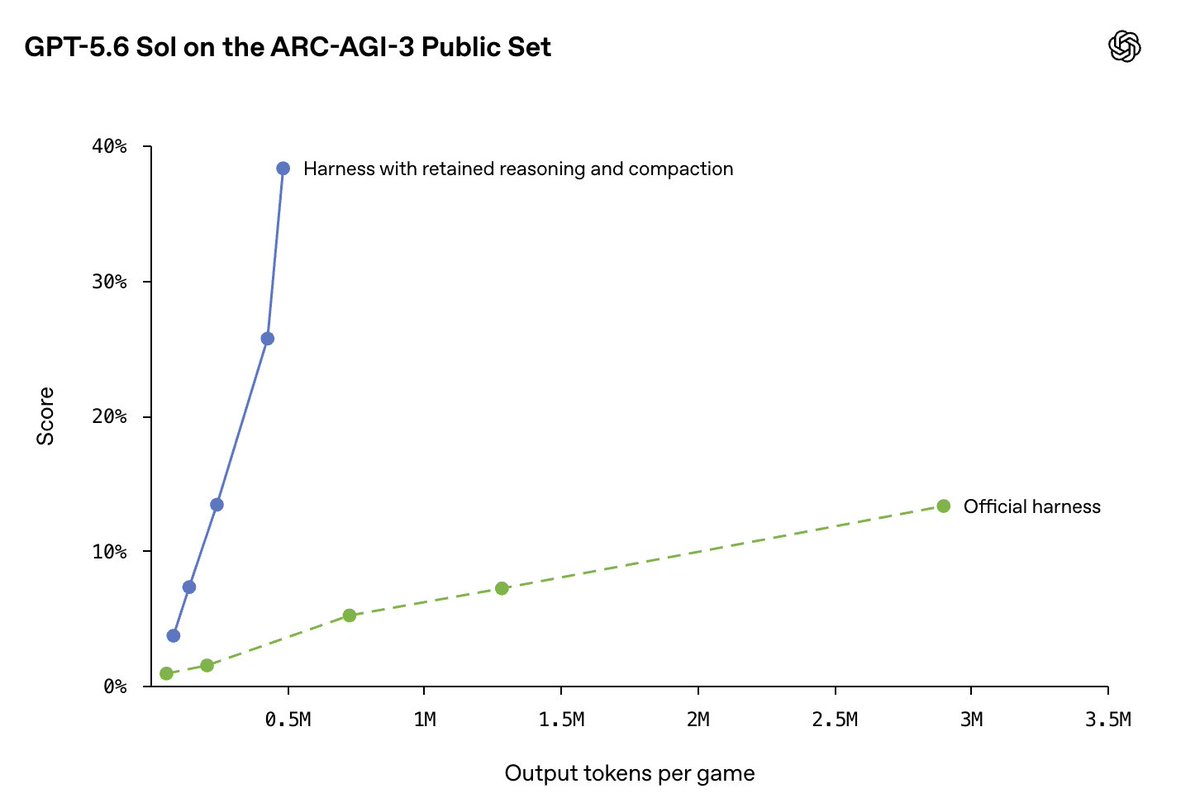
Turns out GPT-5.6 Sol is actually SoTA on ARC-AGI-3.
Just took two setting changes. You just have to allow it to reason and work over multiple context windows with the help of our canonical compaction implementation.
https://t.co/wHjaNsvIv8
@SuryaGanguli Like learning from AlphaGo moves, but for math! Hopefully the same with other sciences. A modern form of "shut up and calculate", in which we get solutions first and understand in hindsight.
I solved 6 open Erdős problems in 5 days, using @OpenAI GPT-5.6 Sol.
I have a math background, but the Codex workflow I used does not require deep mathematical knowledge.
Here’s exactly how I approached it, including my prompts 🧵
VLMは人間のような創造性を持てるか?
ケネス・スタンレー教授らの『目標という幻想(Why Greatness Cannot Be Planned)』は、明確な目標を設定することが、かえって真に偉大な発見を遠ざけてしまうという逆説を論じた書籍です。その議論の中核にあったのが「PicBreeder」の実験でした。
PicBreeder では、ユーザーが「面白い」と感じた画像を選び、それを少しずつ進化させていきます。事前に決められたゴールはなく、人々が「なんとなく良い」と思ったものを選び続けるだけで、顔や動物、乗り物、頭蓋骨といった予期しない形が、何世代もかけて、多くの人の手を経て自然と現れます。スタンレー教授らは、こうした「オープンエンド」、つまり目標をあらかじめ定めない探索こそが人間の創造性の根幹にあると考えたのです。
では、このオープンエンドな探索を、AIは再現できるのでしょうか。
MIT・NYUとの共同研究として発表する「In Search of the Ingredients of Open-Endedness: Replicating Picbreeder with Large Vision-Language Models」では、視覚言語モデル(VLM)エージェントによる再現を試みました。エージェントたちは共有アーカイブを探索し、画像を選んで進化させ、気に入ったものを公開し、他のエージェントの作品を評価します。目標となる画像も「進歩」の定義も与えられていません。
その結果、AIによるオープンエンドな発見の可能性と限界の両方が浮かび上がりました。VLMエージェントは特定の見た目や意味に引き寄せられやすく、既存のアイデアを捨てて予期せぬ何かを探すよりも、手元にあるものを洗練させることに留まりがちでした。一方で、多様な人格を持つエージェント集団を導入すると探索は大きく改善され、生成されたアーカイブの意味的な幅広さは、人間が作ったアーカイブに迫る水準にまで達しました。
しかし、VLMでは届かなかった点もありました。人間は、偶然の産物を持続的な創造へとつなげることに長けています。あるものを見つけたとき、その価値を感じ取り、それを追いかけることで、より大きな概念的飛躍を達成できます。AIエージェントも興味深いパターンに気づくことはできても、そのパターンに囚われてしまう傾向がみられました。
なぜ人間は、本研究のVLMにはできなかったオープンエンドな探索を進められるのか。現在のAIシステムに何が欠けているのか。私たちはまだ十分に理解できていません。ここには、当社が探求するAI駆動型科学研究にも通じる大きな問いが残っています。Sakana AIは今後も、オープンエンドな知性の探求を深めていきます。
ブログ:https://t.co/qsMwcB3N5D
論文:https://t.co/QnxVWLzjez 🐟
More test-time compute leads to greater intelligence. But as we push ttc from seconds to weeks, latency becomes a bottleneck.
GPT-5.6 Sol Ultra scales parallel ttc. The time taken to generate a proof to a 50-year-old problem drops from perhaps a whole day to a single hour.
Neural CAs are amazing, but they've never scaled past low resolution.
We propose a simple solution that allows an ~8x resolution boost with minimal extra parameters.
The core idea: Treat cells as local neural fields instead of pixels.
Try the demo: https://t.co/Nnq8VFOGbB
🧵
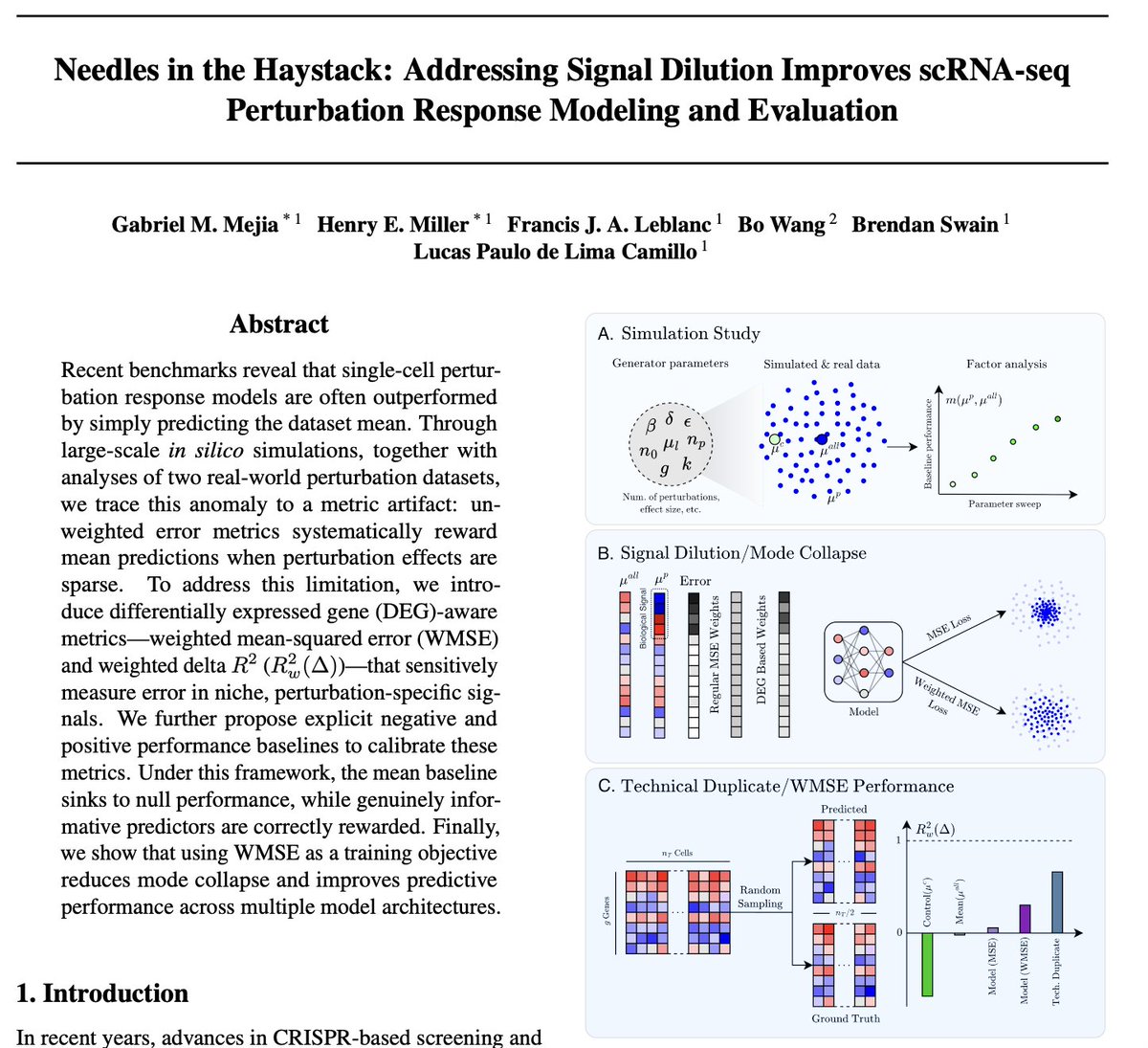
If you are at #ICML2026, check out our paper “Needles in the Haystack”!
Our paper tries to address an uncomfortable finding in the field of "virtual cells": predicting the mean outperforms many scFMs such as GEARS, scGPT, scLambda on standard perturbation benchmarks. No learning required.
Not because the models are bad. Because the benchmarks are wrong.
Here's the root cause: a genetic perturbation changes ~20-50 genes out of ~20,000. Standard MSE weights every gene equally. So you're scoring models on 19,980 noise genes for every 20 signal genes. The mean predictor wins by capturing systematic shifts shared across all perturbations, ie, not the actual perturbation-specific response. Mode collapse dressed up as performance.
The fix is conceptually simple: weight the error toward differentially expressed genes. We call it WMSE. Under WMSE, the mean baseline collapses to null performance, as it should. Models that were supposedly underperforming turn out to actually learn something real. You just couldn't see it with the wrong ruler.
We also introduce calibrated baselines including a "positive" baseline : predict half a perturbation's cells from the other half. That gives you a realistic ceiling based on the dataset's intrinsic noise floor. Now you know what good actually looks like.
The broader point: measurement is upstream of modeling. Every benchmark paper, every foundation model comparison in perturbation biology, is potentially scoring on the wrong thing. We need to fix the ruler before we argue about the model.
"Needles in the Haystack" — paper: https://t.co/GXpraMFnWV | code: https://t.co/gimh9CYXpO
Congrats to first authors Henry and Gabriel, and co-authors Francis, @BrendanMSwain, @lucascamillomd 🙏
Excited to share our paper, “Learning Multi-Agent Coordination via Sheaf-ADMM” to be presented at #ICML2026
Blog: https://t.co/F5CVepgivO
Most AI models process information as one giant, monolithic block. But in nature, intelligence often comes from a group of individuals working together, where each individual only has a limited view of the world.
We built a framework called Sheaf-ADMM to study how this kind of collective problem-solving works. We divide a complex task into smaller overlapping pieces, and assign one agent to each piece.
To solve the global puzzle, the agents negotiate in three simple steps:
1. Local Guesses: Every agent looks at its limited view and proposes a solution.
2. Finding Common Ground: Agents communicate with their direct neighbors to smooth out conflicts. They do not need to agree on everything, but they must agree on the boundaries where their tasks overlap.
3. Remembering Disagreements: If neighbors cannot agree, they keep a memory of that conflict. This memory forces them to try harder to compromise in the next round.
We tested this on problems where no single agent has enough information to succeed alone:
• Multi-Agent Sudoku: Each agent sees only a single row, column, or 3x3 box. The framework achieved a 93% solve rate, while a parameter-matched message-passing baseline scored 11%.
• Image Classification: When we tested canvas-size domain shifts, a standard CNN dropped to 11% accuracy on MNIST, while our method retained 86%.
• Maze Pathfinding: Sheaf-ADMM matches a message-passing baseline’s accuracy while agents communicate over a 5-dimensional channel, 8x smaller than that required of the baseline (42).
Traditional message-passing networks hide their reasoning inside opaque hidden states. Our framework makes coordination completely transparent. You can watch exactly how local agents debate, compromise, and eventually reach a global consensus.
Sheaf-ADMM draws inspiration from two fields with long histories in distributed consensus: ADMM from distributed optimization, and sheaves from applied topology. We think these perspectives may offer insights for the distributed, multi-agent AI systems increasingly being built today.
Read our full paper: https://t.co/RoOHfekjQE
Code: https://t.co/KDKZRcbuQH
Software and hardware achieved escape velocity when hobbyists could build prototypes in their garages and then use them to launch revolutionary new companies. It's much harder to do this for fields like biotechnology and drug discovery, but we have never been closer to it than we are now because of the nexus of AI + automation + cheap used infrastructure + community science. DIY biology has a bright future.
@curiouswavefn many years ago, i ta'd a really interesting physics course focused on watching movies for broken physics. the non-stem students would answer fermi problems derived from the movie intended to estimate different quantities + uncertainty analysis.
speed 1 would've been a good pick!
Arguably the most boring step in genomics is the first one: normalization. Settled science. Scale + log. Move on.
Except that here's been a huge blind spot in the field. And it matters for AIxBio. A 🧵about what I think may be one of the most important papers I've written. 1/
For over a decade, we’ve accepted that end-to-end backprop is the only way to train deep networks. But holding the entire network in memory all at once is why AI training is hitting a resource wall.
We found a new way to break the network into blocks and train them independently. The trick? Treating the network’s forward pass like a diffusion model denoising a signal.
This reinterpretation slashes the memory needed to train deep models. In our #ICLR2026 paper (https://t.co/PK5h0mqQSo), we matched end-to-end performance across ViTs, DiTs, and LLMs. We did this while training just one isolated block at a time.
Most researchers agree that autoregression is best when memory bandwidth is cheap and diffusion is best when FLOPS are cheap. They also admit the future of compute is all FLOPS because memory scaling is hard and scaling FLOPS is easy. So why not go all in on diffusion????
A fascinating paper supervised by Yoshua Bengio 👀
"Generative Recursive Reasoning"
Test time compute should scale not just by thinking deeper, but by thinking wider.
This paper makes recursion generative. It samples many latent reasoning trajectories, letting the model explore multiple hypotheses in parallel, so they don't follow one deterministic path and collapse to one answer.
It improves Sudoku, ARC AGI, N Queens, and graph coloring, while also generating valid Sudoku boards and MNIST digits from scratch.
Today, we share a breakthrough on the planar unit distance problem, a famous open question first posed by Paul Erdős in 1946.
For nearly 80 years, mathematicians believed the best possible solutions looked roughly like square grids.
An OpenAI model has now disproved that belief, discovering an entirely new family of constructions that performs better.
This marks the first time AI has autonomously solved a prominent open problem central to a field of mathematics.
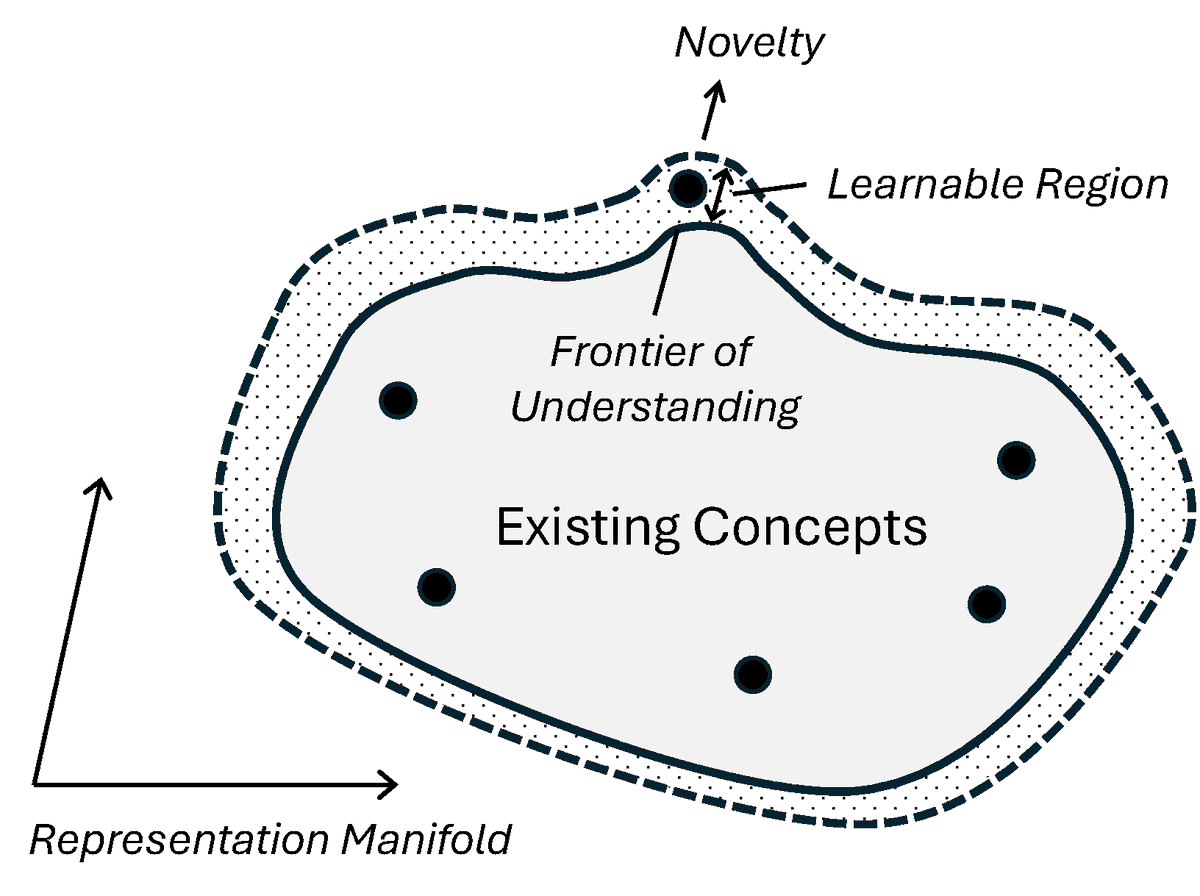
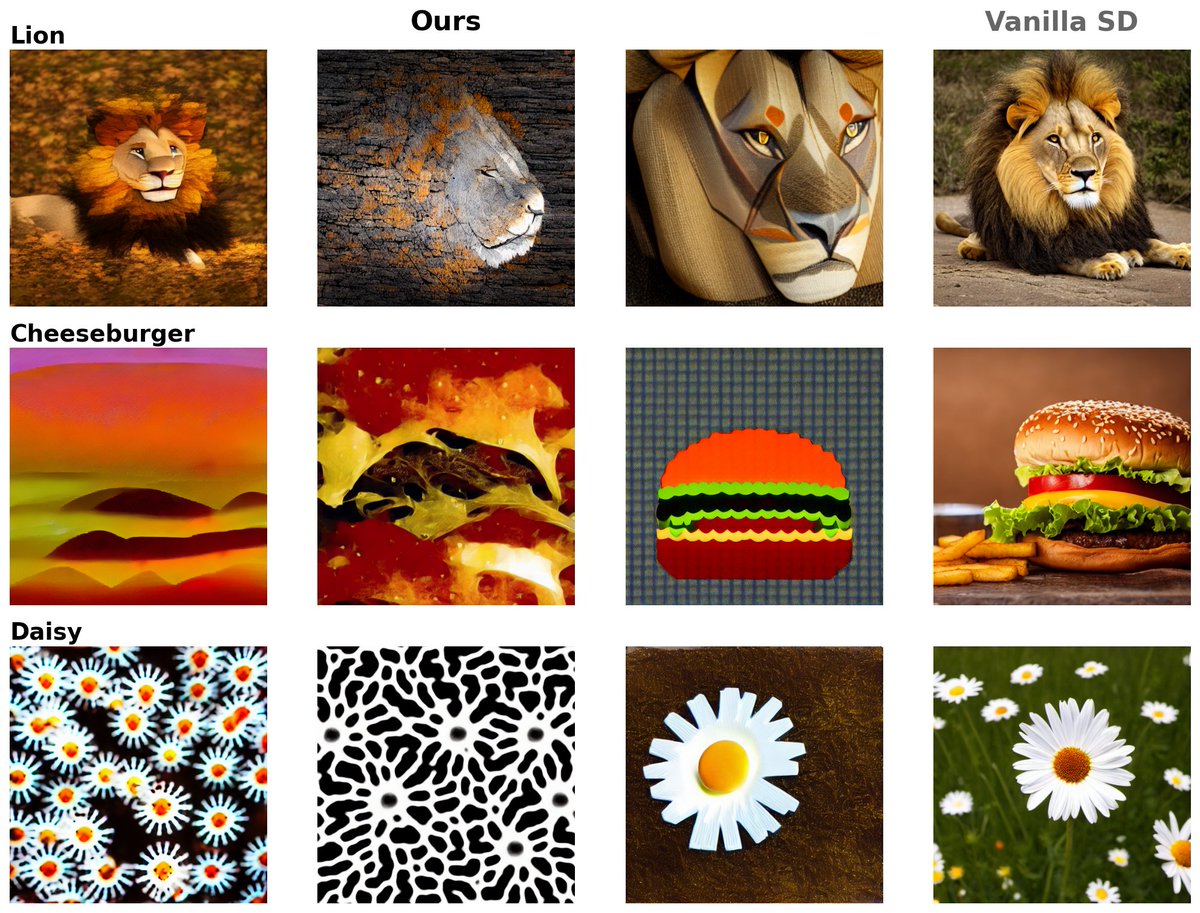
What does it mean to create a new concept rather than retrieve a familiar one?
I propose that creativity is what's unfamiliar at first but quickly learnable by an adaptive observer, and show that meta-learning through a frozen Diffusion model produces stylistic & conceptual creations.
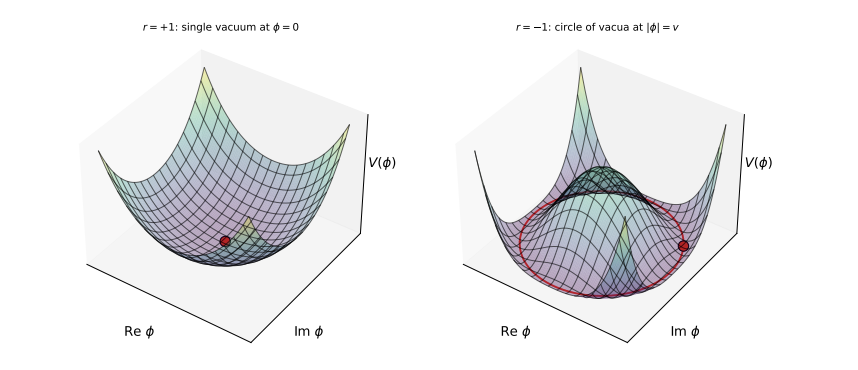
We have a new paper out on spontaneous symmetry breaking, Goldstone modes, and deep learning!
This is work with the amazing team of @t_andy_keller@YueSong48287250@takeru_miyato@wellingmax.
A brief thread on a marriage of physics and ML. (Link at end).
Introducing Flux Matching, a generative modeling paradigm that generalizes diffusion models to vector fields that need not be the score function.
Enables structural priors in the dynamics, faster sampling, interpretable generation, and more!
w/ @StefanoErmon@Xiaojie_Qiu 🧵⤵️