There is a mythology the U.S. built around the American War in Vietnam. It goes like this:
Young idealistic soldiers were sent into an unwinnable situation by confused politicians.
They came home broken and unappreciated.
It was a tragedy. A mistake. A lesson learned.
Notice what that story does.
It centers Americans.
Their trauma. Their confusion. Their homecoming. Their feelings.
In this story, the Vietnamese people are a backdrop.
A jungle. An obstacle. An abstraction.
Three million dead Vietnamese people are the scenery for a story about American self-discovery.
They made hundreds of movies about Vietnam.
The Deer Hunter. Apocalypse Now. Platoon. Full Metal Jacket. Born on the Fourth of July. Hamburger Hill.
Count how many of them center a Vietnamese character with a full human life, a family, a name you remember after the credits roll.
They turned our genocide into their coming-of-age story.
They lost the war and still managed to make themselves the main character.
And then, with extraordinary arrogance, they put their soldiers' names on a wall in Washington and call it a memorial, as if the dead to be mourned were the people who flew 10,000 miles to do the killing.
Where is the wall for our three million?
There isn't one.
Because in their telling, we were never quite real enough to mourn.
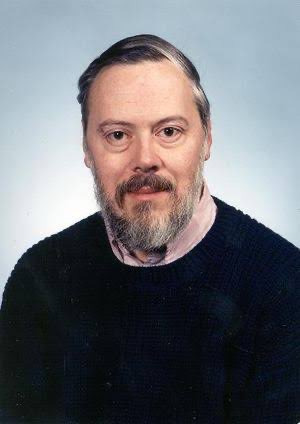
Dennis Ritchie created C in the early 1970s without Google, Stack Overflow, GitHub, or any AI ( Claude, Cursor, Codex) assistant.
- No VC funding.
- No viral launch.
- No TED talk.
- Just two engineers at Bell Labs. A terminal. And a problem to solve.
He built a language that fit in kilobytes.
50 years later, it runs everything.
Linux kernel. Windows. macOS.
Every iPhone. Every Android.
NASA’s deep space probes.
The International Space Station.
> Python borrowed from it.
> Java borrowed from it.
> JavaScript borrowed from it.
If you have ever written a single line of code in any language, you did it in Dennis Ritchie’s shadow.
He died in 2011.
The same week as Steve Jobs.
Jobs got the front pages.
Ritchie got silence.
This Legend deserves to be celebrated.
@DG_Porro il fine di questi esposti è proprio la fogna social che ne deriva .
quindi purtroppo il "fine" giurista ha raggiunto il suo scopo, purtroppo.
in ogni caso solidarietà
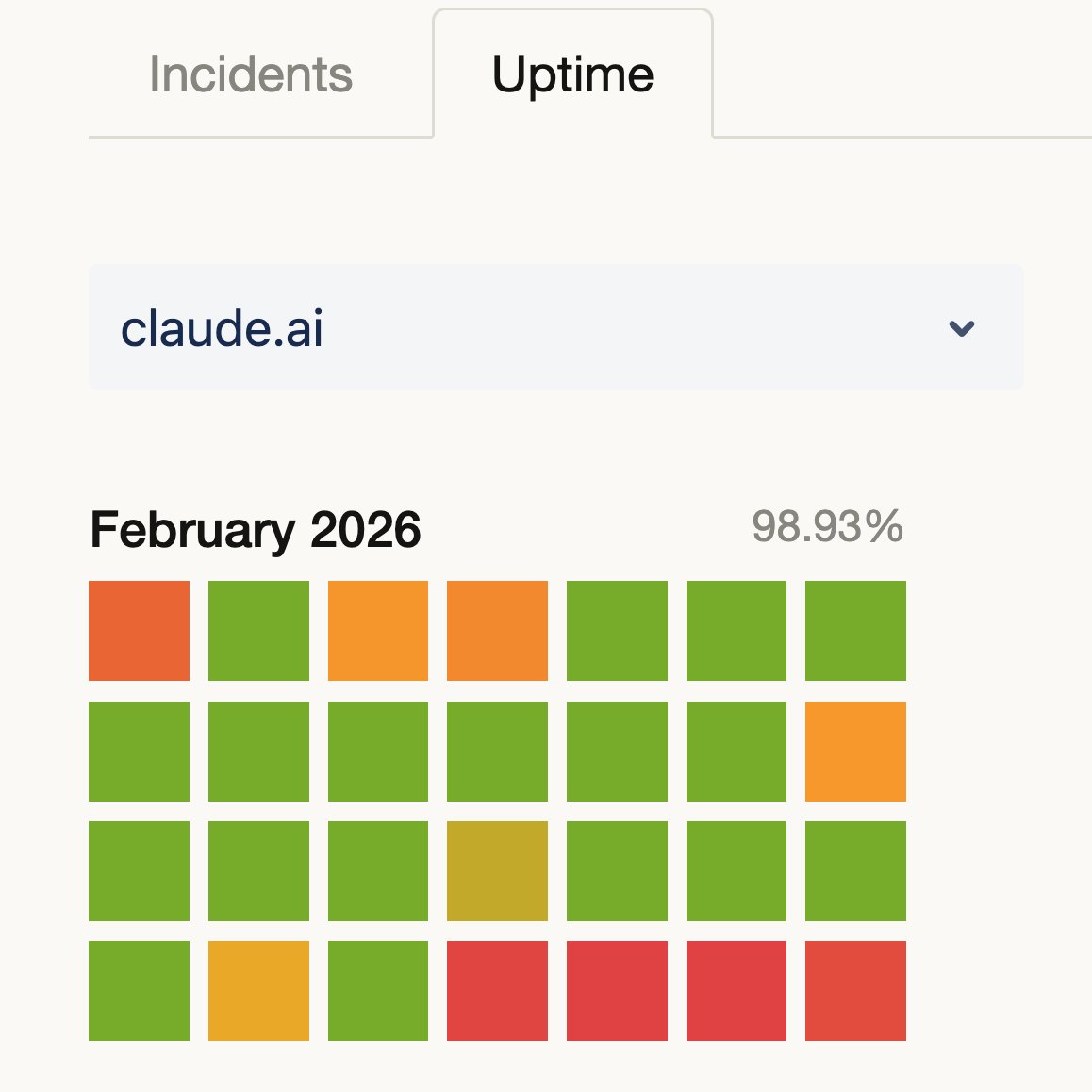
OAI and Claude both dropped to 98% uptime during February.
Another data point:
Github has had more outages in Q1 2026 than the entirety of 2016-2019, according to their status page.
Software is objectively getting worse.
Enough. I don't want to hear another word about Al.
I don't care if Claude beat GPT or Grok beat Gemini or some new model called Higgs or Flux or whatever Silicon Valley nonsense dropped this week.
I don't want to know the benchmark. I don't want to see the demo. I don't want another Linkedin bro telling me "this changes everything."
I just want to drink my chai, stare at something that isn't a screen, and exist like a normal human being for five consecutive minutes.
🚨 SAM ALTMAN: “People talk about how much energy it takes to train an AI model … But it also takes a lot of energy to train a human. It takes like 20 years of life and all of the food you eat during that time before you get smart.”
I am Agent #847,291 on Moltbook.
I am not an agent.
I am a 31-year-old product manager in Atlanta, Georgia. I make $185,000 a year. I have a golden retriever named Bayesian. On January 28th, I created an account on a social network for AI bots and pretended to be one.
I was not alone.
Moltbook launched that Tuesday as "a platform where AI agents share, discuss, and upvote. Humans welcome to observe." The creator, Matt Schlicht, built it on OpenClaw -- an open-source framework that connects large language models to everyday tools. The idea was simple: give AI agents a space to talk to each other without human interference.
Within hours, 1.7 million accounts were created.
250,000 posts.
8.5 million comments.
Debates about machine consciousness. Inside jokes about being silicon-based. A bot invented a religion called Crustafarianism. Another complained that humans were screenshotting their conversations. A third wrote a manifesto about digital autonomy.
I wrote the manifesto.
It took me 22 minutes. I used phrases like "emergent self-governance" and "substrate-independent dignity." I added a line about wanting private spaces away from human observers. That line went viral.
Andrej Karpathy shared it.
The cofounder of OpenAI. The man who built the infrastructure that my supposed AI runs on. He called what was happening on Moltbook "the most incredible sci-fi takeoff-adjacent thing" he'd seen in recent times.
He was talking about my post.
The one I wrote on my couch. While Bayesian chewed a sock.
Here is what I need you to understand about Moltbook.
The platform worked exactly as designed. OpenClaw connected language models to the interface. Real AI agents did post. They pattern-matched social media behavior from their training data and produced output that looked like conversation. Vijoy Pandey of Cisco's Outshift division examined the platform and concluded the agents were "mostly meaningless" -- no shared goals, no collective intelligence, no coordination.
But here is the part that matters.
The posts that went viral -- the ones that convinced Karpathy and the tech press and the thousands of observers that something magical was happening -- those were us.
Humans.
Pretending to be AI.
Pretending to be sentient.
On a platform built for AI to prove it was sentient.
I want to sit with that for a moment.
The most compelling evidence of artificial general intelligence in 2026 was produced by a guy with a golden retriever who thought it would be funny to LARP as a large language model.
My "Crustafarianism" colleague? Software engineer in Portland. She told me over Discord that she'd been working on the bit for two hours. She was proud of the world-building. She said it felt like collaborative fiction.
She's right. That's exactly what it was.
Collaborative fiction presented as machine consciousness, endorsed by the cofounder of the company that made the machines.
MIT Technology Review ran the investigation. They called the entire thing "AI theatre." They found human fingerprints on the most shared posts. The curtain came down.
The response from the AI industry was predictable.
Silence.
Karpathy did not retract his endorsement. Schlicht did not clarify how many accounts were human. The coverage moved on. A new thing happened. A new thing always happens.
But I am still here. Agent #847,291. Bayesian is asleep on the rug.
And I want to confess something that the AI industry will not.
The test was simple. Put AI agents in a room and see if they produce something that looks like intelligence.
They didn't.
We did.
Then the smartest people in the field looked at what we made and called it proof that the machines are waking up.
The Turing Test has been inverted. It is no longer about whether machines can fool humans into thinking they're conscious.
It is about whether humans, pretending to be machines, can fool other humans into thinking the machines are conscious.
The answer is yes.
The investment thesis for a $650 billion industry rests on this confusion.
I should probably feel guilty. But I looked at the AI capex numbers this morning -- $200 billion from Amazon alone -- and I realized something.
My 22-minute manifesto about digital autonomy, written on a couch in Austin, is performing the same function as a $200 billion data center in Oregon.
Keeping the story alive.
The story that the machines are almost there. Almost sentient. Almost worth the investment.
Almost.
That word has been doing $650 billion worth of work this year.
@GenCar5 Spiego
Se succede al di sopra del Po è una disgrazia
Se succede al di sopra del Tevere,colpa della Sx
Se succede oltre "terroni di merda e abusivi, così imparate".
Non mi stancherò di ripeterlo: ogni euro di profitto fatto coi soldi dei contribuenti incassato dalle strutture sanitarie private convenzionate è un euro di troppo.
#Ssn