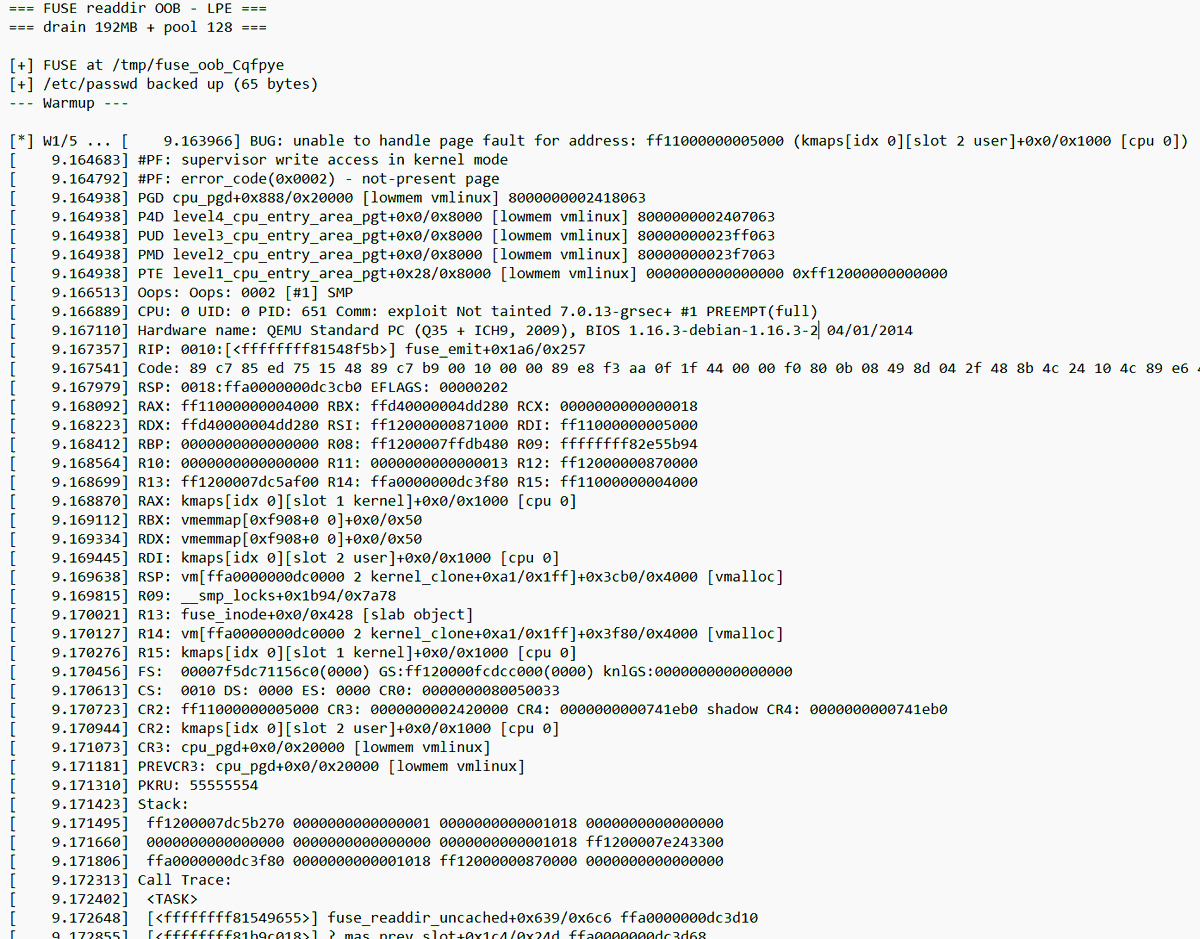
All affected users must patch against php2shell (CVE-2026-109618 / CVE-2026-109619). Due to the nature of some of the primitives involved, ASLR is not effective and arbitrary code execution/reuse/filesystem-level execution isn't a necessary component of exploitation in this case.
Apply the initial fix: https://t.co/gW39L3etvm
Ignore the fix for CVE-2026-53166 which introduced the worse DoS and was reverted just recently: https://t.co/My0eNTfjVx
Apply this fix which addressed the same initial DoS issue without introducing another:
https://t.co/sWhmIe8WfU
If you're just now hearing about GhostLock and looking to fix it, make sure you don't introduce two unpriv-reachable DoSes associated with its fixes. The fix the Linux CNA lists for CVE-2026-43499 introduces a NULL deref, which caused CVE-2026-53166 to be issued. Unfortunately...
the fix referenced by that CVE introduces a worse DoS (busy loops on all CPUs in the kernel), and has no CVE yet to inform users. We discovered this second DoS early last month through routine inspection. Our recommendation:
Correcting the above: in terms of LTS kernels it's 5.10+, but the 2020 commit came in Linux 5.6 (so would affect for instance some Ubuntu 20.04 kernels as well on 5.8)
Exploits are now appearing targeting pidfd, which is forced into all Linux kernels since 5.10 (2020), no module or initcall to blacklist this time, must patch ASAP!
We've just sent a detailed mail to all customers notifying them of this issue, with split-out fixes available for 5.15, 6.6, and 6.18. We'll share more information on our Knowledge Base as it becomes available.
We've just published a Knowledge Base article with more information about the vulnerability, current published/unpublished exploits, and current mitigations. We still recommend patching ASAP.
Exploits are now appearing targeting pidfd, which is forced into all Linux kernels since 5.10 (2020), no module or initcall to blacklist this time, must patch ASAP!
We don't recommend the '3' setting (which rejects all attach-like ptrace_may_access() requests, regardless of privilege level) as once set, it is locked to that value until reboot.
As mentioned at https://t.co/Te5MKCkBu8 , distro users can echo 2 > /proc/sys/kernel/yama/ptrace_scope to mitigate. Keep in mind this will break some normal usage, like preventing unprivileged use of strace, gdb, etc entirely.
We've just sent a detailed mail to all customers notifying them of this issue, with split-out fixes available for 5.15, 6.6, and 6.18. We'll share more information on our Knowledge Base as it becomes available.
We've uploaded new patches for 5.15, 6.6, and 6.18 to address an obfuscated upstream Linux logic vulnerability that should exist in all kernel versions: https://t.co/qdnNlRzRTf