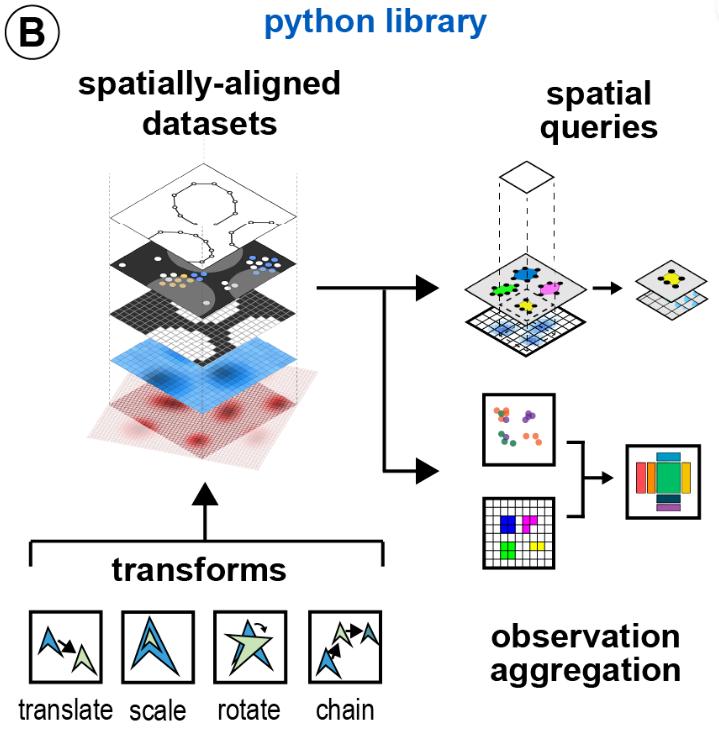
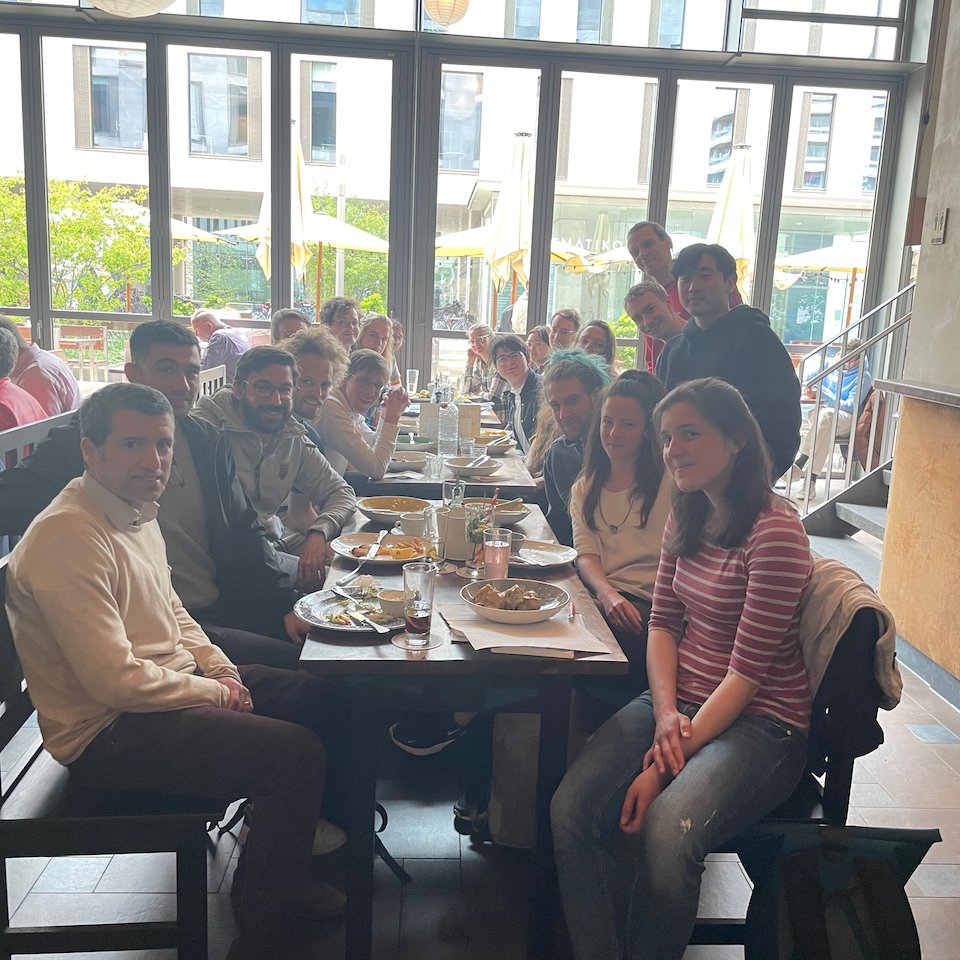
Felix Petschko presented our v0.18 release of scirpy at the @scverse_team conference today:
- 16x speedup of hamming distance
- 120x speedup of clonotype clustering
- 100x speedup by adding tcdist3 metric compared to previous alignment metric
https://t.co/DFHV92C0ql
@saezlab @NAR_Open Thanks for performing this benchmark! As far as I can tell all the tested approaches require to perform DE first. Do you also have insights on how it would perform if you run decoupler first (e.g. on logTPM) and then compare the decoupler scores between conditions?
On top of that it can be parallelized on multiple machines using dask. More performance upgrades are on the way. Thanks to Tobias Ganzenhuber and Felix Petschko for working on this!
We released scirpy v0.15 with a focus on performance improvements. "alignment" distance to find similar clonotypes is now 2-3x faster by default. Additionally there's an (approximate) "fastalignment" metric that is up to 20x faster.
https://t.co/0lNWTFqOZA
For anyone who is working with Personalis data: We made an R package that automates loading the data into a MultiAssayExperiment: https://t.co/PLY882tQTa
Ever wondered what the equivalent of differential gene expression is for cell-cell communication ?
Look no further...it's MultiNicheNet, the first statistically sound framework for multi-sample multi-condition comparison of intercellular communication
👉https://t.co/fsmUXvEW2m
Along the way we added awkward array support in AnnData. What was developed for particle physics turns out to be quite useful in Biology.
Big thanks to @JimPivarski and @agoose77 for their support!
https://t.co/CifVb1BGd5
We just released scirpy v0.13 together with a new specification on how to store receptor chains in AnnData. We hope others find this useful for creating interoperable ecosystem packages (1/5).
https://t.co/vCVTCkNMTs
Today our Human Lung Cell Atlas (HLCA) paper came out in Nature Medicine https://t.co/PAb5zP53p5! The HLCA includes 2.4M cells from 486 individuals and 49 datasets. Check out this tweetorial to learn more about how we built it, and how you can use it (1/21)
The #OpenSource project @scverse_team is now part of NumFOCUS as a sponsored project! Join us in welcoming them and helping advance open science initiatives.
Learn more about the project here: https://t.co/xoX44Em094!
#OpenScience#DataScience#AI
Tonight at 18:00 CEST @g_palla1 will present SpatialData, our new data structure for experiments with spatial resolution! Join our community meeting if you are interested!
More details + zoom link: https://t.co/aufQkoBvDN
Reminder: scverse community meeting about Genomic Ranges support tomorrow.
We start with a short intro to the BiocPy GenomicRanges implementation by @jayaram.
more details: https://t.co/aufQkoBvDN
Follow-up meeting on Genomic Ranges support for AnnData!
Join our next community meeting (2023-05-16 18:00 CEST) if you are interested.
Joining info: https://t.co/aufQkoBvDN
Had a great time! Thanks to organizers and attendees!
I'd especially like to thank @Bioconductor's @wolfgangkhuber, @grimbough, and Martin Morgan for coming out. It's fantastic to work on interoperability with you, and looking forward to doing more in the future!
Many exciting things – and intense coding – at the scverse hackathon this week hosted by @OliverStegle and @saezlab in Heidelberg!
Our focus was on interoperability across languages and knowledgebases. Read on to see what we made! 1/n
Getting started with the @scverse_team hackaton 🧑💻 we co-host with @OliverStegle 's lab, with focus on interoperability and knowledge integration - we hope to contribute to the later with @omnipathdb and @BioCypherPy. Thanks @DanielBDimitrov and @gtcaa for organizing it!
In this single-cell study, we compare immune-cell profiles before and after machine perfusion of transplant livers. Once again using BD Rhapsody, we took a closer look at Neutrophils.
Check out @SalcherStefan's thread for more details 👇
🎉 Exciting news! Our latest publication "Immune cell dynamics deconvoluted by single-cell RNA sequencing in normothermic machine perfusion of the liver" is out in @NatureComms!
#livertransplant#scRNAseq @imed_tweets
https://t.co/yDzCrykeha