It's a new scam by @jncasr
An intern has to pay 5k to just secure the position, then have for pay hostel/mess. At the end, will dedicate 9am to 10pm free labour in the name of science. It's inhumane, pathetic and a serious violation of human rights.
Shame on you.
#MOE
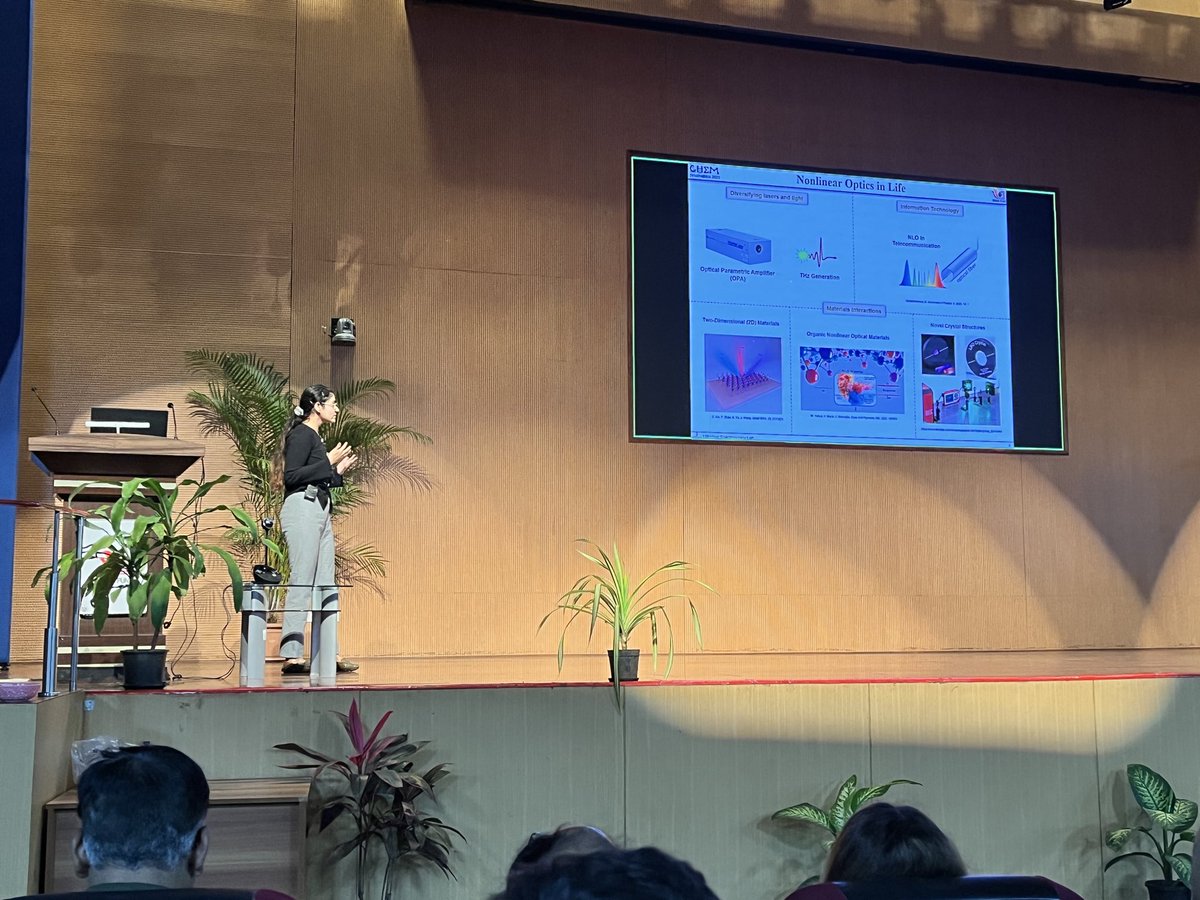
Thrilled to have been a part of Chemsymphoria, our in-house symposium! A heartfelt thank you to the amazing Chemphilic team for giving me the opportunity to share my work with such an inspiring scientific community. @IISERPune@ChemistryIISERP
Evolution of Deep Learning by Hand ✍️ As my tribute to Geoff Hinton's Nobel Prize, I drew this animation to illustrate the key idea behind Hinton's major contributions to deep learning over the years, with artistic liberty.
----
100% original, made by hand ✍️
Join 40k readers of my newsletter: https://t.co/fFt8roc8D9
BIG ANNOUNCEMENT📣: I haven’t been this excited to be part of something new in 15 years… Thrilled to reveal the passion project I’ve been working on for the past year and a half!🙀🥳 It started from my frustration with the depressing effect that the current publishing system has on the well-being of myself, my team, and pretty much every scientist I know (maybe you’ve noticed from my stupid jokes… :) I was exhausted of dealing with the huge delays, reviewers that can be abusive, and how arbitrary it all is. Unfortunately, the most important factors are often WHO your reviewers are and who YOU are... It’s clear we need alternatives or at least ways to improve the situation. So, together with a really special and talented team we worked to develop this idea into “qed” a platform where you can get CONSTRUCTIVE feedback on your own work or CRITICALLY assess other people’s papers. It can be a real difference maker if many of you join us (thousands have tried it already, but today we release a NEW and much stronger version ;) Let’s harness qed to put the power back in the scientists’ hands, to do, to read & to publish science on our own terms. I’m dying for you to TRY IT, and it’s very simple - just drop a paper (the link to the website is in the replies👇) - it’s completely secure, private, and free, and you get results fast. Please show your support, SHARE, tell your friends, and let’s be the revolution 🫵!
Introducing NotebookLM for arXiv papers 🚀
Transform dense AI research into an engaging conversation
With context across thousands of related papers, it captures motivations, draws connections to SOTA, and explains key insights like a professor who's read the entire field
Potassium isn’t just another mineral; it’s the body’s electrical currency.
Understanding potassium balance why It matters for every cell:
Potassium (K⁺) is one of the body’s most critical electrolytes. It drives nerve impulses, muscle contractions, and heart rhythm stability.
Even small shifts, too high (hyperkalemia) or too low (hypokalemia), can have major physiological effects.
Here’s how it works 👇
1️⃣ Where Potassium Lives
About 98% of potassium is stored inside cells, while only 2% circulates in the blood.
This delicate balance is maintained by the sodium–potassium pump (Na⁺/K⁺-ATPase), constantly exchanging Na⁺ for K⁺ across cell membranes.
🟢 Think of it as the electrical wiring that keeps your heart and muscles firing properly.
2️⃣ What Regulates Potassium
Three main systems control potassium balance:
Kidneys: Excrete excess K⁺ under the influence of aldosterone.
Insulin: Moves K⁺ into cells after meals to prevent spikes.
Epinephrine: During stress or exercise, shifts K⁺ into cells to prevent dangerous elevations.
🟢 Example: After a workout, insulin and adrenaline work together to stabilize potassium levels.
3️⃣ When Potassium Is Too High (Hyperkalemia)
Potassium builds up in the blood when:
The kidneys can’t excrete it (e.g., kidney disease, low aldosterone).
Acidosis pushes K⁺ out of cells.
Tissue damage (burns, trauma) releases stored K⁺.
🟢 Result: Overexcited cells, erratic heart rhythm, and, in severe cases, cardiac arrest.
4️⃣ When Potassium Is Too Low (Hypokalemia)
Potassium drops when it’s lost or driven into cells:
Losses: Diuretics, vomiting, diarrhea.
Shifts: High insulin or alkalosis (low blood acidity).
🟢 Result: Fatigue, muscle cramps, and heart rhythm irregularities, often seen in patients using loop or thiazide diuretics.
5️⃣ How Potassium Affects the Heart
Potassium determines how quickly heart cells reset between beats:
High K⁺: Speeds up repolarization → shortened ECG segments, risk of arrhythmia.
Low K⁺: Delays repolarization → “U waves” on ECG and reduced cardiac output.
🟢 Both extremes can be life-threatening — that’s why cardiac patients’ potassium is tightly monitored.
6️⃣ Why Balance Is Everything
Potassium balance reflects kidney function, hormone regulation, and acid–base status.
Too little or too much disrupts the body’s electrical equilibrium, affecting the heart, nerves, and metabolism.
🟢 Example: Diets rich in potassium (bananas, spinach, sweet potatoes) support normal blood pressure and heart rhythm.
Maintaining balance through healthy kidneys, adequate diet, and careful medication management keeps every beat, movement, and thought running on schedule.
How does energy keep us alive?
Our bodies are resistive energetic circuits where electrons flow from food→oxygen in our mitochondria. It's only through energy resistance (éR) - like electrical resistance - that transformation of energy into life is possible.
The Energy Resistance Principle ⎸ ERP explains how this happens. In this paper, we cover the implications of fine-tuning éR for health, disease, aging, and the human experiences make up the mind.
https://t.co/gjVRvA5q9K
I love watching women tear apart the most powerful mightiest egocentric people by just plain words. ❤️
Revolutionary women who stand up for humanity across the world are the most beautiful ones❤️❤️
You can teach a Transformer to execute a simple algorithm if you provide the exact step by step algorithm during training via CoT tokens.
This is interesting, but the point of machine learning should be to *find* the algorithm during training, from input/output pairs only -- not just memorize an externally provided algorithm. Pretty trivial program synthesis techniques can achieve just that in the case of multiplication.
Because if you already have the algorithm, you can just write it down and execute it instead of training a Transformer to inefficiently encode it.
Using precise spatial and temporal analysis, researchers in Science provide insight into how bacteria around the root interact both with the plant and with each other.
Learn more in this week's issue: https://t.co/wXSBg9t3gY
Rest in peace Jane Goodall, a true giant among scientists. Your breakthroughs into the secret lives of chimpanzees viewed through an anthropomorphic lens – without yet knowing that science had forbidden it – changed science forever, and with it how we see ourselves.
biologists continue to mistake single-cell technical sampling noise for meaningful cellular heterogeneity. the apparent sparsity of single-cell data is due largely to technical artifacts like transcript capture and sequencing depth--if there are hundreds of thousands of transcripts per cell but you sequence only 5-10k unique molecules, of course you get mostly zeroes in any given cell. pseudo-bulking makes this clear: when you aggregate these noisy single cell samples, the vast majority of the genome shows expression greater than zero
this is because the entire genome is being pervasively (yet stochastically) transcribed across nearly all cell types, including terminally differentiated cells (with a few obvious exceptions, e.g. enucleated red blood cells, spermatozoa, etc). hence you should expect to find at least one copy of nearly every transcript if you sample a single cell deeply enough over time
it is the *relative* or *ranked* differences in expression compared to this low-level baseline that dictate cellular identity and function
yet this pervasive transcription extends to retrotransposons, heterochromatin, and other supposedly "silenced" regions of the genome--all of which are systematically discarded in most standard processing pipelines. stare at the raw .fastq for long enough and this becomes obvious
thus, this pervasive genome-wide transcription has implications not only for how we train virtual cell models on single-cell RNA count data, but for our understanding of cellular biology as a whole: to truly plumb the depths of the cell, we must venture beyond the reference genome into transcriptional terra incognita, where we will encounter eldritch species of non-coding RNAs that may throw into question much of what we know about the biology of the cell
Last week, China barred its major tech companies from buying Nvidia chips. This move received only modest attention in the media, but has implications beyond what’s widely appreciated. Specifically, it signals that China has progressed sufficiently in semiconductors to break away from dependence on advanced chips designed in the U.S., the vast majority of which are manufactured in Taiwan. It also highlights the U.S. vulnerability to possible disruptions in Taiwan at a moment when China is becoming less vulnerable.
After the U.S. started restricting AI chip sales to China, China dramatically ramped up its semiconductor research and investment to move toward self-sufficiency. These efforts are starting to bear fruit, and China’s willingness to cut off Nvidia is a strong sign of its faith in its domestic capabilities. For example, the new DeepSeek-R1-Safe model was trained on 1000 Huawei Ascend chips. While individual Ascend chips are significantly less powerful than individual Nvidia or AMD chips, Huawei’s system-level design approach to orchestrating how a much larger number of chips work together seems to be paying off. For example, Huawei’s CloudMatrix 384 system of 384 chips aims to compete with Nvidia’s GB200, which uses 72 higher-capability chips.
Today, U.S. access to advanced semiconductors is heavily dependent on Taiwan’s TSMC, which manufactures the vast majority of the most advanced chips. Unfortunately, U.S. efforts to ramp up domestic semiconductor manufacturing have been slow. I am encouraged that one fab at the TSMC Arizona facility is now operating, but issues of workforce training, culture, licensing and permitting, and the supply chain are still being addressed, and there is still a long road ahead for the U.S. facility to be a viable substitute for manufacturing in Taiwan.
If China gains independence from Taiwan manufacturing significantly faster than the U.S., this would leave the U.S. much more vulnerable to possible disruptions in Taiwan, whether through natural disasters or man-made events. If manufacturing in Taiwan is disrupted for any reason and Chinese companies end up accounting for a large fraction of global semiconductor manufacturing capabilities, that would also help China gain tremendous geopolitical influence.
Despite occasional moments of heightened tensions and large-scale military exercises, Taiwan has been mostly peaceful since the 1960s. This peace has helped the people of Taiwan to prosper and allowed AI to make tremendous advances, built on top of chips made by TSMC. I hope we will find a path to maintaining peace for many decades more.
But hope is not a plan. In addition to working to ensure peace, practical work lies ahead to multi-source, build more chip fabs in more nations, and enhance the resilience of the semiconductor supply chain. Dependence on any single manufacturer invites shortages, price spikes, and stalled innovation the moment something goes sideways.
[Original text: https://t.co/5bdEpQcaob ]
I was on H1B too when I was a postdoc fellow at Harvard inventing spatial omics technologies. The US is about to lose its ability to attract a major chunk of the world’s top young talents in STEM innovations and hand over their strengths and competitiveness to other countries.