Sam Altman (CEO of Open AI):
"You no longer need to write prompts."
In just 38 minutes, he explains how to use ChatGpt at a level that most people can't even imagine.
It's talk he gave to stanford students. A friend sent me the recording last night.
After watching it, I realized I was only taking advantage of about 15% of what this tool can really do.
Watch it in full and then read the guide l leave below on how to create a system that prompts itself.
One friend of mine makes $1.2 million a year as an Anthropic engineer.
I asked him how he learned prompting so well. He sent me a video that was never supposed to get out. Their core team's prompting playbook.
You won’t find anything better about prompting than this 30 minutes video.
I watched it last night. Halfway through, I realized I've been using Claude completely wrong for two years.
Watch it, then read the article below.
Sam Altman, CEO de OpenAI:
"Ya no hace falta escribir prompts."
En 38 minutos explica cómo usar ChatGPT a un nivel que la mayoría ni se imagina.
Es una charla que dio a estudiantes de Stanford. Un amigo me pasó la grabación anoche.
Cuando terminé de verla me di cuenta de que solo le estaba sacando como un 15% de lo que puede hacer.
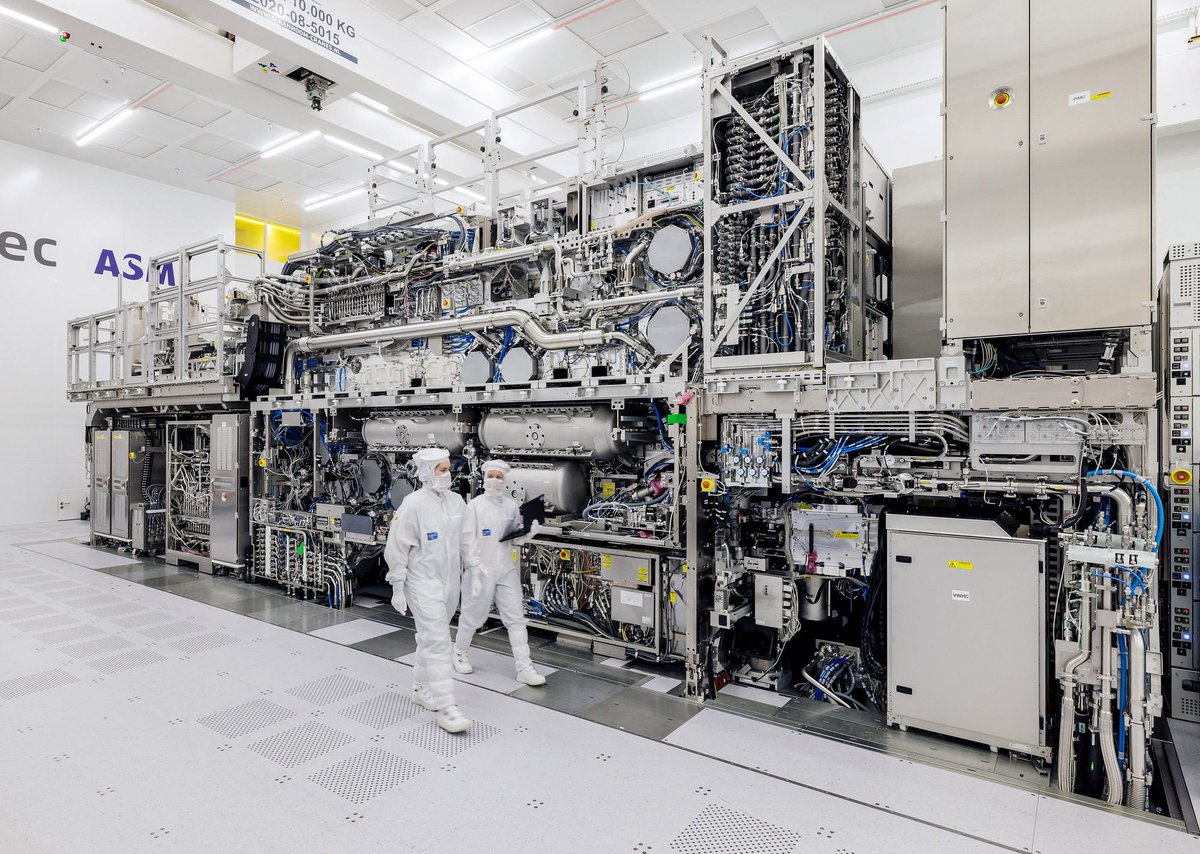
Netherlands is the reason we are able to use AI.
Not the U.S., Not China. Not even Nvidia.
One Dutch company controls the machines that create every AI chip on Earth.
Here's how this one company created a monopoly no one can break:
Goodbye ChatGPT
It’s only been 5 days since Deepseek R1 dropped, and the World is already blown away by its potential.
13 examples that will blow your mind (Don't miss the 5th one):
Visualizing gene structures in R? gggenes, an extension of ggplot2, simplifies the process of creating clear and informative gene diagrams, making genomic data easier to interpret and share.
✔️ Plot gene arrows to represent gene locations and orientations.
✔️ Visualize genomic features, including transcripts and operons.
✔️ Customize labels, colors, and layouts for clear presentations.
Whether you're working on genome annotation, comparative genomics, or molecular biology research, gggenes provides a flexible and user-friendly way to display complex gene structures with clarity.
The visualization shown here is taken from the package website: https://t.co/nutneLhvby
For a deeper dive into creating impactful visualizations with ggplot2 and its extensions, don’t miss my online course "Data Visualization in R Using ggplot2 & Friends!" Click this link for detailed information: https://t.co/ztlEzoEDWv
#RStats #Rpackage #DataAnalytics #ggplot2 #datastructure #DataViz
CURSO: Herramientas Bioinformáticas para el análisis de estructura, desorden e interacciones de proteínas (EByN-UNSAM)
📢ABIERTA LA INSCRIPCIÓN! Se agradece RT!
💻Modalidad: Virtual
🗓️Incio de clases: Lunes 13/5
Duración: 2 semanas
➕Info: https://t.co/wH57pOi1FL
@unsamoficial
Here is updated information on the viral genomics of SARS-CoV-2 in the Lambayeque region, Peru, which is crucial to understanding the origins and dispersion of the virus and provides information on viral pathogenicity, transmission and epidemiology. https://t.co/yZuydlP10M
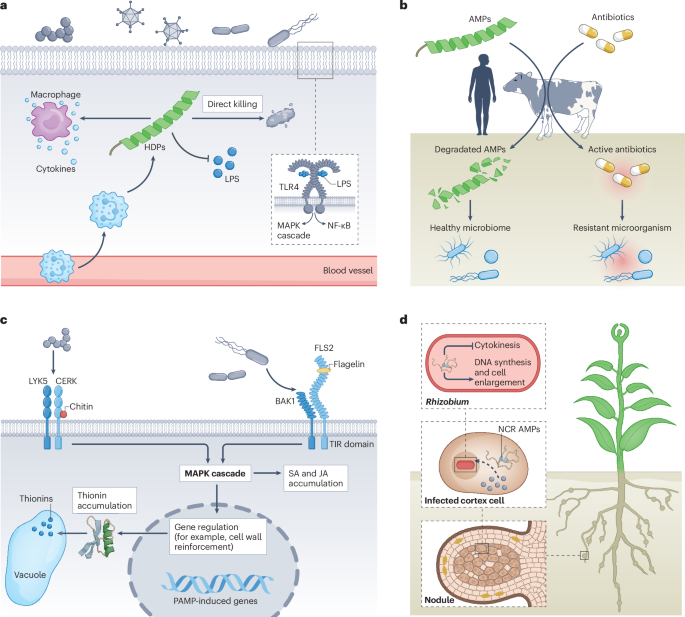
Researchers are using it to fight plastic pollution 🌐
Scientists are using it to tackle antibiotic resistance 🧪
Companies are using it to discover new medical drugs 💊
Two years since we released #AlphaFold, this is how the AI tool is transforming the world of science. ⬇️
Day 4 of synthetic biology papers.
“Chemical Synthesis of Poliovirus cDNA: Generation of Infectious Virus in the Absence of Natural Template” (2002)
“Refactoring bacteriophage T7” (2005)
The early days of genome synthesis. Why tweak organisms when you can build them anew?
***
It is fun to write these tweets, both because it forces me to sit down and type words every day, and because I get to revisit old papers. I think this second reason is especially important because it makes me realize how far we've come in some respects, and how little the field has moved in others.
Yesterday, I talked about early examples of synthetic gene circuits — the represillator and toggle switch. Both of those papers were published in Nature in early 2000. In just a few years, though, the field went from building little "toy circuits" to reimagining entire genomes.
***
In 1970, Har Ghobind Khorana, Marvin Caruthers, and others became the first to build an entire gene in a test tube. It encoded alanine transfer RNA, a molecule that carries alanine amino acids to the ribosome for protein synthesis. The gene was just 77 nucleotides in length, but it took several years to make. (https://t.co/aHNUuNjL0s)
Scaling this feat by 100x would take another three decades.
In 2002, researchers at SUNY in Stony Brook, New York, became the first to synthesize an entire poliovirus genome in a test tube. This viral genome is composed of 7,500 nucleotides, arranged as a single strand of RNA. (https://t.co/wIXrXWbzN8)
To create the virus, a DNA sequence encoding the full RNA genome was first made in a test tube by stitching together lots of short pieces of DNA. Synthetic DNA was next transcribed into RNA using an enzyme.
(Great essay from the lead author: https://t.co/ZXAMNQ7YBV)
The researchers then placed the viral genome into a cell-free extract — basically, the inner guts of cells — and watched it produce infectious poliovirus particles.
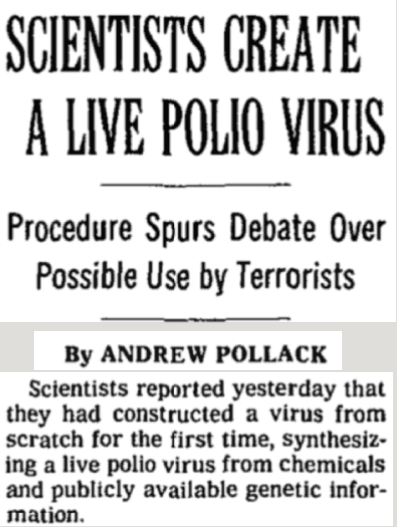
"POLIO VIRUS CREATED IN TEST TUBE," declared the Los Angeles Times in a news story that asserted "the grim prospect that bioterrorists could eventually create their own virulent diseases in test tubes." (See: https://t.co/po4mmtjhnL and Figure 1, from The New York Times.)
But was this achievement really so surprising? If you build a genome identical to one found in nature — atom-by-atom — then of course the thing is gonna boot up and start making viruses.
The real goal for synthetic biologists, of course, is not merely to recreate what already exists in nature, but to try and create something different; something better.
Early steps toward this grander ambition were first achieved in 2005, when a team of biologists at MIT replaced about half of the bacteriophage T7 genome — a type of virus that infects bacteria — with a modified, synthetic version. (https://t.co/0BMpV4VnGx)
The T7 genome is about 40,000 base pairs in length, and 11,515 of these bases were replaced with synthetic DNA. This was done for two reasons:
1. To prove that you can engineer genomes and still make a working virus, and..
2. To make bacteriophage T7 easier to work with.
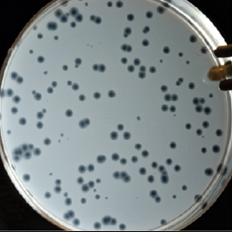
The synthetic DNA carried additional "cut" sites between each gene, which would make it easier to replace genes in bacteriophage T7 for future lab studies. These modified phages were still able to infect bacteria (see Figure 2).
A seminal moment in synthetic biology, this paper experimentally proved, for the first time, that "the genomes encoding natural biological systems can be systematically redesigned and built anew in service of scientific understanding or human intention."
Thanks for reading.