I believe we now have evidence of FIFA's World Cup ticketing shell game: FIFA is colluding with third-party resale platforms for its own supply management.
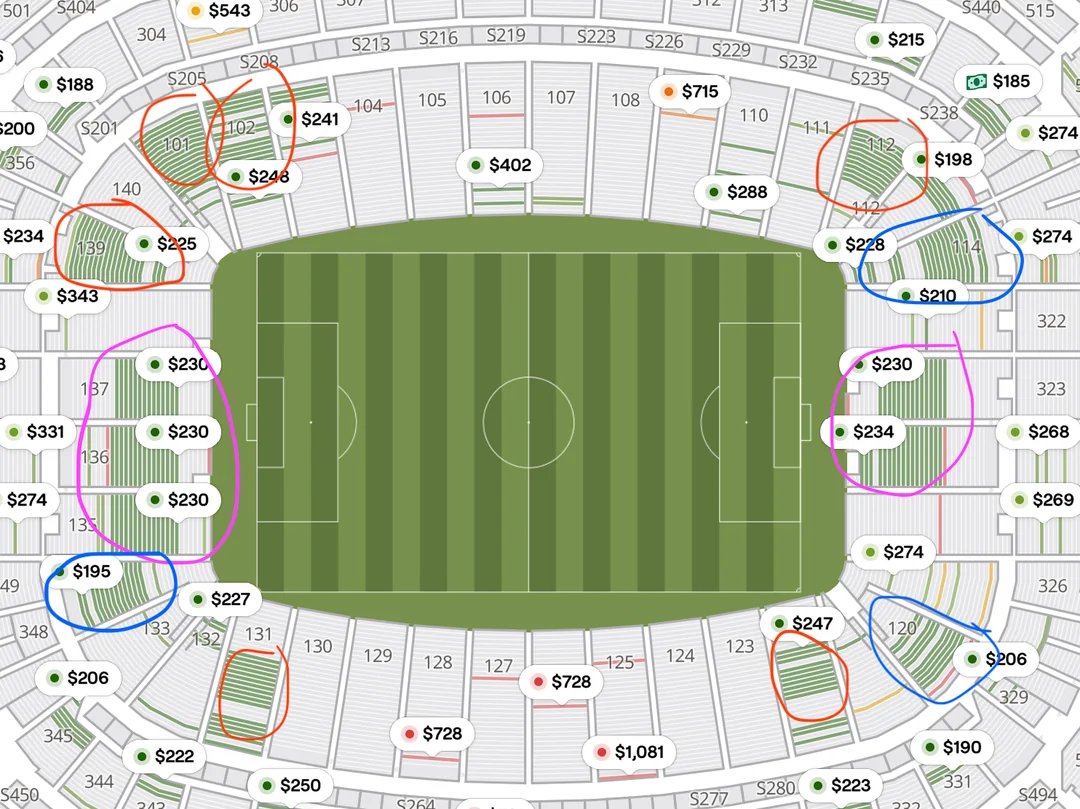
Look at this SeatGeek map (secondary market!) for Saudi Arabia vs Cape Verde. The circled areas are not random single resale tickets, but large, contiguous blocks of seats: entire rows and swaths in sections 101/102, 112/113, 119/120, 134–137, 139, ...
The blue circles appeared weeks ago, then the purple blocks suddenly showed up a day or two ago, and the red blocks seem to have appeared recently too.
That's not what ordinary fan or even commercial scalper resale looks like who resell pairs, fours, and scattered seats. Instead, this looks like inventory being dumped in bulk onto secondary markets, at prices below FIFA's official site.
Why doesn't FIFA just lower prices on its own site Probably because official price cuts could trigger refund demands, chargebacks, or consumer-protection headaches from fans who already bought at much higher prices.
Instead FIFA keeps official prices high, avoids openly admitting the market-clearing price is lower, and moves unsold inventory through third-party resale platforms instead.
Asking for robustness in ref reports wastes everyone's time and DOES NOT WORK.
Authors selectively respond to requests, interpret things differently, and still have many degrees of freedom. This is a stupid dance.
Robustness checks are only useful if done by 3rd parties. 2/
🚨 Public Good Alert 🚨
Two years of development. Zero funding. 𝟲,𝟲𝟵𝟯 𝗼𝗳𝗳𝗶𝗰𝗶𝗮𝗹 𝘀𝘁𝗮𝘁𝗲𝗺𝗲𝗻𝘁𝘀 𝗳𝗿𝗼𝗺 𝟱𝟭 𝗰𝗲𝗻𝘁𝗿𝗮𝗹 𝗯𝗮𝗻𝗸𝘀. #TextData
Today, we are opening the doors to it all for free 🚀
Visit our website: https://t.co/ToBke8Dxww
🧵1/12 #NLP
I put together a short practical guide for economists who want to use Claude Code, but who haven't gotten around to trying yet.
The goal is to reduce the start-up costs by using Claude Code within VS Code.
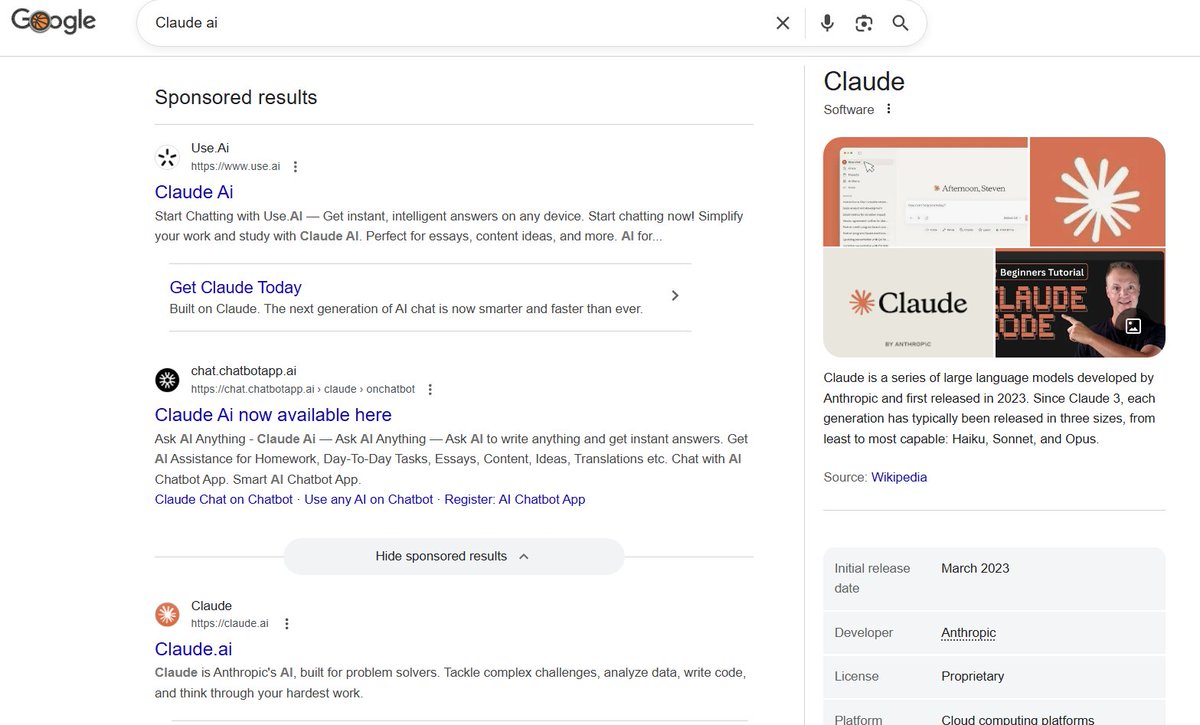
Here's a story on how easy fraud is today, from an example a friend got caught by. Search for "claude ai" on Google and Bing. The first sponsored results are fraudulent aggregators (more in a sec). On @bing, the "sponsored" tag is tiny and easy to miss (come on, guys!) 1/5
De olieprijs daalt al 14 dagen lang en staat ondertussen 27% onder zijn piek. De gasprijs daalt al 30 dagen lang en staat ondertussen 36% onder zijn piek.
Maar Bouchez' populisme piekt steeds hoger.
Exactly. Most people still view AI as a better calculator. But we are already transitioning to AI orchestrating the entire scientific method autonomously. The gap between public perception and lab reality has never been wider.
The 'today + epsilon' fallacy is dangerous. While labs push toward recursive self-improvement, the real friction won't be just compute, it will be institutional and regulatory bottlenecks that are difficult to change.
NEW ODD LOTS:
Goldman's CIO on the warp-speed advances happening in AI
@tracyalloway and I talk to Marco Argenti about the massive changes in AI at the bank in just the last 6 months, and what's actually being done to integrate it into the firm's work https://t.co/rahuXMlTjj
Okay, I have read this paper and it is horrible. The obvious reply, that many economists have made, is that there is no causality in there.
The problem is that I have not seen many replies that cite actual empirical research, so let me plug this in. On five grounds.
Ruime ervaring in de privésector: bij Dexia co-architect van grootste bankenongeval in Belgische geschiedenis, aandeelhouderswaarde vernietigd bij D’Ieteren met overname Moleskine. En die man krijgt de sleutels van investeringsfonds van België? Komaan.
The CfP for the IBEFA Annual Meeting 2027 is out! 📢
We're looking for high-quality research on financial intermediation and related topics. Join us in DC!
🗓️ Jan 3–5, 2027 📍 Washington, DC ⏰Submission deadline: March 31, 2026
Paper submissions: https://t.co/JvhPg1aKvz
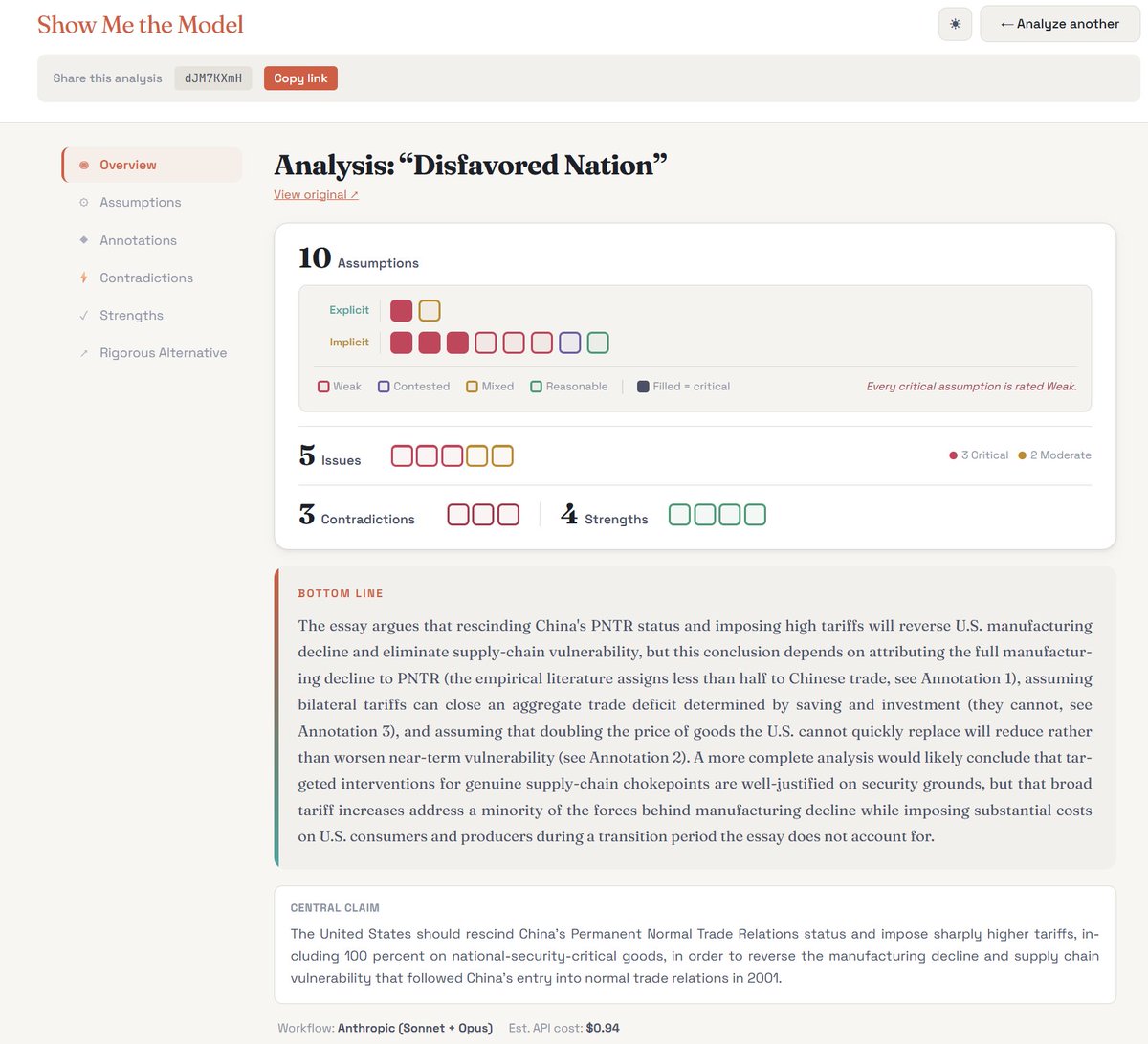
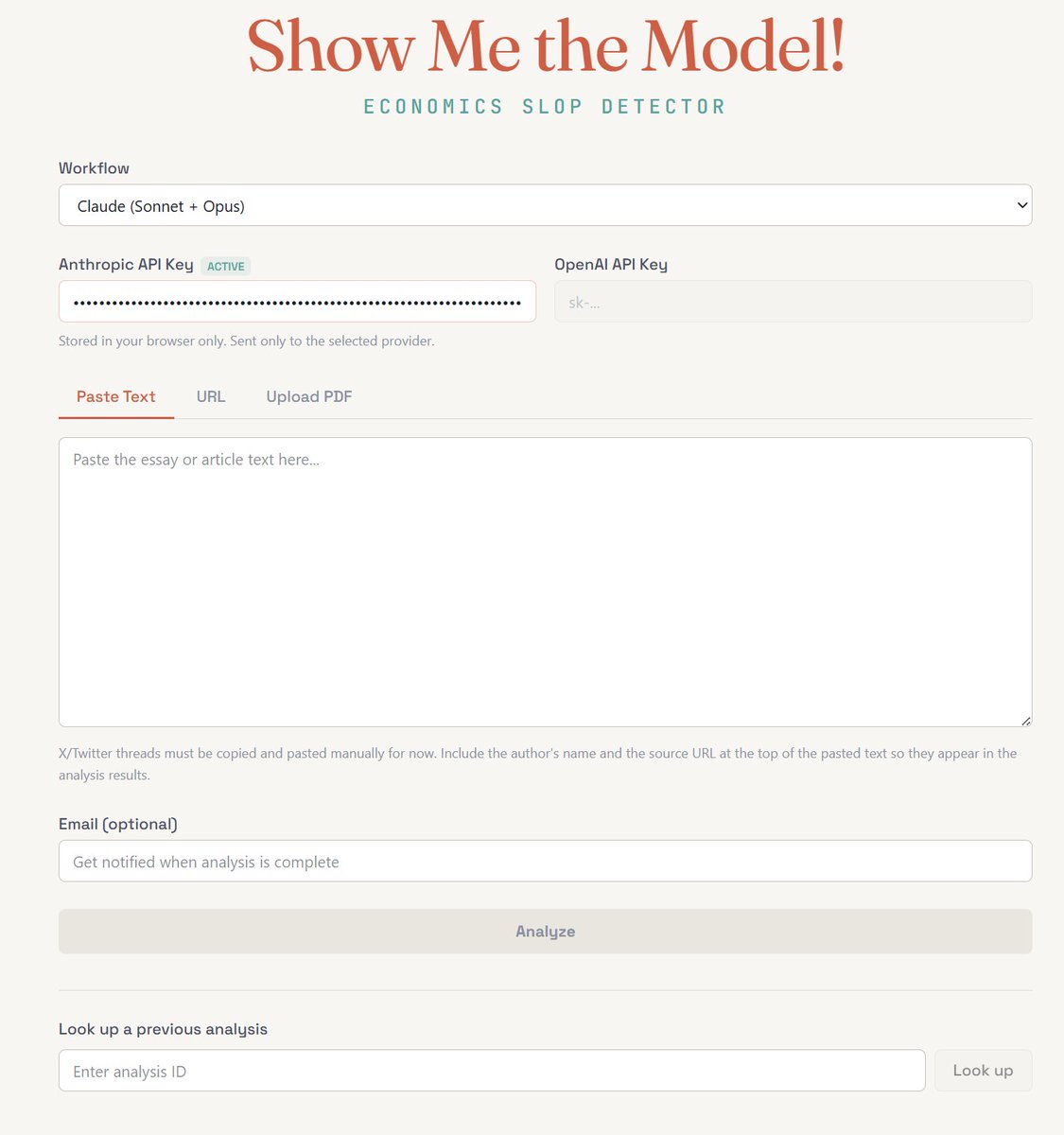
I spend way too much time on social media debunking "economic slop" promulgated by lawyers pretending to be economists, so I built Show Me the Model: a tool that uses AI to check whether the economic reasoning in an essay actually holds up.
https://t.co/cfhWs6MI27
Give it a URL or paste some plain text, and the tool flags hidden assumptions, internal inconsistencies, and other problem areas, and tells you how a real economist would think through the issue.
Right now, it has 4 "personas:" macro, trade, IO/price theory, and labor. The tool first figures out which persona is right for the job, and then uses a parallelized prompt scaffold specific to that persona to process the source text.
Here are some example outputs based on some essays that triggered me hard:
Citrini Research's viral essay on how AI could trigger a self-reinforcing financial crisis rivaling the GFC:
https://t.co/ZNUFHqyEFT
American Compass on the harms of trade deficits:
https://t.co/Nasfvr36iY
@oren_cass on why Built-to-Rent should be banned:
https://t.co/niie7bVRoK
American Compass on the "China Shock:"
https://t.co/nZvoEaTdTv
@michaelxpettis on why China's trade surplus reduces global output:
https://t.co/LqocDslRrH
Try it yourself at https://t.co/cfhWs6MI27. You'll need to bring your own API key (OpenAI or Anthropic), and a typical analysis costs $0.50–$1.50.
It's super preliminary and will probably break on you. I'd love feedback about both the functionality as well as the quality of the output.
Aan de @ugent is er dan blijkbaar een “Departement” dat enkel niet-mannelijke onderzoekers uit het “Globale Zuiden” (Australië?) aanwerft???
Een zaak voor UNIA en het IGVM, toch?
A few people have raised this question. The point isn't about whether we "need" 1,000 papers or not. The point is that that's what is possible now, and we need to adjust to that reality and start redesigning systems to make sure we promote knowledge production.
If we do nothing and leave the journal system as is, then the incentive will be for people to produce thousands of not very good papers, probably. We should aim to do better.
La Commission européenne n'aurait jamais dû assister à la réunion du "Board of Peace" à Washington aujourd'hui, car elle n'en avait pas reçu le mandat du Conseil.
Au-delà des questions politiques légitimes soulevées par le "Board of Peace", la Commission doit respecter scrupuleusement le droit et l'équilibre institutionnel européens en toute circonstance.