If you happen to be at #CVPR today, come and talk with us (@lukaskuhn77) about vision-language alignment and non-contrastive learning at Exhibit Hall A, Poster 242 – during the coffee breaks or at the poster session from 17:30 to 18:30!
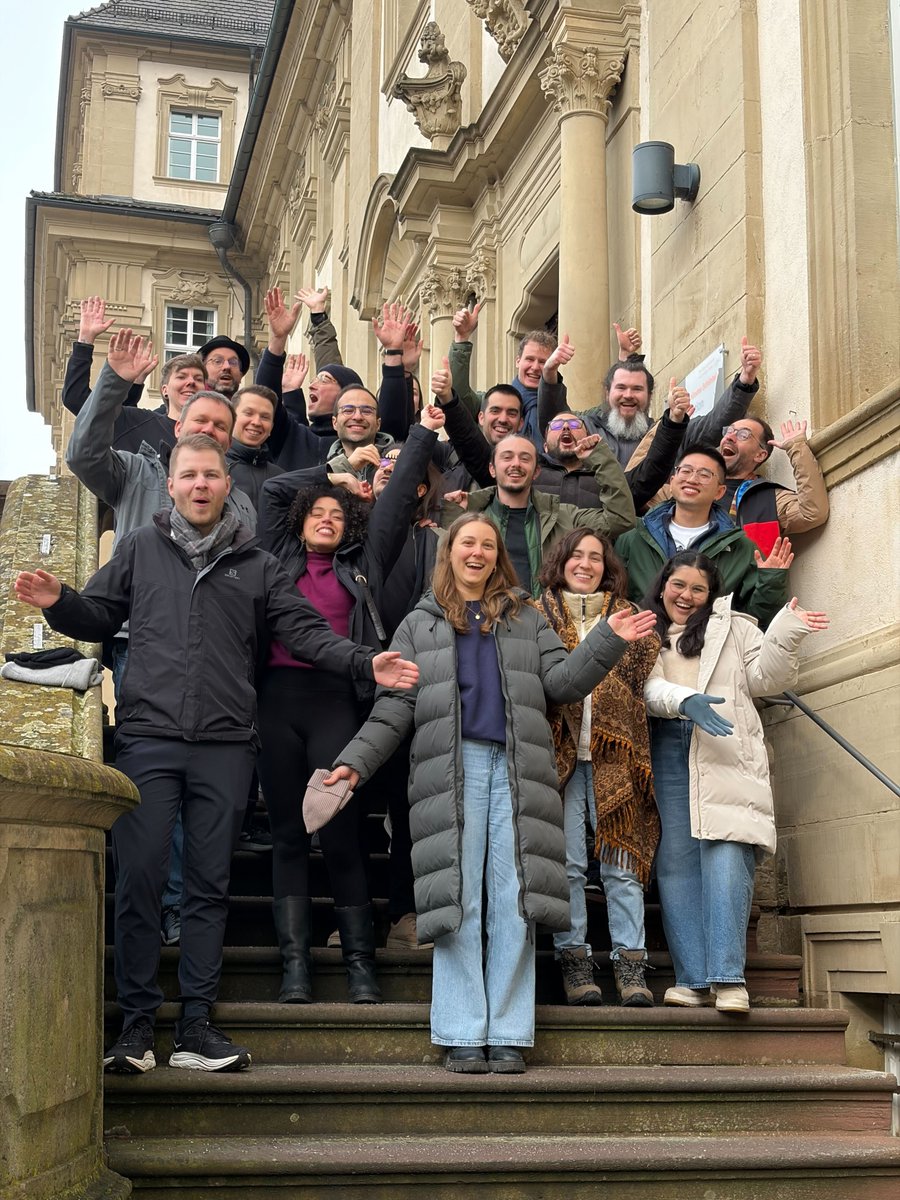
For our 2026 group retreat, the entire team gathered at Bildungshaus Kloster Schöntal. Set in the beautiful monastery surroundings, the retreat gave us dedicated time to discuss orga, exchange ideas on science, and deepen our understanding of our wide range of research areas.
In our latest work, we reimagined vision-language alignment without contrastive learning's tricks.
NOVA, built on LeJEPA's loss with one single hyperparameter, shows better performance and solid stability compared to, e.g., MedCLIP, on zero-shot medical image classification.
Introducing NOVA — Non-Contrastive Vision-Language Alignment!
We show you don't need negative sampling, momentum encoders, or stop-gradients to align vision and language.
Just predict text embeddings from image views + one simple regularizer (hint: it's by @ylecun & @randall_balestr).
🧵👇🏼 1/n
Let's inaugurate the brand new group's account with great news! In our #ICLR2025 paper, we tackle the *online* problem in federated continual learning. Via an uncertainty-aware memory-based approach, we consider settings where retaining the full dataset locally is not possible.
We got accepted at TMLR!
What characteristics of the samples consistently alleviate catastrophic forgetting in memory-based online continual learning?
@gserpep, Ben Werner, and @BuettnerFlo investigated this question under an uncertainty lens.
📜: https://t.co/c8O0HFSFgK
Let's inaugurate the brand new group's account with great news! In our #ICLR2025 paper, we tackle the *online* problem in federated continual learning. Via an uncertainty-aware memory-based approach, we consider settings where retaining the full dataset locally is not possible.
We got accepted at #ICLR2025!
@gserpep and @BuettnerFlo formalized a novel scenario for *online* federated continual learning and introduced an effective memory-based baseline that combines uncertainty-aware updates with random replay.
📄Read more: https://t.co/EM6gEEhYwI
Last week, I presented “L2XGNN: Learning to Explain Graph Neural Networks” at @ECMLPKDD in Vilnius! Joint work with @Mniepert, L2XGNN is an #XAI framework for standard GNNs that learns to generate faithful subgraph explanations during training.
📜⤵️https://t.co/Nn1GR5fCrV