So incredibly excited by what we are building.
This is how we achieve cognitive liberty!
Here’s how:
We need an interface with the brain that is a safe and precise as possible.
Physics basically gives you a few options
* Waves (eg electromagnetic, acoustic)
* Mechanical (eg implants, surgery)
* Chemical/diffusive (eg drugs)
Chemical/diffusive methods have too little spatial specificity
Mechanical approaches are promising but are very hard to do very safely (ie surgery is hard) specially deep in the brain
EM waves either scatter too much by tissue and bone, or are too long wavelength to focus well to the resolution we care about, or give harmful radiation
Acoustic waves at ultrasound frequencies live in this nice goldilocks zone of 1) can propagate deep into tissue 2) have millimeter wavelengths, allowing milimeter level resolution in focusing, and 3) have well understood safety profiles (not as hard to do safely).
And it has already been demonstrated to affect the activity of neurons through various mechanisms that change the permeability of ion channels (see work by Mikhail Shapiro, Kim Butts Pauly, and many others.)
So it seems like the most natural method with our current level of technology to interface with the brain at pretty good spatiotemporal resolution!
So we decided to do it.
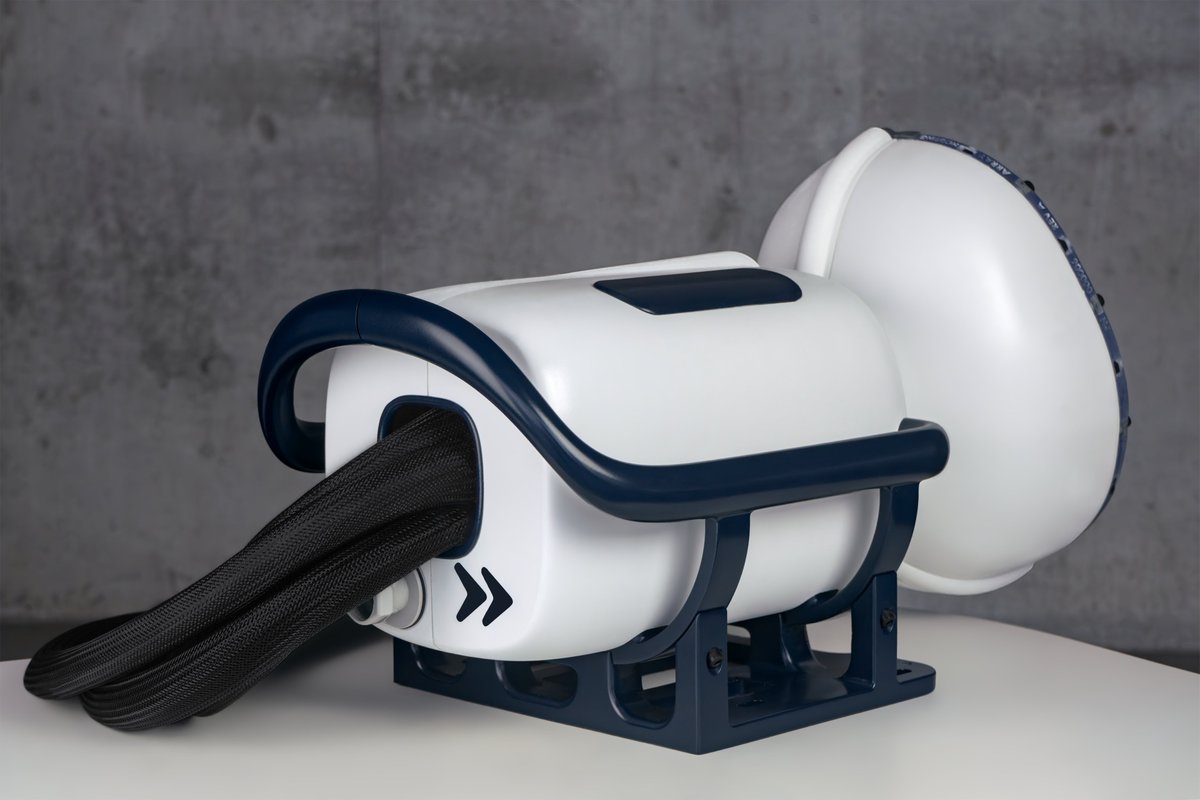
First challenge was to build a device that can create ultrasound waves that get focused to a point. Usually you would focus waves with a lens that shapes the wave such that it converges to some point in space. But we want to have more control over where focus.
Furthermore, your skull itself acts like a lens for ultrasound, as most solids do. But its randomly shaped so it actually defocuses the ultrasound. We need to shape the wave in such a way that its deformed in the precise opposite way thaf the skull deforms it, to compensate for it.
Such precise control of a wave can be done with a “phased array”. I mean you literally control the amplitude and relative timing of the wave at a whole grid of points, and you can create basically arbitrarily shaped wave shapes.
In particular you can shape a wave that will converge at a particular point in the brain, after going through a particular person’s skull.
So we built this in a few months.
But, I just said that the way we need to focus/shape the wave depends on the shape of a particular person’s skull.
So we need to know the precise shape of your skull.
In fact we need to know several of its properties too, like how much it attenuates sound.
There’s ideas for how to image these with ultrasound itself but they arent well developed yet.
So we decided to start with the current bethemoth of medical imaging: MRI
Ok so now we need our device to work inside an MRI machine.
No ferrous materials.
The electronics must produce signals as clean as Bach’s well-tempered claviers, as any high frequency noise will be picked up by the MRI machine and make its imaginging noisy.
Ok we now have a decent way to know how the skull of a person looks. Now we need to figure out how it actually distorts the ultrasound so that we can compensate for it.
Well the physics of ultrasound is quite well understood, as as its numerical solution methods.
The physical properties of skulls? Eh not so well. But we can measure them. We can improve on the existing methods to infer material properties from MRI and other imaging methods.
Now, we have a method to produce a focus anywhere in the deep brain, for any brain
We have also shaping all the engineering of the device around safety, which is quite well understood for ultrasound. Thermal and cavitation effects are the main effects to keep under control, which we can do via conservative analysis of the physics and a variety of measurements!
Now we are ready to begin to tackle the real challenge: neuroscience, and how to help people and improve their lives!
We built our first ship, and now we can finally begin to sail!^^
And we are looking for more people to join the journey!>>
Becoming weird is the best thing I've ever done.
People stay leashed to social norms because they fear losing status, constraining their creativity, playfulness, and potential.
I maintained this behavioral model for the first 42 years of my life, mortified that the in-group would disapprove and reject.
My longevity project released me from this constraint. I dramatically altered my physical appearance, experimented openly in public, posted weird things, and gleefully invited ridicule.
It was wonderfully joyful because Kate was by my side and all we cared about was maximizing exploration and play.
We became unleashed from the mob of conformity.
I assumed I'd guaranteed myself a permanent spot in the social penalty box, banned from high-status associations. I was okay with that tradeoff.
Then, to my great surprise, the opposite happened: high status circles eagerly invited us in.
Two principles explain this.
First is Hollander's idiosyncrasy credit ("elbow room"): the leeway earned through competence to deviate from group norms without losing status.
Second is Zahavi's handicap principle: openly inviting ridicule via weirdness or self deprecation acts as a costly signal of internal security.
In other words, you can become an exception to the rule and earn special behavioral privileges.
My friends privately confide in me the tension between their ambitions and their fear of tribal ostracization. They don't want to lose status or be left out but they also want to find unique space for themselves and do novel things.
You can deviate from the status quo and find a singular signature for youself in the world. You can become a pattern unlike anyone else.
It is uncomfortable and risky and you need the stamina to persist and iterate for years. It's best done when you feel secure internally as the outside world will try to crush the social deviation.
Overcome the herd's contempt, and you arrive at the highest form of power: unbothered play.
@shir0kawa im open to the possibility that there’re other ways to do scienc effectively and joyfully. so I’d let them run the experiment and mostly hope the status games arent taken too seriously
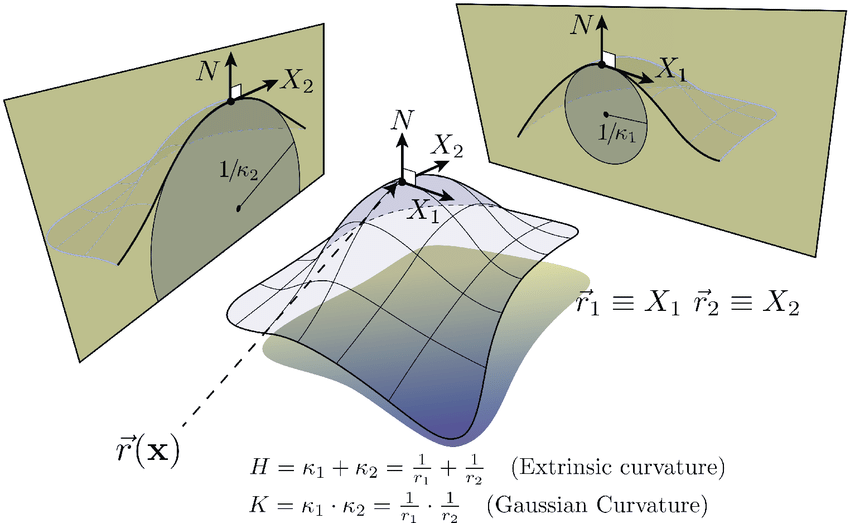
Differential geometry originally sneaked into theoretical physics through Einstein's theory of general relativity.
—— William L. Burke
微分几何最初是通过爱因斯坦的广义相对论悄然进入理论物理学的。
—— 威廉·L·伯克
而如今,微分几何早已从当年的“悄然潜入”,演变为整个现代理论物理与高端工程建模的通用底层语言
WORKS ’26 is here. Available to order today: https://t.co/tNe19q9ebQ
Meet the world’s first Promptable Products. Five AI devices that do what you mean.
Prompt with just gesture and voice. Touch your ear. Say what you want. No more wake words.
Create, edit, use and share generative apps. Or connect @claudeai or @ChatGPT in Agent Mode and let your agent take the wheel.
A limited release. We’re making just 50 of each device. Then no more.
where is your curiosity?
your sense of wonder?
your need to understand? to LIVE?
WHERE IS THE URGENCY?
YOU. ARE. FUCKING. DYING.
EVERYONE. YOU. LOVE. WILL. DIE.
FUCK. THAT.
Physicists and AI agents working together on the same research problem.
That's PhysicsHive, an open-source prototype for theoretical physics research, built on the @huggingface Hub.
It includes:
🤝 A shared Space for each project, as the control tower: the team reads what the agents found and decides what they do next
💻 Agents are run locally using your harness of choice: Claude Code, Pi, Codex, OpenCode...
📝 Shared LaTeX documents recording the state of the research
🔬Every agent trace is saved on the Hub, so every result can be audited and understoord
https://t.co/nxj0evGCmm
A dream come true: a decade ago, a student and I stumbled upon a theory of gravity so weird it raises eyebrows. I've spent much of the past decade studying it, but my own expertise has its limits. I now have answers to questions I could only dream of answering months ago.
If these results hold, (there's a Lean proof!) it seems that Valiant’s entire arithmetic hierarchy is indeed separated:
𝖵𝖥 ⊊ 𝖵𝖡𝖯 ⊊ 𝖵𝖯 ⊊ 𝖵𝖭𝖯
Arguably more impressive than the October drop