No one could have known that telling programmers "spend as much money as possible on this new agent technology; whoever spends the most money wins!" would result in companies spending too much money on this new technology.
The new White House policy requiring green card applicants to apply from outside the US is a capricious attack on legal immigration. It will hurt families, leave us with fewer doctors, teachers and scientists, and hurt American competitiveness in AI.
The $20 Gemini sub is really hard to beat
It includes Google Health, YouTube Premium Lite (less ads, background play), Gemini app, Antigravity, 5TB of storage, Google Home Premium
Value prop here is really hard to beat
I strongly believe there are entire companies right now under heavy AI psychosis and its impossible to have rational conversations about it with them. I can't name any specific people because they include personal friends I deeply respect, but I worry about how this plays out.
I lived through the great MTBF vs MTTR (mean-time-between-failure vs. mean-time-to-recovery) reckoning of infrastructure during the transition to cloud and cloud automation. All those arguments are rearing their ugly heads again but now its... the whole software development industry (maybe the whole world, really).
It's frightening, because the psychosis folks operate under an almost absolute "MTTR is all you need" mentality: "its fine to ship bugs because the agents will fix them so quickly and at a scale humans can't do!" We learned in infrastructure that MTTR is great but you can't yeet resilient systems entirely.
The main issue is I don't even know how to bring this up to people I know personally, because bringing this topic up leads to immediately dismissals like "no no, it has full test coverage" or "bug reports are going down" or something, which just don't paint the whole picture.
We already learned this lesson once in infrastructure: you can automate yourself into a very resilient catastrophe machine. Systems can appear healthy by local metrics while globally becoming incomprehensible. Bug reports can go down while latent risk explodes. Test coverage can rise while semantic understanding falls. Changes happens so fast that nobody notices the underlying architecture decaying.
I worry.
Not enough people are talking about how much AI is impacting the role of data science.
I was chatting with a DS friend, and he said that most of his team's work now is reviewing half-assed AI data analysis from PMs and engineers. And that 50% of the time, that analysis is wrong.
The role is becoming less fun.
This works really well btw, at the end of your query ask your LLM to "structure your response as HTML", then view the generated file in your browser. I've also had some success asking the LLM to present its output as slideshows, etc.
More generally, imo audio is the human-preferred input to AIs but vision (images/animations/video) is the preferred output from them. Around a ~third of our brains are a massively parallel processor dedicated to vision, it is the 10-lane superhighway of information into brain. As AI improves, I think we'll see a progression that takes advantage:
1) raw text (hard/effortful to read)
2) markdown (bold, italic, headings, tables, a bit easier on the eyes) <-- current default
3) HTML (still procedural with underlying code, but a lot more flexibility on the graphics, layout, even interactivity) <-- early but forming new good default
...4,5,6,...
n) interactive neural videos/simulations
Imo the extrapolation (though the technology doesn't exist just yet) ends in some kind of interactive videos generated directly by a diffusion neural net. Many open questions as to how exact/procedural "Software 1.0" artifacts (e.g. interactive simulations) may be woven together with neural artifacts (diffusion grids), but generally something in the direction of the recently viral https://t.co/z21CP5iQfu
There are also improvements necessary and pending at the input. Audio nor text nor video alone are not enough, e.g. I feel a need to point/gesture to things on the screen, similar to all the things you would do with a person physically next to you and your computer screen.
TLDR The input/output mind meld between humans and AIs is ongoing and there is a lot of work to do and significant progress to be made, way before jumping all the way into neuralink-esque BCIs and all that. For what's worth exploring at the current stage, hot tip try ask for HTML.
Mechanistic Interpretability be like..
We wanted to see what the bread slice is thinking when it is in the toaster. Is it taking its singing equanimously? thinking religious thoughts? or plotting revenge? (Face it--a vengeful singed slice is the last thing we want!)
But alas, the bread slice doesn't talk! Its thoughts are intricately encoded in its singe pattern.
So we devised a clever method--of showing the bread slice to a random Joe, asking him to describe its feelings.
Joe says that the slice is having a religious experience involving Mother Mary.
But is random Joe describing these feelings right?
To check, we called random artist Jane and asked her to render these thoughts back to the external appearance of a (different!) bread slice.
We co-trained Joe and Jane until they learn to auto-encode the real truth about the slice's thoughts.
We are finding this technique to be a great way to understand what the bread slice is thinking. The tehcnique is not always (or even sometimes) correct, but it gives us a great window into publishing bread slice thought related podcast articles.
Hope you find this research useful. #AIAphorisms
Noticing an interesting version of gell-man amnesia where people use AI for their job and see all the various things they have to do in the “last mile”, but then look at someone else’s job and think that AI will eliminate it immediately.
We all have a much deeper appreciation for the nuances and complexities of the work that we do every day. We run into issues about accessing data, we know how much context is needed to get AI models to work the way we need, we have to review the output of the AI to make sure it’s accurate, and then we have to incorporate that work into some broader business process. We see all those steps deeply for the work that we do.
Then, a moment later, we see AI do something in a foreign space and think that it can go automate that entire function. We tend to dramatically underestimate the work that goes into making the AI work just as effectively in those jobs.
This is reason to be skeptical about many of the theories of job loss. It’s coming from the lens of being able to automate individual tasks with AI, without understanding all the work that goes into doing the job fully.
you used to spend a day messing with your neovim config, feel self conscious, then get back to work
now people are spending weeks on some hyper customized coding agent workflow that definitely is worse than vanilla but they can talk about it like they're ahead of the game
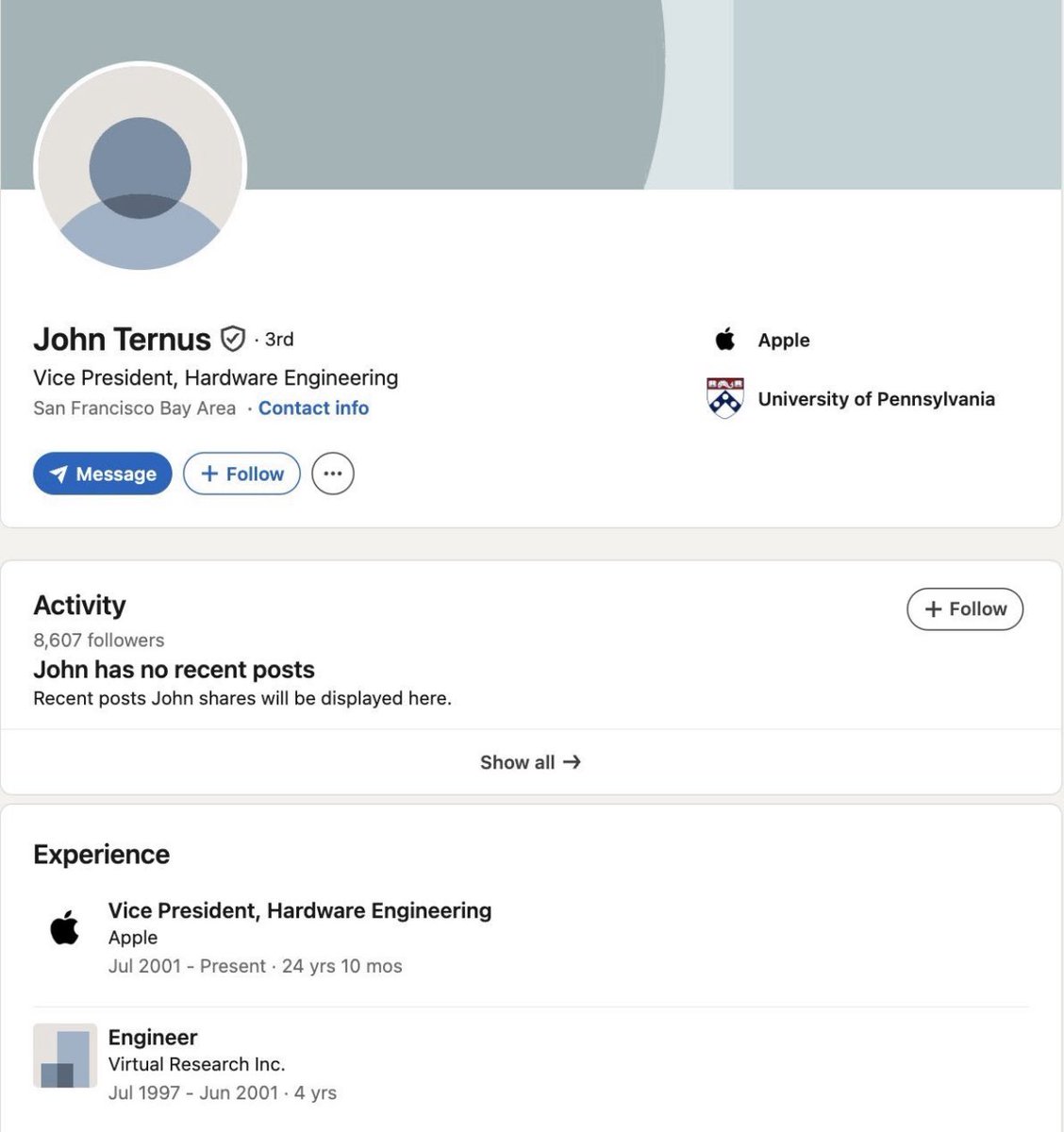
Still shocked John Ternus pulled off Apple CEO with lazy LinkedIn profile:
▫️no banner image
▫️blank profile photo for logged out users
▫️no breakdown of all Apple positions (including role-by-role achievements)
▫️0 social posts (should pin commencement speech)
How are suppliers, manufacturers and future customers going to make a connection in the future with so little to work off? Truly a curious choice.
OVERRATED: running tons of agents in parallel; working on too many things at once; perpetual context-switching; opening lots of low-quality PRs that may never land.
UNDERRATED: using one or two agents at a time; focusing on the task in front of you; thinking deeply; finishing stuff; making your code works in prod.
I like LLMs but I'm convinced many people in the space are delusional and we'll look back at this time and laugh. The whole idea of an "intelligence explosion" or "recursive self-improvement" or "takeoff" rely on strong premises related to functionalism that are easy to reject