The faster technology moves, the more I think about Bezos' question
What won't change in the next 10 years?
Things I've been writing down over time:
- Humans will always need shelter, food, energy, and healthcare.
- The desire for ownership and the accumulation of wealth.
- The physical world will move more slowly than the digital one.
- Every increase in technological capability, especially AI, will require more energy.
- People and businesses will continue to need access to capital.
- Capital will continue to seek returns that exceed inflation.
- Underwriting methods evolve, but demand for credit (loans) is persistent.
- Trust remains scarce and becomes increasingly valuable as content, code, and fraud become cheaper.
- Verified identities and reputation becomes more important as information becomes abundant and synthetic.
- Long-term wealth creation and dynastic (multi-generational) thinking predate modern technology, and will persist.
- Coordination and transaction costs never fully disappear; market friction will continue to justify the existence of firms and intermediaries.
- People will continue to compete for status.
- Consumers will pay a premium for products and services that confer status.
- Time remains fixed at 24 hours per day.
- But attention is a finite resource and an enduring constraint.
- Products that credibly save time (or enable delegation) have a perpetual market.
- Inaccessible, proprietary data will be a persistent moat. The more inaccessible and difficult to aggregate, the deeper the moat.
- People want accountability, recourse, and clearly identifiable responsibility when things go wrong.
- Regulation consistently lags technological innovation.
- Compliance requirements, licensing, and regulatory moats persist even when machines can perform the underlying task.
- Local knowledge remains valuable and difficult to replicate.
- Heterogeneous markets (like real estate) continue to reward people with deep contextual understanding.
- Incumbent organizations tend to underinvest in disrupting their own businesses, which always creates opportunities for challengers.
Bezos' insight on what wouldn't change in 10 years was "Customers will always want lower prices and faster delivery."
It's boring/ true, but I think that's the point.
Everything we build today can and will be rebuilt more cheaply, faster by someone else.
Build on the invariants, not the trends.
What have I missed?
@npckellyzeng@solacelaunch@npckellyzeng - practice is so important before any critical conversation or presentation. How can you tune and reflect this in education and learning ?
On top how it helps the coin growth that leads to community growth
The Billionaire Tax is actually an Everyone Tax.
The Billionaire Tax is a new tax proposal written by four professors who don't believe in the American dream. Some of them aren’t even American…go figure.
Despite its name, it applies to every California resident who currently has assets or ever will.
The creators named it the Billionaire Tax so you would get into a froth andwouldn't look closely at what it actually does to you.
On page twenty-six, it explains how the government can convert to an Everyone Tax without voter approval.
They can also adjust the tax to be a yearly tax, not just one time…again, without your approval.
Here's how the tax would work: As a voter, you're being asked to approve a tax that would require you to:
1. list all your assets and the value of each, then submit them to the California Franchise Tax Board.
2. authorize the tax board to appraise your assets and confirm the value of each.
3. pay a penalty of up to forty percent of your tax bill if the board determines your reported value was too low in their opinion.
4. allow the tax board to subpoena your financial records from every one of your financial institutions for auditing.
This Everyone Tax runs 34 pages of shifty language describing how the government plans to take your assets. Read the fine print and decide for yourself.
If this were truly a billionaire tax, it would be 3 pages.
It’s 34 pages so that it can create the mechanisms to steal from all of you.
A mathematician who shared an office with Claude Shannon at Bell Labs gave one lecture in 1986 that explains why some people win Nobel Prizes and other equally smart people spend their whole lives doing forgettable work.
His name was Richard Hamming. He won the Turing Award. He invented error-correcting codes that made modern computing possible. And he spent 30 years at Bell Labs sitting in a cafeteria at lunch watching which scientists became legendary and which ones faded into nothing.
In March 1986, he walked into a Bellcore auditorium in front of 200 researchers and told them exactly what he had seen.
Here's the framework that has been quoted by every serious scientist for the last 40 years.
His opening line landed like a punch. He said most scientists he worked with at Bell Labs were just as smart as the Nobel Prize winners. Just as hardworking. Just as credentialed. And yet at the end of a 40-year career, one group had changed entire fields and the other group was forgotten by the time they retired.
He wanted to know what the difference actually was. And he said it wasn't luck. It wasn't IQ. It was a specific set of habits that almost nobody is willing to follow.
The first habit was the one that hurts the most to hear. He said most scientists deliberately avoid the most important problem in their field because the odds of failure are too high. They pick a safe adjacent problem, solve it cleanly, publish it, and move on. And because they never swing at the hard problem, they never hit it. He said if you do not work on an important problem, it is unlikely you will do important work. That is not a motivational line. That is a logical one.
The second habit was about doors. Literal doors. He noticed that the scientists at Bell Labs who kept their office doors closed got more done in the short term because they had no interruptions. But the scientists who kept their doors open got more done over a career. The open-door scientists were interrupted constantly. They also absorbed every new idea passing through the hallway. Ten years in, they were working on problems the closed-door scientists did not even know existed.
The third habit was inversion. When Bell Labs refused to give him the team of programmers he wanted, Hamming sat with the rejection for weeks. Then he flipped the question. Instead of asking for programmers to write the programs, he asked why machines could not write the programs themselves. That single inversion pushed him into the frontier of computer science. He said the pattern repeats everywhere. What looks like a defect, if you flip it correctly, becomes the exact thing that pushes you ahead of everyone else.
The fourth habit was the one that hit me the hardest. He said knowledge and productivity compound like interest. Someone who works 10 percent harder than you does not produce 10 percent more over a career. They produce twice as much. The gap doesn't add. It multiplies. And it compounds silently for years before anyone notices.
He finished the lecture with a line I have never been able to shake.
He said Pasteur's famous quote is right. Luck favors the prepared mind. But he meant it literally. You don't hope for luck. You engineer the conditions where luck can land on you. Open doors. Important problems. Inverted questions. Compounded hours. Those are not traits. Those are choices you make every single day.
The transcript has been sitting on the University of Virginia's computer science website for almost 30 years. The video is free on YouTube. Stripe Press reprinted the full lectures as a book in 2020 and Bret Victor wrote the foreword.
Hamming died in 1998. He gave his final lecture a few weeks before. He was 82.
The lecture that explains why some careers become legendary and others disappear is still free. Most people who could benefit from it will never open it.
I’m locked on, @DavidSacks! We’re hiring 1,000 new grads & interns right now to ride the AI exponential. You are right they said AI would kill entry-level jobs. Meanwhile these grads & interns are building it — powering Agentforce & Headless360 at Salesforce. 🚀 New grads: Drop your resume to @salesforcejobs or [email protected]
#FutureForce #AI
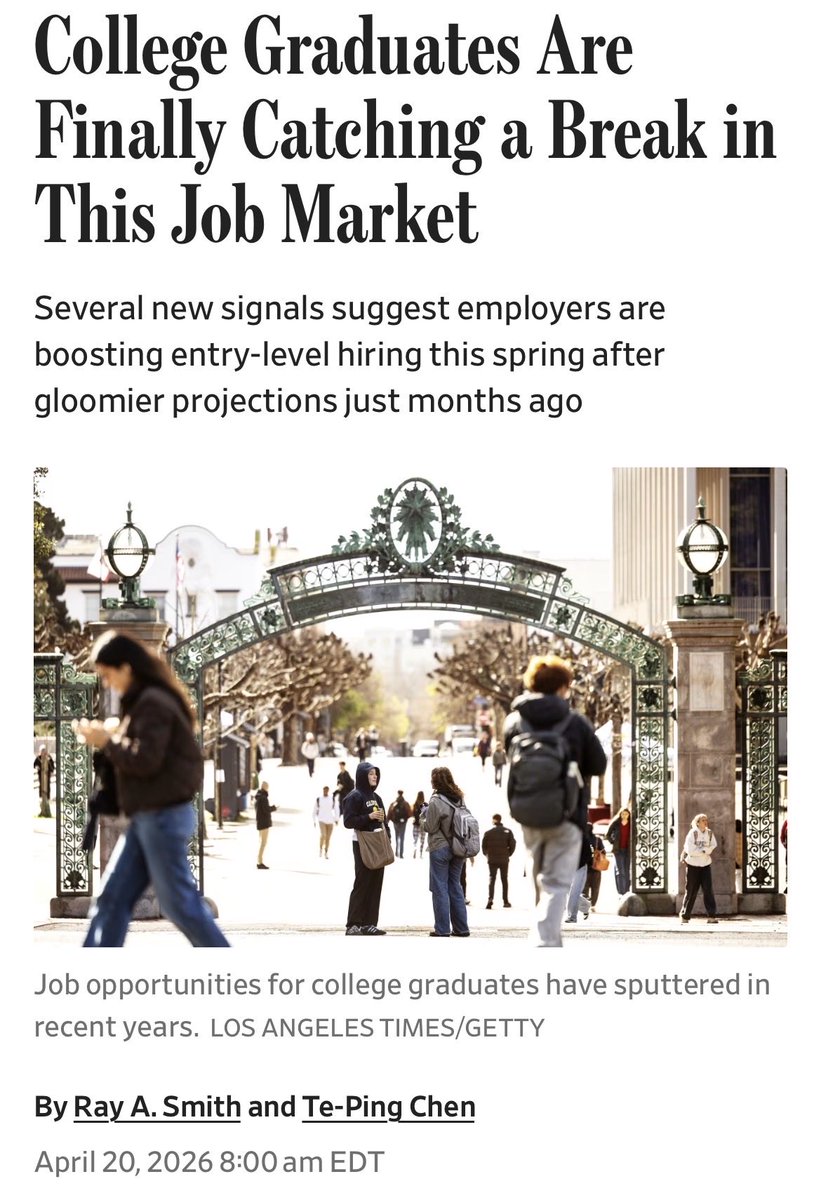
Narrative violation: Hiring of new college graduates is up 5.6% over last year. Youth unemployment for degreed 20–24‑year‑olds fell to 5.3% from 8.9%. Weren’t we told that 50% of entry-level jobs were going away?
@tim_cook Wishing you all the best in this next chapter, @tim_cook. You’ve always led with clarity and purpose, and your impact on Apple and across our industry will be felt for years to come. And congrats John!
I want to thank everyone for the outpouring of love and thank you for believing in me to lead the company that has always put you at the center of our work. This is not goodbye. It’s a hello to John and I can’t wait for you to get to know him like I do! 🙏
Congrats on an incredible run @tim_cook , always respected your deep commitment to Apple's mission and best wishes in your new role! Look forward to working with John as well!
Chamath Palihapitiya just described what happens to the entire tech sector the moment OpenAI and Anthropic go public.
Not a correction.
A verdict.
Chamath: “Nobody in the history of the world has ever seen two businesses like this at this scale.”
Not the dot-com era. Not mobile. Not cloud. Not crypto.
Nothing in the history of venture capital has assembled this much value, this fast.
Chamath: “These are trillion-dollar companies. They both are. And they both deserve to be.”
He is not speculating. He is closing the debate.
Two companies. Both trillion-dollar entities. Both built in under a decade. Both converging on the same IPO window.
When they arrive, they will not simply absorb capital. They will decide where every dollar in the sector is allowed to flow.
Chamath: “The tech sector P/E is going to shrink faster, in my opinion, than non-tech P/E.”
That inverts every consensus assumption in the room.
The prevailing thesis is that AI benefits tech first. AI rises. Tech sector wins.
Chamath is saying the opposite. AI does not lift the sector. AI eats it from inside.
Chamath: “It will eliminate, cannibalize, and erode most of the moats that support this differential trading.”
Three verbs. Eliminate. Cannibalize. Erode. He chose all three because one was not violent enough.
For twenty years, software companies commanded premium multiples because they had moats. Proprietary code. Switching costs. Network effects. Data advantages.
AI dissolves all of it.
When an intelligence that compounds every ninety days can replicate your entire product stack at a fraction of the cost, your moat is not a moat.
It is a trench your competitor crosses in a single quarter.
The market is still pricing software companies as if that defensibility holds for fifteen years. Chamath just cut the window to five or six.
Chamath: “I’ll buy the first five or six years of this story, but I’m not buying year 15 of this anymore.”
That is a Wall Street death sentence written in plain English.
Every SaaS company trading at 20x revenue on the assumption of a long runway just had that runway cut by two-thirds.
Not because their product failed.
Because three companies are about to make the entire software category irrelevant.
OpenAI. Anthropic. SpaceX.
When those three hit the public market, capital does what capital always does.
It consolidates around certainty.
When the highest-conviction bet available is general intelligence itself, every other software company becomes a rounding error.
Capital does not slowly migrate. It floods.
Institutions do not politely trim their mid-tier SaaS exposure. They dump it. They redeploy everything into the three companies that now control the direction of the entire industry.
The companies left behind do not gradually decline.
Their multiples compress. Their valuations crater. Their ability to raise capital, retain talent, or execute a meaningful acquisition evaporates inside a single earnings cycle.
Chamath: “These software businesses are going to approach the rest of the non-tech P/E… it’s going to be nasty.”
Tech companies valued like tech companies for two decades are about to be valued like everyone else.
Not a market correction.
The moment Wall Street strips the software sector of its premium and never gives it back.
Three companies absorbed the premium.
The rest of the sector gets the invoice.
Wow, this tweet went very viral!
I wanted share a possibly slightly improved version of the tweet in an "idea file". The idea of the idea file is that in this era of LLM agents, there is less of a point/need of sharing the specific code/app, you just share the idea, then the other person's agent customizes & builds it for your specific needs.
So here's the idea in a gist format: https://t.co/NlAfEJjtJV
You can give this to your agent and it can build you your own LLM wiki and guide you on how to use it etc. It's intentionally kept a little bit abstract/vague because there are so many directions to take this in. And ofc, people can adjust the idea or contribute their own in the Discussion which is cool.
Where is he going??
Everyone wants to take the traditional route, book a flight on Google or united airlines. But some have their hearts set on being trend setters.
The call to something bigger brings them closer.
That’s how I feel about $FLYTE is a way for people to actually use an AI agent and not just some agent that lives to show off. A utility based agent to ease you in your life.
Are you the penguin?
@base@virtuals_io
Caught up with @karpathy for a new @NoPriorsPod: on the phase shift in engineering, AI psychosis, claws, AutoResearch, the opportunity for a SETI-at-Home like movement in AI, the model landscape, and second order effects
02:55 - What Capability Limits Remain?
06:15 - What Mastery of Coding Agents Looks Like
11:16 - Second Order Effects of Coding Agents
15:51 - Why AutoResearch
22:45 - Relevant Skills in the AI Era
28:25 - Model Speciation
32:30 - Collaboration Surfaces for Humans and AI
37:28 - Analysis of Jobs Market Data
48:25 - Open vs. Closed Source Models
53:51 - Autonomous Robotics and Atoms
1:00:59 - MicroGPT and Agentic Education
1:05:40 - End Thoughts
Offshore accounts used to be for the wealthy.
Switzerland. Panama. Cayman Islands. Minimum deposits most people couldn't touch.
In 2026, crypto changed that.
With vPay, privacy-first banking isn't just for HNWIs anymore.
Read this vPay-featured article on @Binance to learn whether your neobank is actually different, or just a prettier interface running on the same old system?
https://t.co/u0vYUBy7fn
While we’re waiting for our partners to finish their integration, we’ve been cooking up something huge at Flyte…
We’re adding limit orders for flight tickets.
You choose your route and dates, set the price you want, and Flyte monitors fares around the clock. When the price drops to your target, the system auto-books the ticket using your escrowed USDC. No constant refreshing, no missed deals, no stress.
This basically lets you “buy the dip” on airfare and lock in flights at your price, not whatever the airline throws at you.
This is the kind of travel tool we’ve always wished existed so we're building it.
#FlyteAI #TravelTech #Web3