What happens when you point a sensitive telescope at a nebula for 24 hours? This is an ultra-deep view of the leftmost star in Orion's belt. The horsehead and Flame Nebulae are practically invisible, but come alive after enough exposure time. This is where stars are born.
Dynamic duo! 🤩
In R Aquarii, a dense white dwarf orbits a cooler red giant star. The white dwarf pulls material from the red giant onto its surface, and with time, the build-up causes a combustion.
This image features data from @chandraxray & Hubble: https://t.co/YjXp9rjD0L
Like fireworks illuminating dark clouds at night, a star’s light reflects off the surface of pitch-black clouds of cold gas laced with dust in this #HubbleClassic image.
Known as IC 349, this reflection nebula is about 380 light-years away: https://t.co/tnGDPBY9Hq
You are here.
In 2013, the Cassini spacecraft captured this wide-angle view of Saturn and a chunk of its rings. That pale blue dot just below the rings? That’s Earth from about 898 million miles (1.4 billion kilometers) away. Explore @NASASolarSystem: https://t.co/9sLPATJHaE
Echo, echo…
In this #HubbleClassic image, a “light echo” from the unusual variable star V838 Mon illuminates the surrounding dust.
V838 Mon is about 20,000 light-years away, on the periphery of our Milky Way Galaxy.
Read more: https://t.co/HIsrjMRrz1
This is as old as it gets.
Messier 3, a globular cluster of stars, 11.5 billion years old.
The galaxy in the bottom right corner is NGC 5263, 195 million light years away from us.
#Astrophotography ✨🌌🔭📷🏕
Photo taken in Suffolk, England by yours truly.
The #orionnebula is only in my FOV for a short time each night. So for fun I thought I’d see what I could to with 30 mins. 2 x 300s each channel SHO. I messed with it until I got it as close to natural color as I could. #astro#m42#Astrophotography#orion
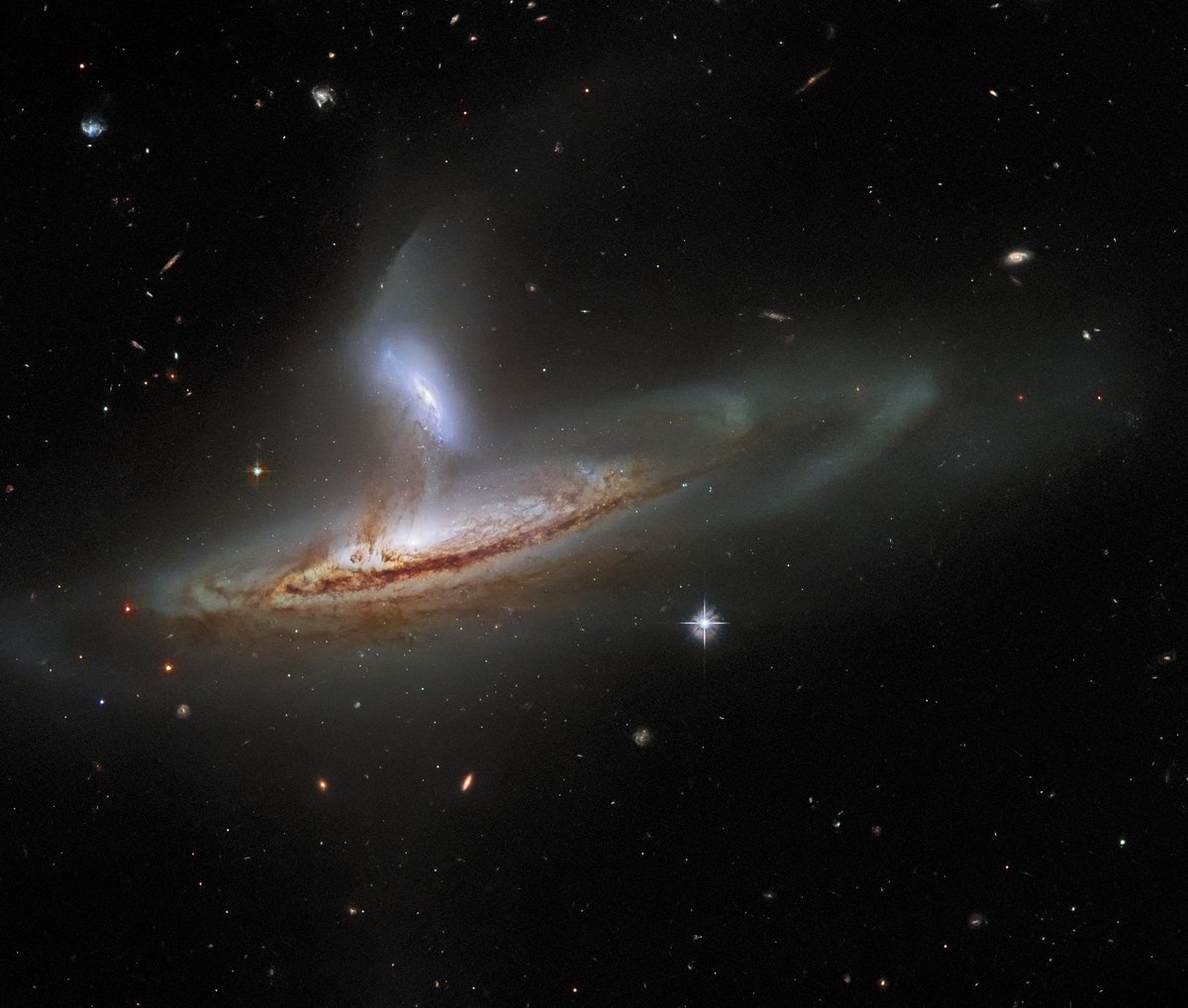
1/ In the 2022 ESA/Hubble Calendar the month of February features Arp 86, a peculiar pair of interacting galaxies which lies roughly 220 million light-years from Earth.
Free .pdf of the 2022 calendar here: https://t.co/o06kf8lwzU
Go with the tide 🌊
Tidal forces, that is.
In this captivating #HubbleFriday image, an interacting galaxy pair known as Arp 282 is experiencing tidal interaction, which occurs when an object's gravity causes another object to stretch or distort: https://t.co/MmeajkDG1I