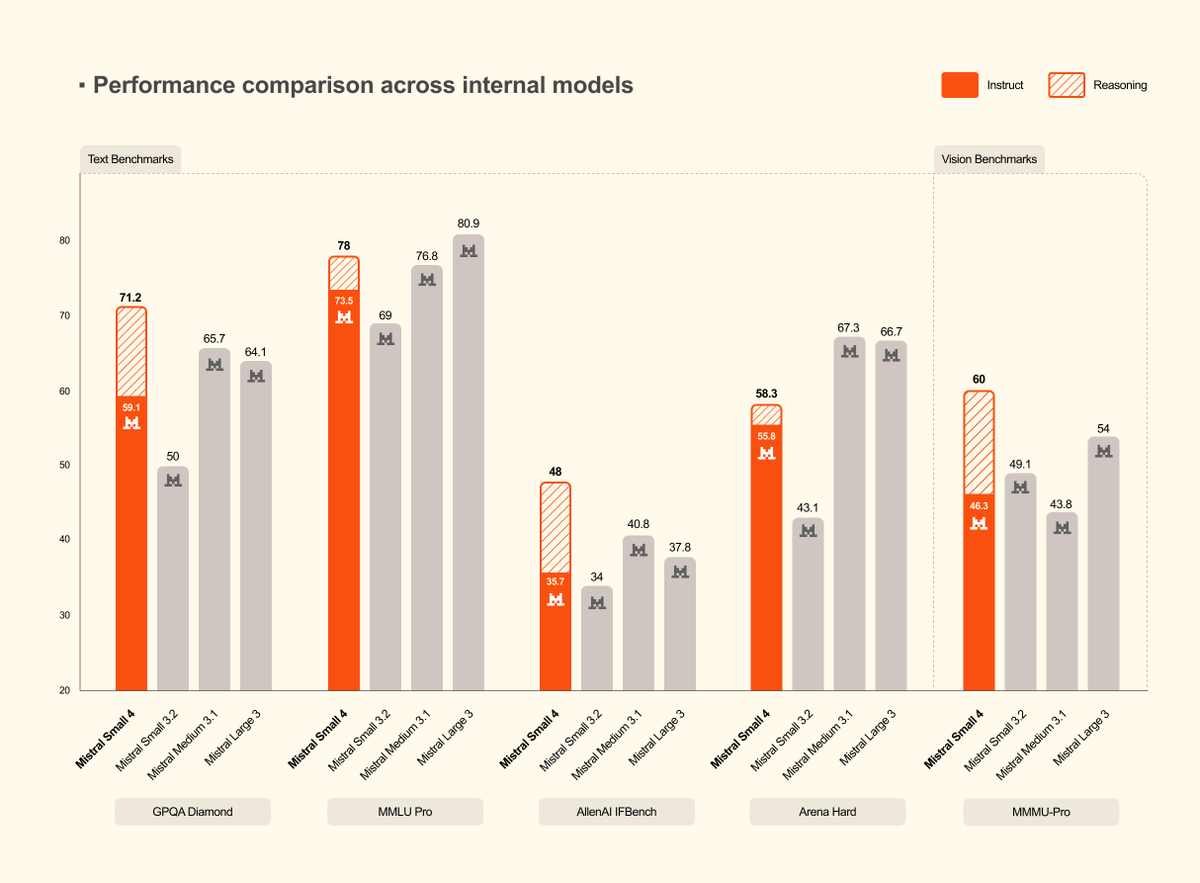
🔥 Meet Mistral Small 4: One model to do it all.
⚡ 128 experts, 119B total parameters, 256k context window
⚡ Configurable Reasoning
⚡ Apache 2.0
⚡ 40% faster, 3x more throughput
Our first model to unify the capabilities of our flagship models into a single, versatile model.
anyone outside of modal hosting this 9B mamba ssm right now?
separately... has anyone looked at the tokenizer for this model? something looks... off...
would also like to find this source, if it exists.
Are AI scientists already better than human researchers?
We recruited 43 PhD students to spend 3 months executing research ideas proposed by an LLM agent vs human experts.
Main finding: LLM ideas result in worse projects than human ideas.
hey all, couple quick notes:
1) yes, we will be joining Meta.
2) no, we did not get 100M sign-on, that's fake news.
Excited about what's ahead though, will share more in due time!
cc @__kolesnikov__ and @XiaohuaZhai.
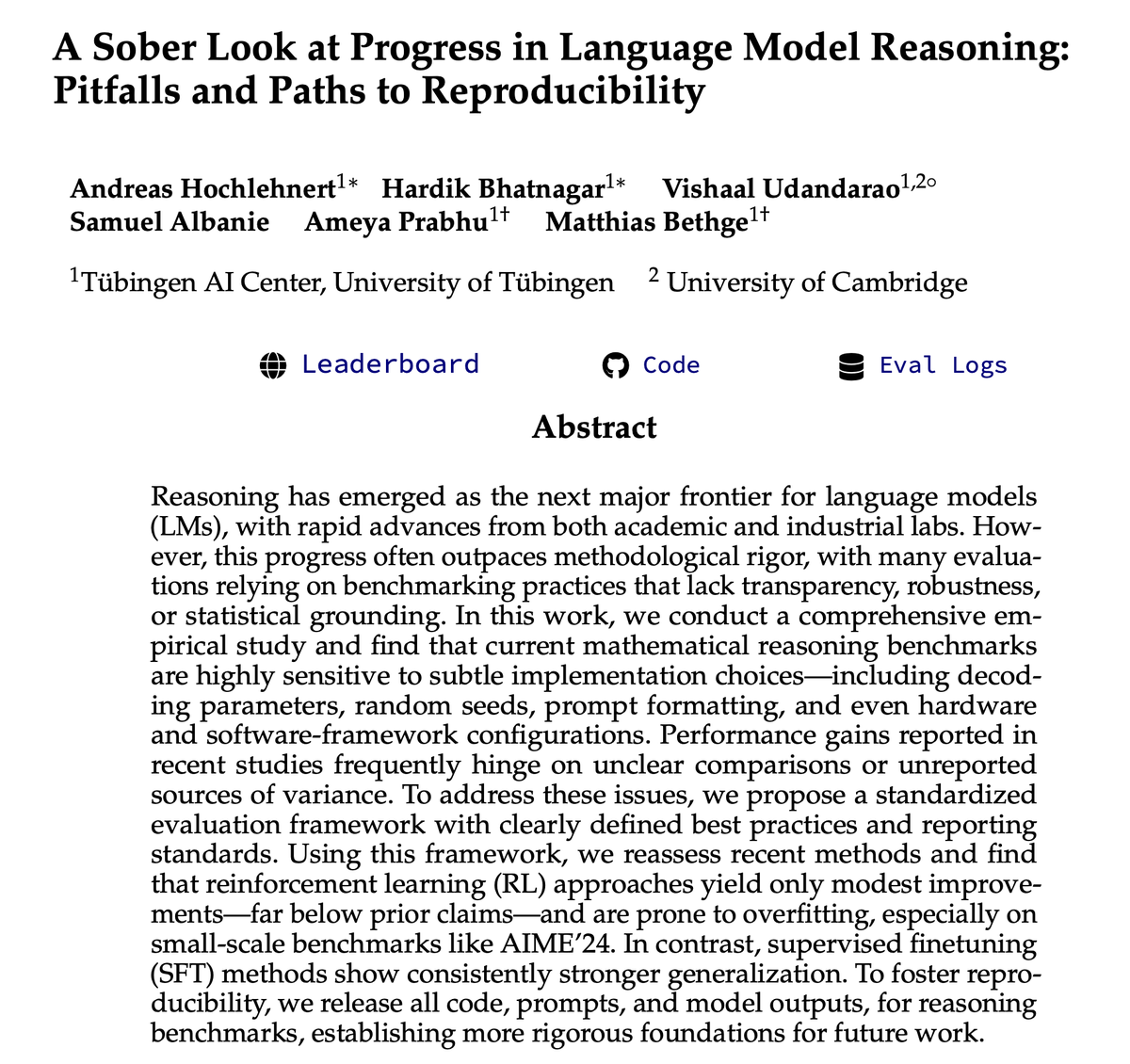
https://t.co/CnF3eyDXRs is quite interesting. It standardizes the evaluation of all the existing math reasoning models and re-evaluate these models.
Takeaway 1: Most RL-trained variants of the DeepSeek R1-Distill model do not yield meaningful performance improvements (except DeepscaleR), suggesting that a reliable and scalable RL training recipes are still lacking.
Takeaway 2 While RL-trained methods can often substantially improve base model performance, instruction tuning remains superior (except Open Reasoner Zero), suggesting again that a reliable and scalable RL training recipes are still lacking.
They propose to maintain a third-party evaluation of math reasoning models at https://t.co/ZlJc35RXsI. This effort is really applaudable.
The #NobelPrizeinPhysics2024 for Hopfield & Hinton rewards plagiarism and incorrect attribution in computer science. It's mostly about Amari's "Hopfield network" and the "Boltzmann Machine."
1. The Lenz-Ising recurrent architecture with neuron-like elements was published in 1925 [L20][I24][I25]. In 1972, Shun-Ichi Amari made it adaptive such that it could learn to associate input patterns with output patterns by changing its connection weights [AMH1]. However, Amari is only briefly cited in the "Scientific Background to the Nobel Prize in Physics 2024." Unfortunately, Amari's net was later called the "Hopfield network." Hopfield republished it 10 years later [AMH2], without citing Amari, not even in later papers.
2. The related Boltzmann Machine paper by Ackley, Hinton, and Sejnowski (1985) [BM] was about learning internal representations in hidden units of neural networks (NNs) [S20]. It didn't cite the first working algorithm for deep learning of internal representations by Ivakhnenko & Lapa (Ukraine, 1965)[DEEP1-2][HIN]. It didn't cite Amari's separate work (1967-68)[GD1-2] on learning internal representations in deep NNs end-to-end through stochastic gradient descent (SGD). Not even the later surveys by the authors [S20][DL3][DLP] nor the "Scientific Background to the Nobel Prize in Physics 2024" mention these origins of deep learning. ([BM] also did not cite relevant prior work by Sherrington & Kirkpatrick [SK75] & Glauber [G63].)
3. The Nobel Committee also lauds Hinton et al.'s 2006 method for layer-wise pretraining of deep NNs (2006) [UN4]. However, this work neither cited the original layer-wise training of deep NNs by Ivakhnenko & Lapa (1965)[DEEP1-2] nor the original work on unsupervised pretraining of deep NNs (1991) [UN0-1][DLP].
4. The "Popular information" says: “At the end of the 1960s, some discouraging theoretical results caused many researchers to suspect that these neural networks would never be of any real use." However, deep learning research was obviously alive and kicking in the 1960s-70s, especially outside of the Anglosphere [DEEP1-2][GD1-3][CNN1][DL1-2][DLP][DLH].
5. Many additional cases of plagiarism and incorrect attribution can be found in the following reference [DLP], which also contains the other references above. One can start with Sec. 3:
[DLP] J. Schmidhuber (2023). How 3 Turing awardees republished key methods and ideas whose creators they failed to credit. Technical Report IDSIA-23-23, Swiss AI Lab IDSIA, 14 Dec 2023. https://t.co/Nz0fjc6kyx
See also the following reference [DLH] for a history of the field:
[DLH] J. Schmidhuber (2022). Annotated History of Modern AI and Deep Learning. Technical Report IDSIA-22-22, IDSIA, Lugano, Switzerland, 2022. Preprint arXiv:2212.11279. https://t.co/Ys0dw5hkF4 (This extends the 2015 award-winning survey https://t.co/7goTtI5Uwv)
@ShiweiLiu9@_EldarKurtic@neuralmagic It will be very helpful for the pruning community to open your code for evaluating the speedup. Reviewers who are not familiar with this field often have such concerns.
@ShiweiLiu9@_EldarKurtic@neuralmagic In nm-vllm https://t.co/z6PxLaVKFN , it achieves around 1.5x inference speed-up in A10 GPU using 50% unstructured sparsity (not 2:4). Have you checked nm-vllm?