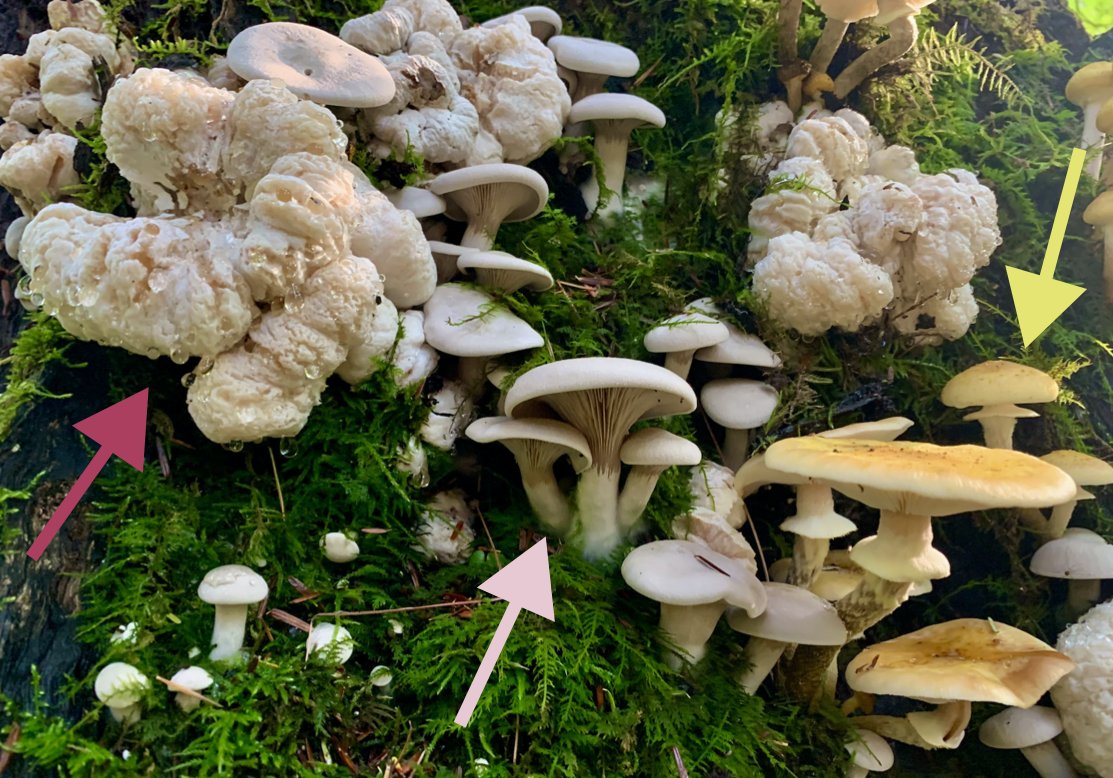
I’m happy to announce new work with @numberthree on the putative mycoparasitic interaction between Armillaria and Entoloma abortivum that was just published in mSystems! Thank you @BenLemmond for providing the best photos of this system I’ve ever seen!
I neglected to announce that our study on #mushrooms that parasitize other mushrooms is out in @mSystemsJ. I've wanted to study this particular interaction for over 20 years and I was so happy @guyanagaster was on board! https://t.co/PYwBVPfN3z
Excited to be a part of this great collection of reviews for the @CurrentBiology special issue on biodiversity along with mentor @hyphaltip: “Fungal biodiversity and conservation mycology in light of new technology, big data, and changing attitudes”
https://t.co/MpMMas7gll
Awwwww @BlaiseJumbam! You have no idea how this brightened my day to see your smile and read your story!!! Great piece!!!! Check it out everyone and see the important work he’s doing!!! 😁😁😁 https://t.co/OwI25SNzBn
Hey #mycofam! I am working on a project regarding the #mycoparasite Entoloma abortivum. Does anyone have an photos where the entoloma and armillaria mushrooms, as well as the carpophoroids, are all together that you’d be willing to share? I will be so thankful for any assistance!
Super excited for Rachel's talk today titled "Fungal symbiosis in the tropics: understanding how interactions with plants, birds, and termites shape the evolution and diversity of fungi" 🍄🌳 @guyanagaster@UFTropical@UFPlantPath
And this landed me the Best Graduate Student Poster Award @MSA2021 @BSA2021 conference. Many thanks to all who contributed to this accomplishment that fits well with the Best Teacher's Award that my advisor received at the same event. AimeLaber forever.
Using over 16,000 fecal samples 🐵, we found microbiome heritability is widespread in the @AmboseliBaboons. These longitudinal data may explain why heritability is more pervasive in baboons than in humans.
Check out our latest work in @ScienceMagazine: https://t.co/chmvmDrAaV
@kasson_wvu @NickRajtar@forestmycology@FungiwithBengi@retronek@wvudavis @beetle_mom @HosannaDB @lovettbr @FungaLoyd A-M-A-Z-I-N-G! Thank you for checking! If you need a home for that collection or want to do some follow up on that Armillaria species let me know! I’d be happy to help! Too cool!
@kasson_wvu @NickRajtar@forestmycology@FungiwithBengi@retronek@wvudavis @beetle_mom @HosannaDB @lovettbr @FungaLoyd COOL!!!! Armillaria hyphae live inside the sclerotia! In a study on that interaction in FUSE in 2019, it looks like the Armillaria with a Wynnea collection from WV represents a new species, so could be fun to further investigate!
So so excited that my paper on the biology of #Guyanagaster is finally published. https://t.co/jPXGkp0bnW We show that this fungus harbors active nitrogen-fixing bacteria within its sporocarps, which results in an increased nitrogen content of its tissues.