Best hooks on Meta for each funnel stage (from a guy who’s made 10,000+ ads):
TOF:
• “I swapped this for this”
• “Most X isn’t X anymore”
• “Here’s 4 truths about X that’ll change the way you do Y forever”
MOF:
• “This is not your regular X” (our Portland Leather ad)
• “I’ve been doing X for Y, so you don’t have to”
BOF:
• “There’s a double discount on X right now”
These are the 3 Meta ads metrics I track beyond just ROAS
ㅤ
1. Cost per add to cart
→ The clearest signal of which ads are bringing people into the funnel
→ Low cost per ATC + low CPC = the ads doing the real top of funnel work
→ These are your best ads, even if the ROAS sucks
ㅤ
2. Add to cart rate
→ Tells you how your offer and landing page are holding up with the audience each ad pulls in
ㅤ
3. Checkout to purchase rate
→ Helps me spot when an ad is worth keeping on
→ People are moving through the funnel but haven't converted yet, so be patient, don't pull the plug
→ A dropping rate can also mean something's wrong with your checkout or shipping offer
ㅤ
Together these 3 will help you identify winners & losers way before your ROAS does
You DON’T Need TOF/MOF/BOF Campaigns
Here’s what’s really going on under the hood with Facebook’s targeting + retargeting behavior:
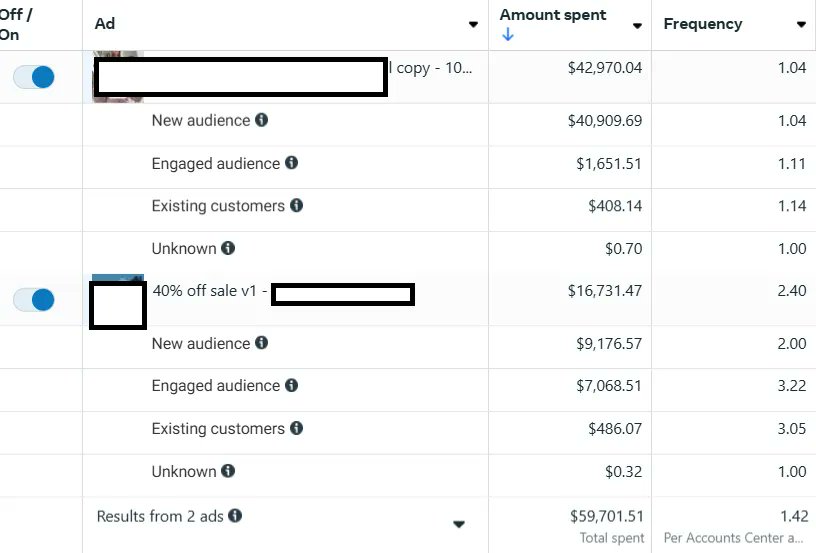
Let me show you with two ads that are absolutely printing inside my ASC scaling campaign.
The biggest budget hog is a short mini‑VSL.
It’s sitting at a 1.04 frequency, which tells you it’s mostly hitting cold, first‑time viewers, and the audience breakdown backs that up with a heavy lean toward new customers.
On the other side, there’s a dead‑simple image ad pushing a 40% off deal.
It spent about 2.5x less, but it’s running at around twice the frequency—aka it’s repeatedly showing up in front of warmer people: engagers, site visitors, anyone already aware.
And that’s the point:
Facebook is already doing the TOF/MOF/BOF sorting for you by matching each creative to the audience most likely to respond, without you manually slicing campaigns into little funnel buckets.
Which is why spinning up a separate retargeting campaign is basically doing extra work for the same outcome.
You gotta leave room for stuff you can't measure but Meta can and does.
Meta knows waaay more about users and your ads that you can't see.
Think about the number of people who see but don't click the link on your ads every day.
You can't know if someone watched 90 seconds of a top of funnel ad, read every comment on it, clicked to your IG profile, watched five organic posts, and shared the ad to their partner, but didn't click the link.
No way for you to know:
A. What a single user did all of that, but it's normal high-intent behavior.
B. What the next ad will be after they do all that or why, but Meta knows.
C. How many ads someone saw, engaged with, or clicked, before they converted.
D. Why or how Meta sequenced the ads that got them to buy.
E. How any of this interacted with your other efforts, like emails...
This is a problem with both in-platform and third party data.
At scale, with good data, if Meta wants to spend on ads or ad sets, that's a good sign.
How should you deal with this?
1. Remember that humans are imperfect and marketing isn't exact.
2. Have a higher CPA and ROAS tolerance for ads and ad sets for colder audiences.
3. Focus more on ads and ad sets ability to spend instead of CPA or ROAS
4. Focus on total account CPA and ROAS more than granular levels that overlap
5. Study your audience segment breakdown ratio (new vs engaged) to better understand where your budget is going for those ads and ad sets.
6. Trust Meta more (when it's optimized properly and getting lots of good data!)
If you're optimizing for the wrong actions or not giving Meta enough data, none of this will work well.
5 ecom categories I wouldn't get into in 2027 (and yes, I see the irony on #5)
1. Men's accessories
Glasses, jewelry, rings
2. Phone accessories
Couldn't pay me enough to get in this space at ALL
3. Bottles and drinkware
Honestly, 1-3 are all just getting so much cheaper and cheaper and cheaper
4. THC
Gummies, vapes..that window is going to close in about a month
5. Beverage
You couldn't pay me to get into a beverage ever again (trust me on this one)
What else would you guys stay out of in 2027?
"just make a good product!" Ok? What is good product? lol.
What matters is
product your audience thinks is good
with a big enough TAM
that works well in the channels it is a fit for
All three at once.
It's way more important to have a full funnel running in your ad account than most brands realize.
Most run plenty of top of funnel ads to reach new people, and bottom of funnel ads to push the offer with urgency and scarcity.
But then they skip the middle of funnel almost completely.
That's where most objections need to be handled.
Someone already noticed your brand and showed interest, now they just have doubts.
Maybe they think it's too expensive, or they don't trust the brand yet, or they're not sure it actually works.
Go through your reviews, comments, customer service tickets and see what objections people keep bringing up, then start making ads specifically to overcome those.
Here are some great examples👇
https://t.co/ptsyap66Wk
this is the top spending youtube creative in one of our accounts:
- introduces the problem
- challenges common belief about the cause
- lists everyday struggles
- mentions failed solutions
- reveals hidden cause
- establishes scientific credibility
- explains unique mechanism behind the problem
- exposes limitations of conventional tests
- aggravates social embarrassment
- explains why conventional solutions fail
- reframes the real problem
- introduces brand and product
- introduces unique solution mechanism
- breaks down ingredients and their benefits
- explains how ingredients work together
- highlights ease of use
- paints desired outcome
- guarantee
- limited-time offer
- final CTA
Today's growth is the result of the investment, sacrifice, and work that was put in months and years ago.
A great example is trees.
When a tree is planted it seems dormant for an extended period. But it is doing the hard work.
Once its roots are established, it flourishes.
I work 2 hours a day, and our skincare brand has done $100M+ in lifetime sales.
This is the system that got me here without stalling growth:
1. Go to Claude. Enter this prompt:
5 characteristics that make a product more suited for e-commerce than physical retail:
1. Inexpensive to ship
Physical retailers like Walmart have amazing supply chains and economies of scale. If an item is bulky or heavy then it will cost significantly more to ship it to a customer than to get it on a shelf.
2. Low return rate
E-commerce returns are insanely inefficient. If a customer buys an item, returns it, and is sent a replacement then that item has to be shipped 3x. Items that have low single-digit return rates are able to avoid the financial catastrophe of ecom returns.
3. Customers want breadth of selection
Physical retail is always built around the majority preferences out of necessity due to limited shelf space. Products that have lots of color, size, style, or feature options can capture a much larger % of customer demand online.
4. Not perishable
Perishable items increase the complexity of inventory management by an order of magnitude. In addition, they add costs to the delivery process because usually, the item requires some sort of additional packaging elements to keep it cold.
5. Do not require sampling in-person
Even if you know your measurements, buying jeans from a new company online has a high risk of disappointment. Ditto if your product has to be seen, smelled, or touched to really appreciate.
These characteristics are the reason some products are seeing their sales mix move online while others are still rooted in physical retail.
The future is omnichannel.
This chart might be the most important thing you look at today. I notice 4 things:
1. Invest in your relationship with your spouse. The quality of that relationship will go a long way in defining your happiness in the second half of life.
2. Time with your kids is precious and fleeting. Take advantage of the years where you can get several hours a day with your children. There will not be many of them
3. Develop the skill of using time alone well. The person you will spend the most time with in your life is you.
4. This is a graph for Americans. It shows just how isolated people become in our culture as they age. It doesn’t have to be that way. Take steps now to make sure that you are surrounded by community as you grow older.
Meta doesn’t know who your customer is...but it does know what your customer 𝘥𝘰𝘦𝘴.
When you run broad targeting on Meta, you aren't really bidding on "personas" anymore.
You’re paying the delivery system to test human reactions to your creative in real time.
Here is how the algorithm matches your ads to potential customers 🧵👇
𝗦𝘁𝗮𝗴𝗲 𝟭: 𝗦𝗰𝗮𝗻𝗻𝗶𝗻𝗴 𝘁𝗵𝗲 𝗰𝗿𝗲𝗮𝘁𝗶𝘃𝗲.
Meta doesn’t inspect bios or interest stacks anymore. Instead, it scans your ad’s audio transcript, on-screen text, visuals, and pacing, then simply tracks and predicts in real time who might slow down their scroll to watch it.
𝗦𝘁𝗮𝗴𝗲 𝟮: 𝗣𝗮𝘁𝘁𝗲𝗿𝗻 𝗿𝗲𝗽𝗹𝗶𝗰𝗮𝘁𝗶𝗼𝗻.
If your ad gets a specific reaction from a small cohort (e.g., stopping to read a chart or graph in your ad), the system will then test it on other users who also usually pause to read charts. It then groups them by behavioral 𝘩𝘢𝘣𝘪𝘵𝘴...even across totally unrelated topics. 🤯
𝗦𝘁𝗮𝗴𝗲 𝟯: 𝗔𝗰𝘁𝗶𝗼𝗻 > 𝗗𝗲𝗺𝗼𝗴𝗿𝗮𝗽𝗵𝗶𝗰𝘀.
The auction doesn’t really care if someone is 22 in Miami or 55 in Denver. If both stop to watch a clip of a super in-depth chart or graph, they get tagged with that behavior and share the 𝘦𝘹𝘢𝘤𝘵 𝘴𝘢𝘮𝘦 behavioral bucket. AKA: you get served based on 𝘩𝘰𝘸 𝘺𝘰𝘶 𝘣𝘳𝘰𝘸𝘴𝘦, not who you are on paper.
𝗦𝘁𝗮𝗴𝗲 𝟰: 𝗖𝘂𝗿𝗿𝗲𝗻𝘁 𝗶𝗻𝘁𝗲𝗻𝘁 𝘄𝗶𝗻𝘀.
Something a user does today will outweigh their long-term history (which is bonkers, if you think about it!). Someone watching comedy for 3 months who suddenly spends 20 minutes researching back pain gets categorized for back pain, and their feed changes instantly. The feed delivers for 𝘢𝘤𝘵𝘪𝘷𝘦 intent, not an outdated profile tag.
(I think this is why manual interest targeting is fading so quickly. Trying to target the tag "interested in dogs" isn't going to hold up when the user just binged 10 funny cat videos in a row...)
You don’t select an audience inside Ads Manager; your creative does that for you. And if you start designing for 𝘢𝘤𝘵𝘪𝘰𝘯𝘴 instead of 𝘪𝘥𝘦𝘯𝘵𝘪𝘵𝘪𝘦𝘴, you can tap into entirely unsaturated audiences at cheaper CPMs much faster.
Example: say you're selling a premium ergonomic office chair.
The crowded pool goes after: remote tech workers.
(High overlap, brutal bidding wars, sky-high CPMs).
You're smarter than that, though, because you read this post 😅. Instead of targeting that interest tag, you build creative around 3 different consumer behaviors:
1️⃣ The "spreadsheet" watch behavior
Format: A first-person, giant spreadsheet comparison yapper of 14 chairs tested over 1,000 hrs, measuring foam sag.
2️⃣ The "How It's Made" watch behavior
Format: A pro-produced walkthrough of the entire manufacturing process.
3️⃣ The "bad habit" watch behavior
Format: A real user review: "If you sit on one leg by 2 PM every day, your seat pan depth is misaligned."
These 3 pieces of content all promote the exact same product, but the system indexes those formats independently and routes your ads into fresh buyer pools competitors ignore.
To scale creative under modern delivery models, test formats that prompt specific physical actions:
• Stress Tests (durability, torture tests, failure demos)
• Teardowns (internals, build quality, materials)
• Contrasts (cheap vs. premium, old vs. new)
• Audits (scoring rubrics, grading sheets, ratings)
• Corrections (mistakes, bloopers, "don't do this")
• Borrowing (shop setups, adjacent trade visuals)
• Symptoms (habit callouts, physical quirks)
• Raw Proof (spreadsheets, bench tests, data logs)
• Tool Stacks (software setups, equipment teardowns)
• Before/Afters (process timelapses, real-time transformations)
• Exposés (industry secrets, vendor pricing, markup myths)
• Protocols (step-by-step SOPs, daily routines)
• Debates (provocative questions, unpopular takes, trade lore)
• Stress Audits (calculators, cost-per-use, loss estimators)
📍 TL;DR: Platforms don’t run on manual demographic checkboxes.
They follow interaction sequences.
Your creative is your targeting system. Target the 𝘸𝘢𝘵𝘤𝘩𝘪𝘯𝘨 𝘣𝘦𝘩𝘢𝘷𝘪𝘰𝘳, not the persona.
(END OF YAP. 😅)
*Disclaimer: This is my interpretation of Meta's documentation around Andromeda, GEM, and the new targeting system we're dealing with in paid advertising, what have you guys seen??
One of the cool things I'm working on at the moment is combining my 12 month marketing forecast with my merchandising dashboard.
The marketing forecast sets the revenue target. Ops buys the inventory needed to hit it. In most brands I speak with, these 2 plans sit in separate functions with little communication or alignment.
The goal is to connect them, so the spend and revenue marketing is planning for gets converted into units by product that ops can use when buying inventory.
The Problem
Ops teams usually forecast inventory in a few ways:
- Sales velocity and weeks of cover
- Last year’s sales for the same period plus a % uplift
- Inventory software with its own forecasting methodology
These are good at what they’re built for, like lead times, stock on hand and reorder points. But none of them can see how much marketing plans to spend, or marketing’s revenue forecasting scenarios, if they even exist.
The typical marketing forecast methodology has its own issues. Often it’s a basic % monthly uplift with some bad assumptions, like flat or decreasing CAC as spend scales. And even a good one usually stops at total revenue. It doesn’t take into consideration the distribution of products that revenue is made of.
Finance has the P&L and cashflow model, but the revenue line is usually a top down budget that doesn’t move when product mix or spend and aMER changes.
So I think this is mostly a system problem. Each forecast is reasonable on its own, but nothing connects all 3.
How It Works
The marketing forecast sets the main revenue expectation. It forecasts spend, aMER, new & returning customer revenue and contribution $ each month across Conservative, Base & Stretch scenarios.
The merchandising layer then converts that revenue into units. It takes each product’s historical % of new and returning customer revenue for that month, applies it to the forecast, then divides by average selling price. So Nov’s forecast gets Nov’s historical mix, which means seasonality is built in.
This approach only works for existing products. New launches have no history, so assumptions need to be added manually.
Validation
Before ops relies on it, the plan is to build the unit forecast on historical data and test it against actual sales the model hasn’t seen.
Then compare that to what ops’ current method would have forecast for the same period. This shows where each one is accurate and where it’s off, by product and by month.
Department Forecasts
This doesn’t mean marketing should replace ops forecasting.
I think marketing, ops (or product) & finance should each have their own forecasts:
- Marketing: spend, aMER, new & returning revenue, and CM $
- Product: inventory, new launches, COGS + variable costs
- Finance: P&L, cash, fixed costs
The overlap is where important conversations happen:
- Marketing & Finance: spend budget & contribution margin
- Marketing & Product: launch timing & stock for moments
- Product & Finance: purchase orders & cash tied up in stock
The Result
Alignment on expected net profit, while minimising knowledge gaps between departments.
Marketing gives ops 3 revenue scenarios and forward looking units. Ops brings their view from sales history, lead times and new launches.
The correct answer is probably somewhere in the middle.
“I’m all out of new ideas for video ads”
Here’s a board where I share my favorite top performing video ads, updated weekly.
Must be a top 3 ad in the brand’s account, live at least 21 days, 90s min runtime to filter out BOF ads:
https://t.co/GoTSEHr5S9
“We were up 90% year on year going into Q4. Then October 1st we hit a brick wall. November’s 20% down and we didn’t even change a thing.”
A founder sent me that this week.
First thing we checked was reach, not ROAS.
Last year the account reached about 3 million people a week, each seeing the ads 1.8 times.
This year, 1.3 million people were reached, seeing the ads 3 times.
Spend was only up 4%, while frequency was up 50%.
They had the exact same budget both years, however this year they have a smaller audience who are shown the same ads more often. The funnel has shrunk, and October is when that starts to hurt.
Two things were driving it:
1. The account was still optimizing on 7-day click only, so Meta had fewer signals from people who watch without clicking and kept going back to the same buyers it already trusted.
2. Some campaigns were spending more on Engaged audiences than New.
Founders don’t necessarily look at reach or frequency, which is usually where the answer lies. They care about being down YoY.
BFCM makes it worse.
Across our accounts, spend runs at 1.79x normal daily budget for 30 days straight. If you’re already showing the same people the same ads, that extra budget is being outright wasted.
Right now, go to your account and check these three things:
1. Weekly reach vs last year
2. Frequency vs last year
3. Spend split between New, Engaged and Existing in Audience Segments
If reach is falling and frequency is climbing, fix it right now.
I think sometimes people blame rising CAC on Meta when in reality it's just that the low hanging fruits are gone and they ran out of reachable TAM.
Every brand has a natural steady state ceiling of reachable TAM based on a multitude of factors, the most fundamental variables are your product, price and positioning within the market.
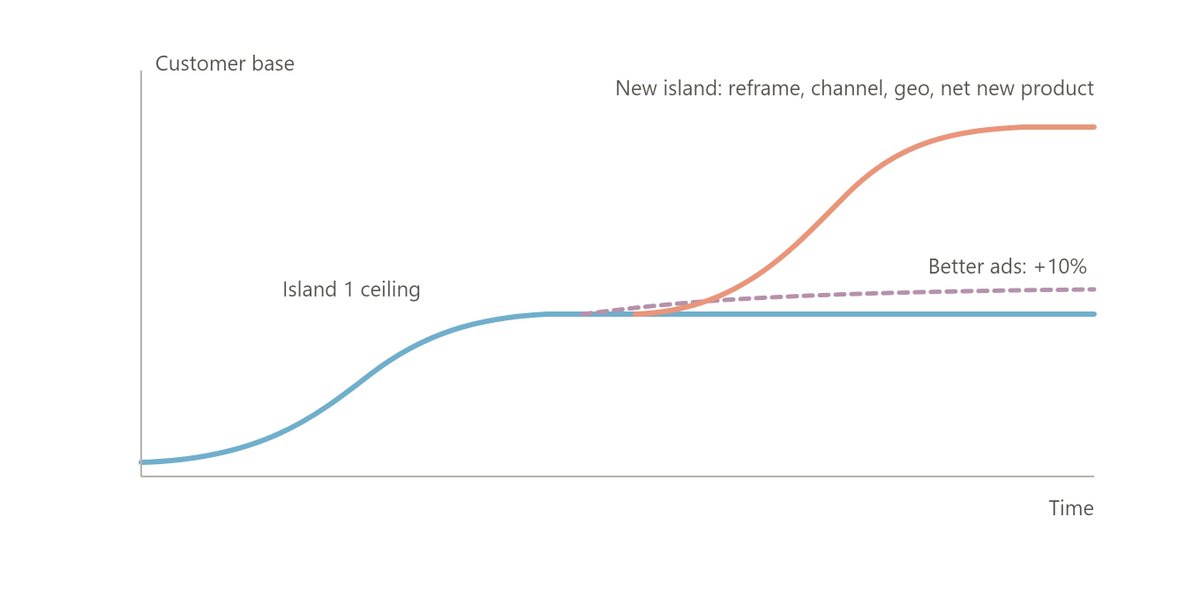
At the beginning, your product is indeed novel and thus you can acquire customers easily, like a new species that just arrived on an island with no natural competitors with abundant resources.
Your CAC will be low, your population growth rate is fast.
You will scale very fast and feel like a god.
But the island will eventually run out of space, hit its carrying capacity and you will only able to acquire at the natural "resource renewal rate" of the island.
- New entrants into the category since they now suddenly need that item, often times they are aging into the category as time is the defining factor of forcing change in people's lives. This grows at the rate of population growth of the cohort.
- Repeat purchases. This is the actual place where the "brand" lives and competes.
- Switching from competitors.
- Cultural change. This can be a giant shift in theoretical TAM but not easy to shift culture obviously. Mostly luck.
Once you hit that reachable TAM ceiling, you may be able to make better ads to communicate your values better but it will be incremental at best.
You can continue to try to "just make better ads" but that's an never ending paddle that is not durable. As soon as you are out of touch with culture you are done.
Some smarter marketers will say "just reframe the positioning towards a different audience and expand the category". That is smart and will work. It gives you another "island" to go into and exploit but eventually it will run into the same problem.
Once you hit that diminishing return, if you still want to only focus on that product because theoretical TAM is large, you have to focus on category expansion via reframe, channel + geo expansion or serve the repeat purchasers/switchers from competitors better.
The mindset is very different to funnel hacking and requires longer time horizon.
From my experience, precisely because Meta is efficient at finding you customers, it will also precisely ends and marginal CAC rises rapidly once you hit that wall.
This entire S curve journey can take 1-3 years which is a life time for online discourse but it will hit you like a truck and that's how many brands die because "it came out of nowhere and we over extended" and they then blame Meta or competition but it was inevitable.
If your goal is to build something durable, the entire game is to continually spot new islands to hop to and identifying when you will hit the carrying capacity of the island you are on with no ego.
It's easy to look at the other competitor and go "oh but they are doing $1B so I should be able to do $100M".
Yes that is indeed your theoretical TAM but it's differrent to your reachable TAM.
Pretty much all discourse about brands and growth should be view through this lens first in order for it to be maximally productive.
Hope the graphs help.