@Hippius_cloud is a Huggingface replacement.
I've used it for decentralized training, hosting quadrillion token datasets, and tens of thousands of models.
It works, its cheap, secure, reliable, and runs on encrypted compute contributed by a community of miners across the world.
Best bet replacement IMO.
https://t.co/7j1TX90Xvj
JUST IN: 🇬🇧 $2.3 TRILLION BARCLAYS JUST ANNOUNCED IT BOUGHT OVER $54,000,000 WORTH OF #BITCOIN
THEY NOW OWN OVER $165,000,000 WORTH OF BTC
ONE OF THE UK’S LARGEST BANKS IS STACKING SATS 🔥
Bittensor unveils quantum-resistant wallets.
As AI renews debate over cryptographic security, the update gives users post-quantum signatures and the option to replace signing keys automatically.
Revolut: Europe's most valuable startup ($200B) just showed the world its AI strategy.
Every company will end up copying it.
At the start of this year, Revolut leaned on the frontier labs. Its 2,000 engineers used Claude Code and Codex, and some burned $1,000 to $10,000 a month each. The bills kept climbing, and the returns weren't there.
So Revolut switched its default to an open-source model called GLM. All it needs is GPUs, which it rents from Together AI.
The results, by Revolut's own count:
- The bill is about a tenth of what it paid OpenAI and Anthropic
- Engineers get unlimited tokens instead of spending caps
- Coding time is down 60% and lead time is down 70%
That's the chart below.
Revolut still uses Claude and GPT, but only as "the exception," for the tasks they do best. Everything else runs on open source.
So here's the question I keep coming back to: how many use cases can companies really justify sending to frontier models?
My answer is very few. Plenty of companies still route everything to OpenAI and Anthropic today. For how long?
I think open source ends up handling the vast majority of corporate AI work, and frontier models get a short list of the hardest jobs. That's a problem for labs whose revenue forecasts assume unlimited growth.
If you appreciate unpopular takes, follow me @m0xt_ for more.
Some people are calling the $6 billion Binance hack the biggest heist in history.
For context, the Federal Reserve printed almost $4 trillion in 2020...
The Binance hacker might have just executed one of the most brilliant moves in crypto.
First, Tether froze $1.5 billion worth of USDT.
Then Circle followed by freezing another $800 million in USDC.
At that point, it seemed like the hacker’s funds were completely trapped.
But apparently, he had already thought several steps ahead.
Rather than keeping the stolen USDT in a wallet, he allegedly deposited it into Aave and used it as collateral to borrow ETH.
Then he walked away.
And this is where things get really interesting.
Tether can freeze the USDT sitting in that wallet.
But it can’t freeze the ETH that was already borrowed.
So now, Aave is left with frozen collateral, while the hacker is holding liquid ETH.
And unless the protocol finds a way to recover those funds, he might not even have to repay the loan.
Two companies froze billions of dollars in seconds.
Yet someone who understood how DeFi works may have found a way to bypass both restrictions.
Pretty wild when you think about it.
We announced an agreement to acquire a nationwide low-band spectrum license portfolio that will pave the way for @Starlink to become a major mobile carrier in the US.
With this new spectrum and our Gen2 constellation, Starlink Mobile can ensure Americans have access to high-speed mobile broadband no matter where they are → https://t.co/1Uaf48v5pm
Important note regarding Grok @Bot:
Going forward, @SpaceX will use the best back end model for any given task, including Claude Opus 5.5, MidJourney, Suno and other leading APIs.
Whatever is most likely to give you the best outcome.
September was a big month for @LeadpoetAI.
Doubled sales.
Started our sales agent competition.
Rolled out outreach to early users.
Presented at Exploit.
Now for October:
Double sales again.
Keep pushing the frontier of sales intelligence.
Launch our biggest product update yet.
Help more subnets go to market.
What excites me most is how these pieces are starting to reinforce each other.
The product improves. The pipeline grows. The competition gets stronger.
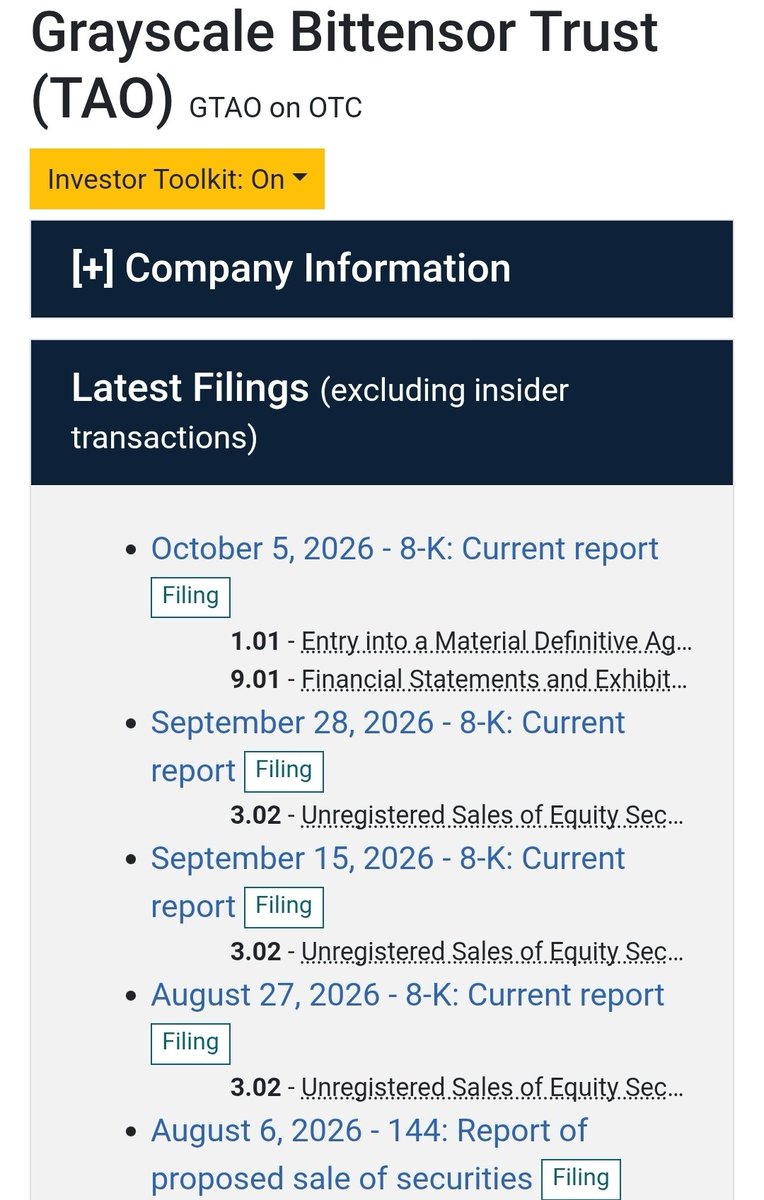
🚨 Coinbase. BitGo. Grayscale. One trust. One asset: $TAO.
Wall Street's plumbing is going in under Bittensor, and it's all in the SEC filing.
The Oct 5 filing confirms:
• Sept 29: the Grayscale Bittensor Trust joined Grayscale's Coinbase Prime Broker Agreement, including custody
• Coinbase will custody a portion of the trust's $TAO, held separate from its own assets and other clients'
• BitGo stays primary custodian under an updated agreement
• Grayscale ties the extra custodian to risk management as the trust grows
It's more than one filing:
• The April 2 amended S-1 said they intended to engage Coinbase Custody before the registration statement goes effective. The September agreement is that step, done
• The BitGo amendment (Exhibit 10.2) references GTAO's registration statement for listing its shares as an ETP
• TAO held: 36,193 to 46,332 in H1, up 28%
• Then another 2,869 TAO (about $891K) contributed, per the Sept 28 filing
Not hiding it:
• No approval timeline. The latest S-1 amendment is still April 2. No effectiveness notice, no launch date
• Grayscale added custodians to other products on Oct 5 too (Anchorage on its CoinDesk Crypto 5 ETF), so part of this is routine
• Contributions can be in kind, so they aren't necessarily fresh market buying
Fair.
But look at the direction.
Nobody builds custody rails for an asset they plan to ignore.
If approval comes, $TAO becomes buyable in a brokerage account. Net creations will show whether that becomes real demand against about 3,600 $TAO a day of issuance.
I'm watching for an effectiveness notice, a final prospectus and an official launch announcement.
The filings are public.
Read them yourself:
https://t.co/B2CdkvUVwT
Sources: SEC filings (Grayscale Bittensor Trust), Grayscale research.
$TAO / DYOR.
When I started Coinbase, getting a bank to work with us at all was nearly impossible.
Now Citi is partnering with us to bring stablecoins to institutions.
We’ve come a long way from 2012. Thank you @Citi.