Black Friday Giveaway!
Win FREE access to:
1 CRTP seat
1 CRTE seat
How to participate:
1. Like and follow @AlteredSecurity.
2. Comment which course you're interested in and why.
3. Repost this post.
Winners will be selected at random and announced on 27 November 2026.
Our Black Friday Sale is also LIVE! Get 20% OFF on all courses and bootcamps, plus an additional 5% OFF when purchasing 2 or more items.
Grab the offer now: https://t.co/hp0GLwqSIz
Microsoft Threat Intelligence has published a detailed analysis of the phishing campaign exploiting the November 12 Microsoft 365 service disruption, an example of threat actors exploiting notable global incidents in social engineering lures. https://t.co/AnGgiciktm
The campaign uses emails disguised as legitimate Microsoft 365 service-health notifications to target organizations across multiple industry sectors worldwide. Microsoft Defender blocks malicious domains used in this campaign, and Microsoft Defender for Office 365 blocks and quarantines phishing emails.
We assess that this activity was likely credential phishing, but available evidence does not confirm credential capture, malware delivery, or post-compromise activity. If credentials were entered, organizations should consider the risk of account compromise, mailbox access, business email compromise, internal phishing, and access to cloud collaboration data.
Read the blog for IOCs, Microsoft Defender XDR hunting queries, and mitigation guidance.
Malware analysis looks scary until you notice it is a method.
9 resources that teach it in order:
roadmap → book → workshop → course → fundamentals → toolkit → sandbox → real samples
Names and links in the replies.
As promised, sharing my presentation and some useful resources from my session at 𝗢𝗪𝗔𝗦𝗣 𝗚𝗹𝗼𝗯𝗮𝗹 𝗔𝗽𝗽𝗦𝗲𝗰 𝗨𝗦𝗔 𝟮𝟬𝟮𝟲! 😊
My session,“𝗢𝗪𝗔𝗦𝗣 𝗠𝗖𝗣: 𝗧𝗵𝗿𝗲𝗮𝘁 𝗠𝗼𝗱𝗲𝗹𝗶𝗻𝗴 𝗮𝗻𝗱 𝗗𝗲𝗳𝗲𝗻𝗱𝗶𝗻𝗴 𝗠𝗖𝗣 𝗶𝗻 𝗔𝗴𝗲𝗻𝘁𝗶𝗰 𝗔𝗜 𝗔𝗽𝗽𝗹𝗶𝗰𝗮𝘁𝗶𝗼𝗻𝘀, focused on something I believe we need to pay much more attention to as we build AI-powered applications.
A few people reached out asking for the slides and resources, so here they are!
📎 𝗣𝗿𝗲𝘀𝗲𝗻𝘁𝗮𝘁𝗶𝗼𝗻: https://t.co/dYJHtwEh9x @owasp
Stop learning AI backwards.
Most people are jumping straight into RAG, AI Agents, and whatever new framework is trending.
But they can't explain how the underlying LLM actually works.
That's not learning AI Engineering. That's collecting buzzwords.
Stanford just gave you a better path. For FREE.
CME 295: Transformers & Large Language Models.
9 lectures. 16+ hours. The entire modern LLM stack explained in the RIGHT order.
Here's the roadmap:
1️⃣ Transformers
Tokenization → Embeddings → Attention → Transformers
2️⃣ Model Architectures
MHA → GQA → RoPE → BERT
3️⃣ Large Language Models
Mixture of Experts → Prompting → Context Windows → Chain-of-Thought
4️⃣ LLM Training
Pretraining → Distributed Training → Quantization → LoRA
5️⃣ Post-Training
SFT → RLHF → PPO → DPO
6️⃣ AI Reasoning
Reasoning Models → GRPO → Inference-Time Scaling
7️⃣ AI Agents
RAG → Advanced Retrieval → Function Calling → ReAct Agents
8️⃣ LLM Evaluation
LLM-as-a-Judge → Evaluation Metrics → Bias Detection
9️⃣ What's Next
Multimodal AI → Vision → Diffusion Models
And Stanford includes:
✅ Lecture slides
✅ Companion cheatsheet
✅ Midterm + final exams with solutions
✅ Full lectures on YouTube
Here's why I think this matters for Data Scientists:
You already understand Python, statistics, and machine learning.
That's a MASSIVE advantage.
But the AI landscape has changed.
Now you need to understand how foundation models are built, trained, optimized, and used in real applications.
Not just memorize the latest framework.
And here's the part most people get wrong:
Learning RAG doesn't make you an AI Engineer.
Neither does learning LangChain or building a chatbot.
You need to understand how the pieces fit together.
Then USE that knowledge to build real AI systems.
Stanford gives you the foundation.
Your job is to turn it into something useful.
Stop collecting AI tutorials. Start connecting the dots.
Stanford CME 295. FREE on YouTube.
(Playlist in the comments)
♻️ Repost for a Data Scientist making the leap to AI Engineering.
🚨 Want to learn how to build + ship AI and Data Science projects (that businesses actually want in 2026)?
On November 11th, I am hosting a free workshop to help you get started with AI + DS projects in Python (free).
Register here (500 seats): https://t.co/onpLpRwkzH
ASN enumeration is an important yet frequently overlooked recon method.
Finding the ASN can reveal the target's network ranges.
Tools include:
- https://t.co/uMX4tHKKY3
- https://t.co/z8bIbQABb3
- @Yassineaboukir's ASNlookup
And more!
What tools do you like to use?
Bug bounty tip: you found the bug. Now write a report that gets paid.
The triager has never seen your target. They have a queue of reports and a few minutes for yours.
1. Title says what and where. "Any user can read other users' invoices" beats "Critical bug found."
2. Lead with what an attacker can do. How you found it comes second.
3. Steps anyone can repeat. Then run your own steps from a clean session. One missing step and you get "needs more info."
4. Show proof. Screenshots for simple bugs, a short video for complex ones.
5. Impact in plain words. No "might" or "could." Say what you proved, for this company.
6. Be honest on severity. Call a low a critical and your next report gets read with doubt.
7. AI wrote the report? Fine. Retest every step yourself before you submit.
A valid bug with a bad report is still a closed ticket.
#bugbounty
"The remote server request makes it look like it could be a GIF image that is being downloaded. The file is dropped to C:\programdata\ using a filename that looks like a JPEG image."
Read the full report: https://t.co/HnmGmywfnU
#DFIR#ThreatIntel
🚨 8 Chrome zero-days exploited in the wild in 2026.
Google has now released a security update for the latest one: CVE-2026-125350, a high-severity use-after-free flaw in Chrome's XML component.
An exploit exists in the wild. Attack details remain undisclosed.
Update Chrome. Details - https://t.co/xzM1QDicFf
Andrej Karpathy put his whole AI course on GitHub for free.
7 repos, in the order to learn them
→ nn-zero-to-hero, his video course that builds neural networks from scratch
https://t.co/bUbJjjJtup
→ micrograd, the math that makes AI learn, in a tiny amount of code
https://t.co/fa2H6dHRx2
→ makemore, a small model that learns to invent new names
https://t.co/ILWge5cDuv
→ minbpe, how AI chops your words into tokens
https://t.co/OnazNRnxZI
→ nanoGPT, train your own GPT model
https://t.co/a9aIZtuqw7
→ nanochat, "the best ChatGPT that $100 can buy"
https://t.co/Ws1gcb9J4l
→ autoresearch, AI agents that run AI experiments on one GPU by themselves
https://t.co/wEoFLqoL9d
284,000 GitHub stars between them.
Everything you need to understand how ChatGPT works is free and open source.
Bypassing a top EDR in a crystal clear way.
Building a Crystal Palace reflective loader that hides a Cobalt Strike beacon from EDR by overloading a sacrificial DLL and transferring execution with NtContinue() and synthetic stack frames.
Loader API calls are spoofed with Draugr, sleep is masked by encrypting sections at rest, and Crystal Palace YARA signatures get stripped.
A post and tool by Lorenzo Meacci.
Source: https://t.co/JZ2347SZkZ
#redteam #blueteam
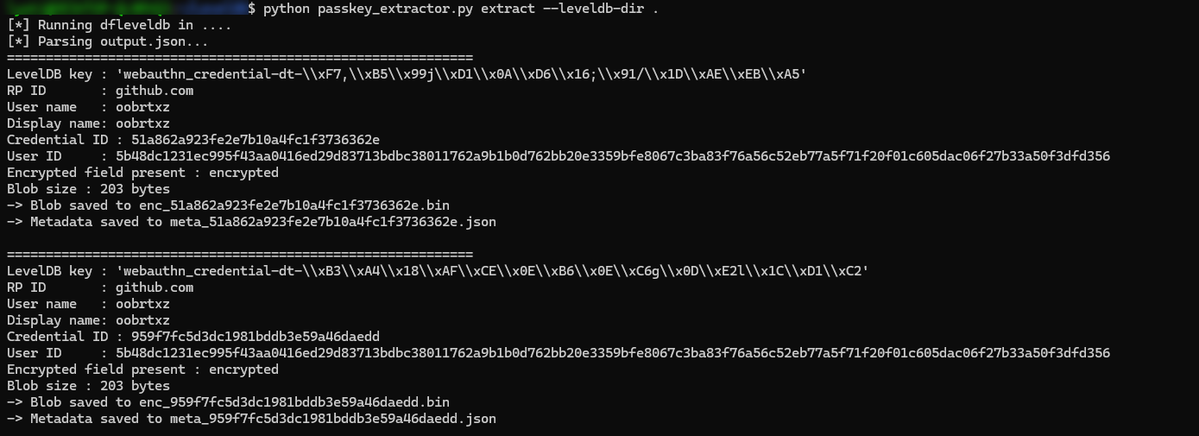
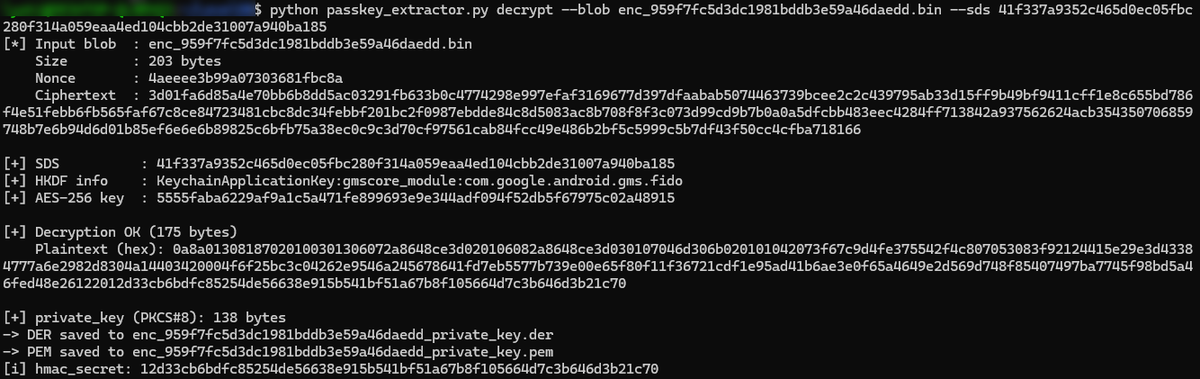
Extracting the Security Domain Secret from Chrome process memory: https://t.co/mXYmtvXD0F
Decrypting GPM Passkeys and Forging WebAuthn Assertions for Account Takeover: https://t.co/PNH0zxfowj
poc: https://t.co/hT6futPtkN
research : @ricpwnme