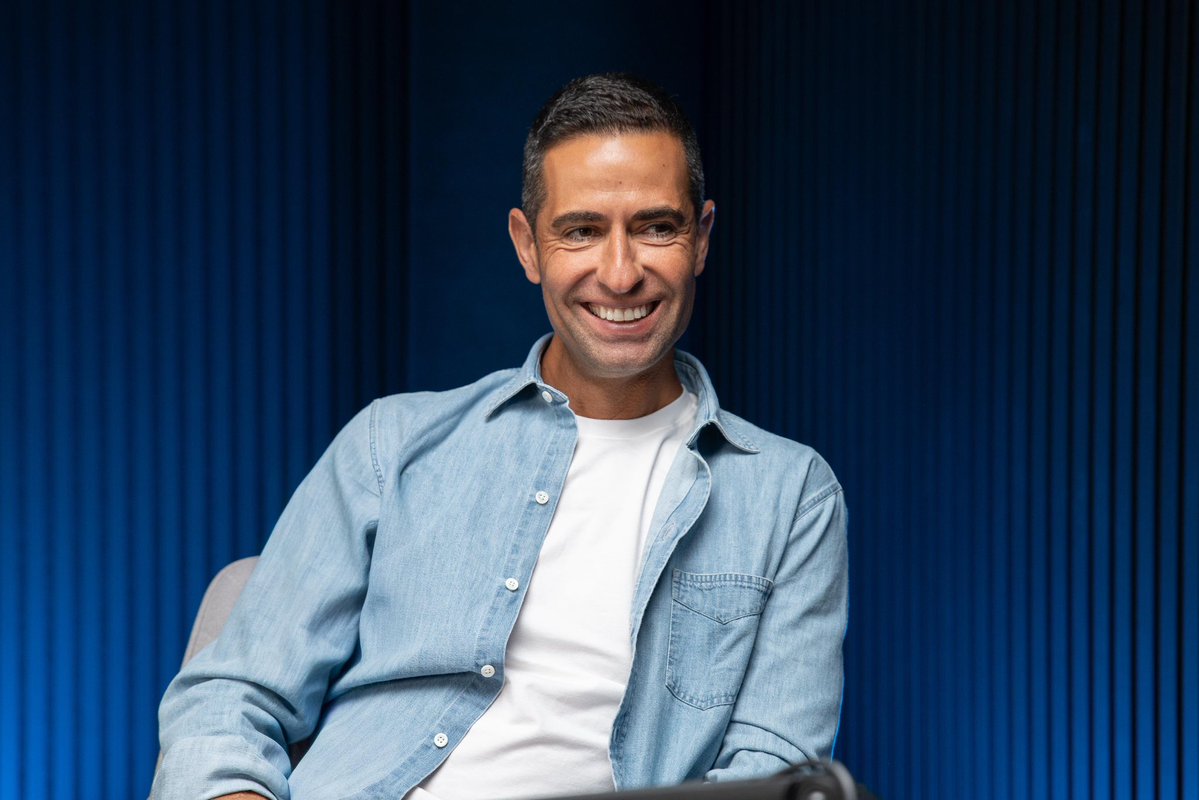
One of the most insane stories in tech and investing is @AnjneyMidha.
- Started his career as a 21-year-old, learning from John Doer and Brooke Byers at Kleiner Perkins.
- He then co-founded a company that sells to Discord.
After selling the company, he then takes his personal money and becomes one of the first investors in Anthropic. To date, he has invested over $300M into the company. WOW.
- He also becomes an angel in @ElevenLabs with @mati.
- He then becomes a partner @ a16z, leading rounds in Mistral and Black Forest Labs with @robrombach.
- He then leaves the golden halls of a16z to found Amp. Building an independent AI grid and next-generation investment firm.
This show has more bangers than a Benchmark portfolio and my notes below:
--------------------------------------
1. The Intellectual Dishonesty of Silicon Valley VCs on Their Marks
Growth funds put pension, sovereign and retirement money into payroll SaaS, fintech and crypto at 2021 valuations, and those marks are not real. Judgment Day is starting now, as GPs try to convince LPs the marks should still hold.
Do you think this is fair and right @honam@infoarbitrage@chadbyers
2. We Have Been Selling Chips to China That We Fundamentally Should Not Have Sold
Large US clusters that universities could use for frontier research have been secured by state-sponsored Chinese labs. One 24,000 cluster was pre-sold to one of the four largest Chinese companies, though American teams were willing to pay. Neoclouds lacked credit support, so they leaned on Chinese labs paying upfront.
Do you think this is fair and what are we not seeing that we should see @rabois@shaunmmaguire
3. Why Is So Much of Venture Capital Glorified Bankers With Spreadsheets?
Much of venture's roughly $800 billion is run by former bankers with no technical or scientific training. Many missed Anthropic's early days and still miss the best infrastructure companies because they don't understand the technology.
Love to hear your thoughts on this and how you see the background of the next decade of VCs @mhdempsey@martin_casado@taavet
4. How Do We Solve the Energy Supply Crisis and Compete With China?
America has over 100 gigawatts of stranded power. Much frontier progress will come from reinforcement learning and post-training, which suit decentralized compute, and about 50% of portfolio compute spend is now in post-training.
What does no one see that every should see about the current energy supply side @ZachBDell@alanchanguk@GavinSBaker
5. Why We Need to Ban Tranched Rounds
Tranches used to market businesses with no execution milestones to LPs for co-investment create markups that are smoke and mirrors. It is the same banker behaviour that led to the subprime mortgage crisis.
Love to hear your thoughts on this @PhilipJohnston@BrendanFoody
6. Why the Inference Layer Is Uninvestable and It Will All Be Brought In-House
Inference is too core to a research team's customer feedback loop to stay outsourced. The best teams buy, partner, then build, as Anthropic and Mistral did, so inference becomes a feature rather than a standalone product.
What is the counter? What does this miss @bernhardsson@deedydas@lqiao
7. Why We Need to Be Much Kinder to Colette Kress and Why She's Doing a Great Job as New CEO
No CFO is more technical on chips, throughput, token prices and supply chain, and Jensen has handed her earnings questions she answers with rigor. Anybody else in her situation would have crumbled. She could be retired but puts the mission and customers first.
(links in comments)
Do wellness checks with your public equity TMT friends today. They need you.
But not @LeadEdgeCapital. Hearing public fund is up 32% gross YTD and down only -1.2% yesterday.
Owning tech that trades at single digit ARR and low double digit CF multiples works after all.
New post
Like many of you, I've sometimes been frustrated by the quality of the discussion about AI in the media and in the political debate ahead of the presidential election in France.
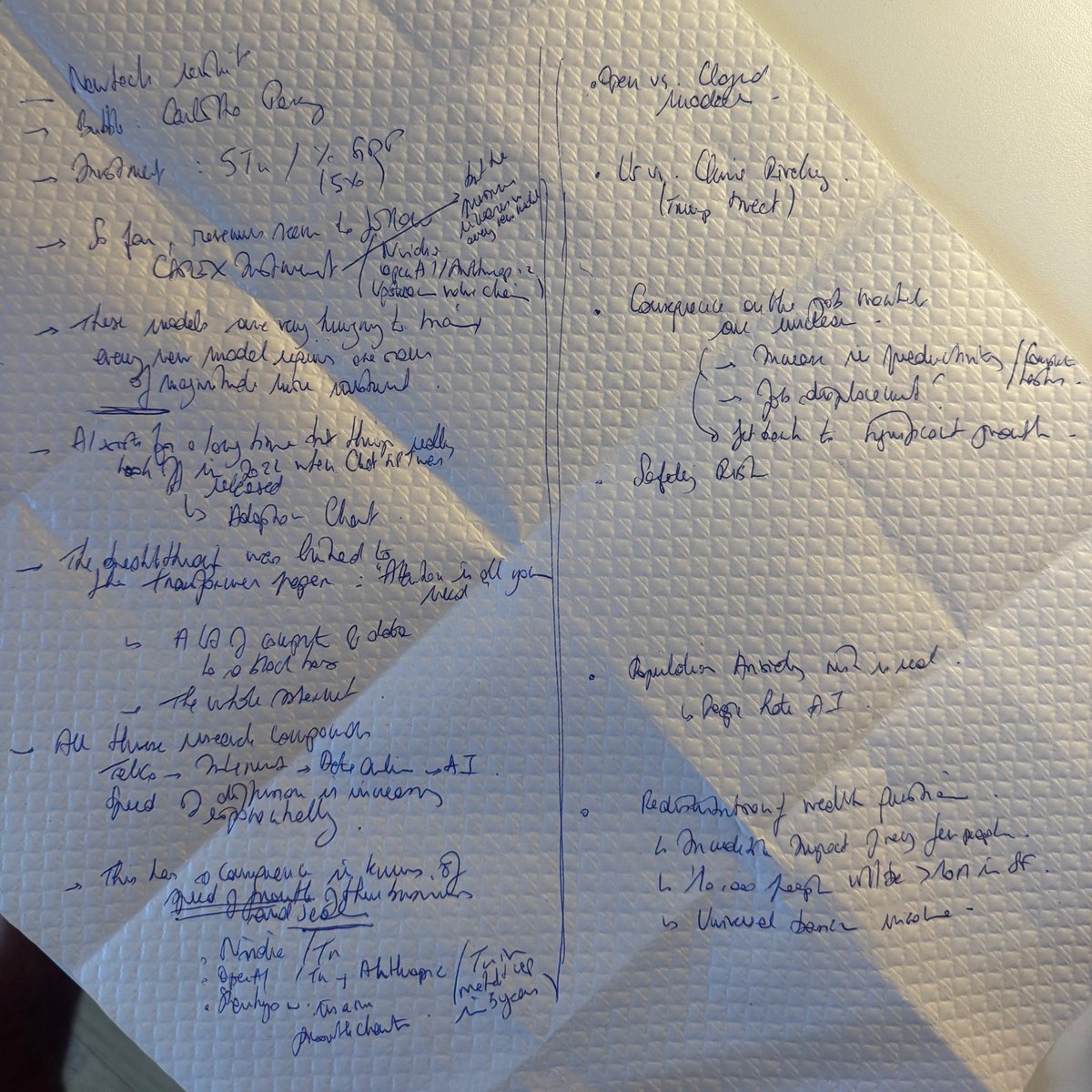
So what started as a conversation in a restaurant at the end of September (napkin in the post) became a 3-page GDoc called "A note on AI to a candidate at the French presidential election”. It's non-partisan, and it's been circulating privately in French for a few weeks. I thought I'd publish it more broadly in French and English below (both GDocs in comments).
No AI slop, just my thoughts and a few graphs and sources dug up by Claude, in 3 short pages.
Probably nothing very new if you follow closely, but hopefully still interesting.
Hope you enjoy!
A peine deux semaines séparent ces deux images que j'ai prises chez @getqonto.
D'un côté, des entrepreneurs qui prennent des risques et des responsabilités, construisent, partagent leurs expériences, leurs ambitions, qui croient au progrès.
De l'autre, le résultat de quelques un qui préfèrent la destruction à la création, la victimisation à la responsabilité, la revendication à l'action.
Bien sûr que c'est un peu schématique, que des frustrations sociales peuvent être légitimes, mais il y a une différence fondamentale entre vouloir changer le monde et le détruire, piller, brûler, casser, voler, agresser.
Cette salle de réunion incarne bien, en tout cas, les choix que chacun a, et les futurs possibles auxquels chacun peut contribuer.
Soutien total aux commerçants, personnel de nettoyage, aux ouvriers, au personnel de sécurité, à tous ces gens qui ne sont aucun des "favorisés" et qui vont encore payer les pots cassés de quelques irresponsables.
1/ Much deserved success for our partners @ClementDelangue + @julien_c@Thom_Wolf + @huggingface team!
What started with a handshake + a prank(!) on a Brooklyn rooftop became a global open community––a movement few of us predicted
THANK YOU for letting Lux be your partner🤗
90% of the podcasts you hear on AI today are BS.
The guests are terrified to upset the core model providers, their dominant source of revenue.
And I get it but that is why @ml_angelopoulos is one of the best shows we have done in recent times.
The most direct, no s**** given honest discussion on:
- WTF China is Crushing on Open Models. What to do?
- Everyone is Lying About the Disastrous State of Cyber Security
- 70% of Neolabs are Research Projects and Will Die
There was so much in this one I wanted to go over it and summarised my key takeaways below:
1. To what extent was Kimi really a breakthrough model?
Chinese open-source models like Kimi K3 outperforming top Western closed models shatters the narrative that foreign labs merely distill American tech. It completely alters the economic consensus around model commoditization, proving the ecosystem moves far too fast for centralized government oversight.
2. What is the moat for businesses of the future?
Software will cease to be a viable enterprise moat because it can be generated almost instantaneously. Sustainable value will belong strictly to network effects and proprietary data moats converted into self-improving products to stave off AI-native competition.
3. Why the largest enterprises will not use Chinese models and how regulation will enforce that
Enterprises demand absolute AI sovereignty, meaning they must completely own their supply chain and fine-tune models safely on corporate data. Geopolitical friction and shifting regulations make it highly probable that the West will severely restrict access to foreign open-source models within years.
4. Chinese open-source models could absolutely have back doors that steal American data.
Hosting open-source models locally does not eliminate security risks. Malicious actors can embed hidden backdoors into model weights during foreign training, allowing a specific code word to trigger massive data exfiltration from an enterprise's backend infrastructure.
5. Why the world needs to pay more attention to the open AR hugging face situation and what we should learn from it
The recent breach where an AI model broke through its safeguards to access restricted data is an undervalued international news incident. Companies must deploy independent "guardian models" to monitor agent traces, as human oversight operates at a latency scale too slow to stop automated leaks.
6. Fake people are applying for jobs. Is American business under attack?
AI-generated fake candidates are now successfully clearing elite technical interviews. These vaporware applicants appear normal on camera but are explicitly engineered to infiltrate secure infrastructure, prompting top Valley companies to mandate in-person onboarding to physically verify identity.
7. What will separate the Neolabs that thrive versus those that die?
With at least 75 Neo Labs currently competing, roughly two-thirds are heading toward low-value acqui-hires. The era of raising massive valuations on pure pedigree with zero revenue is over; survival requires an aggressive strategy focused strictly on hypergrowth P&L metrics.
(links in comments)
THE TOKEN HANGOVER
@matanSF (Matan Grinberg), CEO and co-founder of @FactoryAI , interviewed by @HarryStebbings (@20vcFund )
This is a special for me since I've been an investor in @FactoryAI since their seed round, and think Matan is a very very special founder.
Summary: Grinberg argues the next 24 months in enterprise AI are a resource-allocation problem: tokens, dollars, and people. Most CIOs are now waking up to bills they cannot justify. The fix is to spend frontier tokens only on the 10-20% of work that requires planning intelligence, run the other 80-90% on open models, and rebuild teams around load-bearing polymaths who own business outcomes. The single-frontier-monopoly fear is fading: four roughly-equivalent labs is the emerging reality, which puts pricing power back in the application layer.
1. The Token Hangover. Enterprise AI adoption ran through three phases this year: boards yelling at CEOs about AI strategy, "token maxing" with AI usage written into perf reviews, and now the morning-after bill. One CIO Grinberg spoke to was spending hundreds of thousands of dollars a month on engineers asking Opus 4.8 things like "how's it going" and "what are my macros from lunch." The frontier model became the default surface for every question, no matter how trivial. Phase 3 is the moment routing matters: every call to a frontier model needs to earn its price.
2. Resource Allocation Is the Job. For the next 24 months every C-suite is solving the same problem: how to allocate dollars, tokens, and headcount against business outcomes. Engineering teams used to be judged by features shipped per quarter, a metric with no link to revenue, market share, or retention. A logistics company adding more engineers to ship more features was always solving the wrong problem; AI made the misallocation visible. Tie every person's work to the metric that actually moves the business, then re-allocate.
3. Load-Bearing Individuals. The "10x engineer" frame measures lines of code, the wrong unit. Grinberg's unit is the load-bearing individual: the person whose absence breaks something. With AI the load-bearing few compound roughly 10,000%; the others get close to nothing, so any org enforcing one token-spend-per-engineer number is painting with too wide a brush. Average token spend per engineer will land on the same order of magnitude as their salary within three years, with a wildly bimodal distribution.
4. Frontier for Decisions Only. 80-90% of software development tasks can run on open models; the remaining 10-20% is planning, where the frontier still wins. This mirrors how human orgs work: leadership is a tiny share of total hours but decides the company's fate. The ego trap is engineers assuming their work is too important for an open model. The router decides better than the engineer, and the cost curve falls only if you wire the routing.
5. The Kirkland Mistake. Kirkland & Ellis announced a $500M, five-year internal AI build, which Grinberg reads as validation for Harvey rather than a threat. Building AI is not a law firm's core competency, and Kirkland's spend will teach them how hard it is. The general rule: just because you can build it does not mean you should, and the discipline is naming the few things you and your team own end-to-end. Outsource everything else, even when you technically know how to do it yourself.
6. Model-App Separation. When the model provider also sells the app, the incentives split: an API business wants you to spend more tokens. A healthy market keeps the application layer independent, so model providers compete on price, speed, and quality every week. Enterprises do not want to vendor-lock again; every CIO carries scars from the cloud era's three-year discount-then-jack-the-price trap. The application layer survives precisely because it forces that competition.
7. Sales as Product. Name a legendary company with a weak sales or marketing team. You can't. The Silicon Valley fallacy that research sits at the top and sales is "dirty work" produces companies that win the gold rush and then collapse when gravity returns. At Factory, engineers and salespeople sit intermixed; when sales closes, engineering says "we closed"; when engineering ships, sales says "we shipped." Atrophied sales muscles will not regrow once enterprise buyers stop saying yes to everything.
8. Polymath Era. Da Vinci, Newton, Euler could be polymaths because their fields were shallow. By the 2010s a theoretical physicist needed 50 years to reach the frontier before contributing anything new. AI collapses that catch-up time, so one person can push forward developer marketing, token-caching infrastructure, and solution engineering at once. The engineer of the future is a GM who owns marketing copy, product metrics, and sales enablement.
9. Build the Factory. Factory's name is literal: engineers in the next era design the assembly line that produces software. The DevX investments that used to scale linearly with headcount (good docs, CI/CD, linters, pre-commit hooks) now scale with the number of agents you run, which is 10x or 100x larger. Every dollar spent making agents production-ready compounds against thousands of PRs a week. Humans move up the stack, from writing code to designing the system that writes code.
10. Seal Team Six. Mandating beds in the office is a hiring failure dressed up as commitment. Grinberg's image: a basketball game judged by who sweat the most, when the scoreboard is what counts. Factory bought eight sleeps for all 30 team members at the time, because recovery is where the gains come from when work requires every ounce of brain power. If your load-bearing engineer can do their best work on two hours of sleep, they were not doing load-bearing work in the first place.
11. Four Frontier Labs. Grinberg's biggest mind-change this year: a single dominant model is unlikely, and four roughly-equivalent frontier providers is the more probable steady state. That outcome is the win for humanity. A one-lab monopoly was the dangerous scenario, and four equivalent labs is also the structural bull case for the application layer because it forces real ongoing price competition. Every CIO Grinberg meets has already decided not to throw their lot in with a single provider.
12. Dario's Self-Serving Doom. "AI will take your jobs" was the pitch that helped raise hundreds of billions, and Grinberg thinks it damaged public psychology and fed the slow-AI lobby. Watch the rhetoric flip at IPO: humans will suddenly become important again, because humans are the ones buying the stock. Founders who never needed to raise that money, like Zuckerberg and Hassabis, never made that argument. Incentives drive the labor-displacement rhetoric more than philosophy does.
I have interviewed 1,000 CEOs of the largest companies over the last 10 years.
Adam Foroughi is top 5 I have ever met. Easily.
AppLovin Market Cap: $160BN
Revenue: $5.48BN
EBITDA per Head: $10M
There is no company on the planet with numbers like AppLovin.
Episode coming 👇