If governments were actually doing their job, this Palantir document 👇 wouldn't be a manifesto they proudly boast about, but a clear sign of the urgent need to purge its software from the public institutions it has infiltrated.
What are they saying, essentially?
They basically promote a clash of civilization worldview in which there exists a "they" - the supposed enemies of Western civilization, whose cultures the document codes as inferior - and a "we" who must stop indulging in decadent restraint and invest massively in AI weapons and defense software (which conveniently makes Palantir's product catalog the civilizational cure).
Look at point 4 for instance. They write that "the limits of soft power, of soaring rhetoric alone, have been exposed. The ability of free and democratic societies to prevail requires something more than moral appeal. It requires hard power, and hard power in this century will be built on software."
It all rests on a pretty massive assumption: that coexistence is impossible. Why would "free and democratic societies" (by which they obviously mean Western-style liberal-democracies) need to "prevail"? Why can't they simply coexist with other civilizations or political systems out there?
Nowhere in the document do they defend this assumption: it's simply asserted as the starting condition of the argument.
But it's the entire ballgame: if civilizations and political systems can coexist - as they largely have, imperfectly but recognizably, throughout history - then the entire case they make in the document evaporates.
In fact one can argue that, studying history, the big problem was not that civilizations couldn't coexist: it was that, from time to time, one of them decided that others were inferior, threatening, or standing in the way of its rightful expansion - and acted accordingly.
So many catastrophes and so much human suffering in history trace back not to the fact of plural civilizations, but to one of them deciding it could no longer tolerate the others.
The problem, in other words, has almost always been exactly the worldview Palantir is now selling. Their manifesto isn't warning against the cause of some of the worst periods in history: it's arguing for reviving them!
Or take point 15: they explicitly call for the re-armament of Germany and Japan, and an end to "Japanese pacifism". Basically undoing one of the foundational settlements of the post-WW2 order.
I mean, think about the insanity of this for a second: a private company - unelected, answerable only to its shareholders - is casually proposing to overturn the security architecture of two continents. A settlement that took a world war, and tens of millions of dead to establish.
Why do they propose this? There is obviously a commercial motivation: a remilitarized Germany and Japan are massive new defense-software markets.
But the more troubling answer is that point 15 fits into the ideological project the rest of the manifesto lays out - a civilizational contest requires a consolidated Western bloc, and pacifist members are a liability in such a contest.
So taking a step back we now have what's the most influential defense-software company in the world, with its code deeply embedded in all the machinery of Western states - intelligence agencies, militaries, police forces, welfare systems, border controls - openly outing itself as an ideological project.
They're effectively saying "our tools aren't meant to serve your foreign policy. They're meant to enforce ours."
Because, worryingly, that's what they CAN do. Palantir software is all about basically telling states: "these are your threats, these are the people and groups to watch, these are the patterns that matter, these are the targets that warrant action."
For instance the DGSI - the French intelligence services - use Palantir (see: https://t.co/3YJk88k4QY): do you honestly think the software is warning them about, say, the NSA tapping the phones of French government officials? About the weaponization of US extraterritorial law against French companies? Did it warn them about the AUKUS ambush that cost France a sixty-billion-euro submarine contract? Obviously not.
And that's exactly what the manifesto is saying. They've positioned themselves as advocates of Western civilizational unity, so their software can't undermine it. The ideological position and the product roadmap have to align, or the whole project falls apart.
This makes their software not only deeply dangerous for the world as a whole but also, almost by definition, for any country using it. When it comes to your security as a state, it is primordial you base yourself on truth as opposed to ideology. The entire point of an intelligence agency is to tell its government what is true, not what your so-called "allies'" defense contractors would like you to see.
A state that outsources its threat assessment to a company with an explicit ideological agenda is not gathering intelligence, it is essentially subscribing to propaganda.
The conclusion couldn't be more obvious. Every government still running Palantir software in its intelligence, security, or public-service infrastructure needs to start ripping it out, now! Lest they want to be embarked on the delusional and deeply destructive clash-of-civilizations crusade Palantir has now openly committed itself to.
I’ve wanted to do this for a decade.
But I never did - I refuse to give any company my DNA.
It is me.
So this week I sequenced my genome entirely at home. Literally on my kitchen table.
I never exposed my DNA sequence to the internet. Not at any point.
I used a MinION to do the sequencing (it’s smaller + weighs less than an iPhone).
I used open-source DNA models for the analysis (Evo2 and AlphaGenome) running locally on a DGX Spark and Mac Studio.
I traced mechanisms behind my family’s multigenerational autoimmune conditions that no clinician has been able to understand.
When I set out to do this I didn’t know if it would actually work. It does.
Your genome is the most private data you will ever have. You probably shouldn’t let it leave your house.
1/2 Како се манипулира правдата и се штитат моќни лица од кривичен прогон?
Во центарот на оваа приказна е еден извештај од надзор врз работата на Вишото јавно обвинителство Скопје, кој со месеци бил сокриен од јавноста.
China: "We have met every target of the 14th Five-Year Plan. Our renewable output alone now exceeds electricity consumption for the entire EU"
USA: "We are killing little girls in Iran for Israel. $779M/day. Can't protect Dubai or Kuwait. Life expectancy: behind Cuba."
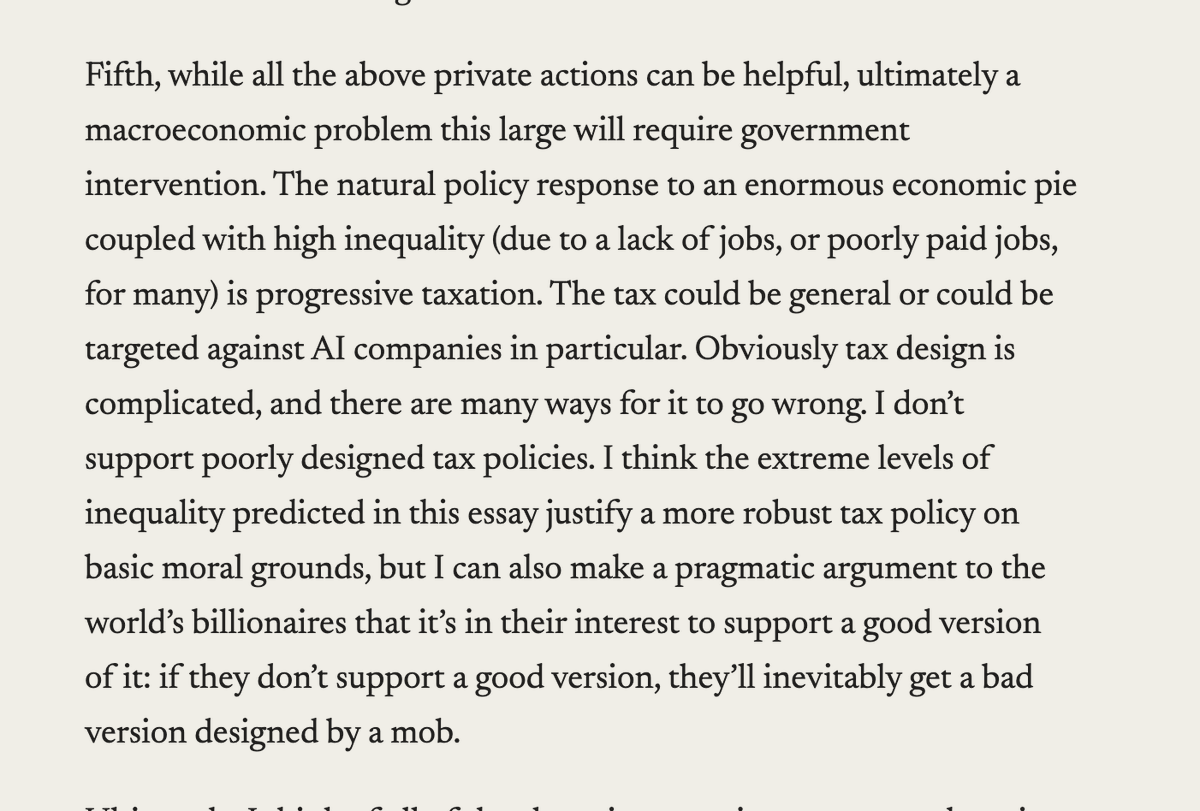
Amodei (CEO Anthropic) on the need for progressive taxation in the age of AI. Can't agree more - we need way more talent working on this.
This is not some socialist hobby horse, it's essential if we want to avoid a caste society, sorted by who controls the AI.
Според сајтов трите најголеми емитери на PM 2.5 се
-Железара
-Гасната централа Те-То
-Усје
Еден од трите а во топ 10% во свет
"Additionally 1 of these sources are super emitters meaning they are among the top 10% of emitters of PM2.5 pollution tracked by Climate TRACE worldwide"
Доста беше од нагаѓања за загадувањето во Скопје.
Фактите се јасни и поткрепени со светски достапни податоци.
Ова е прашање на јавно здравје и институционална одговорност.
👉https://t.co/pW64NJ4JOn
#Skopje#AirPollution#PublicHealth#RightToCleanAir#FactsMatter
На невидено тврдам дека во ниедна демократска, па и полудемократска држава во светов не постои закон со кој новинар мора да добие дозвола да преработува јавни податоци.
Ова е глуп обид од глупави луѓе да забранат нешто на исклучително глуп начин.
People often ask how did the Unitree robots get so good all of a sudden.
It wasn't all of a sudden, and it's because they ship their hardware and open source their SDKs. Arguably these robots are nearly useless out of the box, but you have full dev control of them.
Because of that, the hardware has become a very popular R&D platform with an ecosystem around it and the Unitree G1 is undoubtedly an order of magnitude better than it could ever be at this point if Unitree was instead just doing quiet internal dev of both the hardware and software.
Too many hardware companies for really cool products that seek to be community-driven (robots, AR glasses...etc) desire to make a profitable walled garden and their greed just ends up walling out developers and their product gets outpaced by the G1s of the world.
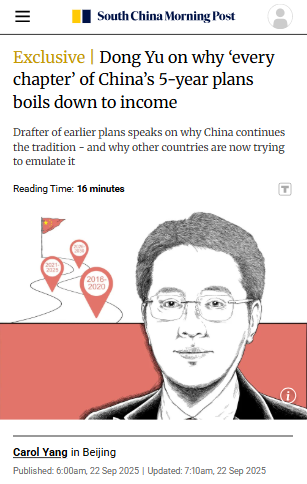
It's exceptionally rare for former Chinese officials to reveal the inner workings of the system, all the more so when it involves detailing the mechanics of China's famous 5-year plans.
Dong Yu, interviewed by the SCMP (link: https://t.co/q3inkXE8qz) helped draft China's 11th, 12th, and 13th five-year plans and he's now VP of the China Institute for Development Planning at Tsinghua University. In other words, the guy knows China's planning process in and out, both in theory and in practice.
I'll let you read the interview in full for yourself, but here were the parts that stood out for me:
1) What I hadn't realized, but which makes complete sense when you think about it, is the extent to which 5-year plans are not as much a mere forecasting exercise or even an economic blueprint but first and foremost a mass behavioral/psychological exercise.
Dong Yu makes 3 points around this:
- He emphasizes that "planning targets are not the same as forecasts. A target is not only based on technical calculations, but also takes into account how it shapes expectations." In other words the targets have a psychological dimension that's critical in determining actual outcomes, they have a self-fulfilling dimension.
- He says that "today, we have placed expectations in a position of unprecedented importance, and much of our work now revolves around shaping these expectations." Which basically means that to him planning is fundamentally about managing collective psychology.
- Lastly he argues that "the more uncertain the future feels, the more vital planning becomes... It is precisely in such moments that planning can provide much-needed stability and direction." In other words, the mere existence of a plan helps create psychological stability that enables economic activity.
2) The elaboration of the plan is more bottom-up than top-down.
This may come as a surprise to many people still under the impression that everything in China is decided in Beijing (or even solely by Xi Jinping himself 😅) - especially when it comes to the country's 5-year plans which are largely seen as a top-down exercise - but as Dong Yu reveals the process is surprisingly bottom-up.
For one thing the national plan is based on the targets set by China's provinces, which are often defined by the provinces themselves beforehand in the process.
The proactiveness of local governments is what Dong Yu highlights as "one of China's key strengths": he says that they "conduct extensive analyses and forecasts on industrial development" in their jurisdictions, and that this "widespread engagement and effort from top to bottom" is essential to the planning process.
3) The 5-year plan is not only about planning, but is part of a "full process, from formulation to implementation" which is intrinsically linked to China's political system, specifically its capacity to deliver "consistency and stability in carrying out long-term plans."
Dong Yu says that means replicating the 5-year plan process is very difficult for other countries: "Other countries are trying to learn from this model, but so far they mostly copy the form of the plans or isolated policies. The full process, from formulation to implementation, is unique and not easy to replicate."
4) He says that there is one key overarching objective behind all 5-year plan chapters: they are all fundamentally organized around improving people's living standards ("household income") rather than pure technocratic objectives around industrial targets or infrastructure.
There are of course many various ways to go about this and his personal philosophy is that "we shouldn't only focus on slicing the pie; we must also think about how to make a bigger pie. Only when the pie grows larger does dividing it become easier."
5) The are many other interesting tidbits in the article but I'll end on what Dong Yu says about both "involution" (cutthroat zero-sum competition) and "overcapacity", which are two hot topics today.
On involution, a problem Xi Jinping recently highlighted as a one of the key issues to solve for China (https://t.co/2XWu49HkNF), Dong Yu says that it is a difficult balance to strike because "part of what we call involution is market-driven competition, and we do not need to see it as entirely negative."
As he puts it the goal isn't to eliminate competition but to ensure "the sound development of the ecosystem by preventing excessive competition from eroding the growth prospects of smaller enterprises." To him the real issue with involution is when the cutthroat competition "undermines small and medium-sized businesses, especially in sectors that are related to people's livelihoods."
On "overcapacity", it looks like Dong Yu doesn't quite believe in the narrative - which is largely driven by the West. As he puts it: "This 'overcapacity' is largely a mischaracterisation when viewed in the context of global supply and demand."
Using electric vehicles as an example, he argues that "Chinese products have already far surpassed their competitors in both quality and value for money, yet their current sales volume and market share remain below what they should achieve due to various external barriers." He asks rhetorically: "Are other companies or governments really suggesting that people should just accept higher prices and lower-quality goods?"
His basic point: overcapacity is a Western narrative to protect inferior, more expensive products from legitimate market competition.
That's it, please go read the entire interview (https://t.co/q3inkXE8qz): again it's very rare to hear a former Chinese official speak so openly about the inner workings of the system; we should have more of this!
Murray and most of race twitter has apparently been fooled by this completely fabricated analysis purporting to show African ancestry is associated with IQ. People lie on twitter all the time, but this is both more revealing and more disturbing than usual. A 🧵
> be me
> Larry Ellison
> own a database empire, a sailboat, and a disdain for poor people
> OpenAI wants to build AGI
> needs compute
> *a lot* of compute
> like “$300B GPU cluster in a volcano” levels of compute
> "Hello. I own Oracle Cloud. Also, I’m rich."
> sign $300B GPU hosting deal with OpenAI
> nothing ships. no GPUs installed. no fans spinning.
> Oracle stock: skyrockets to the moon
> my net worth: +$100B
> GPUs? still imaginary
> OpenAI raises a $1 TRILLION round
> yes, with a T
> investors lining up like it's a Taylor Swift concert
> I invest
> where’d I get the money?
> from the $300B deal *I signed with them*
> yes.
> OpenAI takes my $300B investment
> uses it to pay *me*
> for the GPU deal *I offered them*
> Oracle stock: skyrockets again
> I make another $100B
> invest it back into OpenAI
> round and round we go
> I pay me to pay me to invest in me to boost me to get paid by me
> call it a "strategic whatever"
> call it “AI innovation”
> call it what it is:
> infinite money glitch
> mfw i built a recursive economy where i am the only customer and vendor
> mfw GPUs are optional
> mfw capitalism is just a well-placed loop with exit liquidity
New Research: Ketogenic Diet Associated with Improvements in Depression in College Students
The first ever peer-reviewed pilot trial of ketogenic diet for depression was published today in Translational Psychiatry. The study was conducted in college students with a primary diagnosis of major depressive disorder at The Ohio State University.
All 16 students who completed the study saw improvements in depression, with an average reduction in symptoms of 70% across scales. Metabolic health markers also improved.
The video below includes perspectives from the research team and students who participated in the study.
Read the full study in Translational Psychiatry: https://t.co/PkJr1RTul9
Read @OhioStateNews announcement: https://t.co/nkamW7NrG7
One of the reasons socialists don't focus on conspiracy analysis and the deep state as much as the right is because it's not our only argument. It's not that conspiracies and parapolitical power structures don't exist, they absolutely do, but because we're not ideologically compelled to make excuses for the unavoidable abuses of capitalism we don't need to act like any specific cabal of machiavellian elites is the source and summit of all our problems.
The rightist suffers from the delusion that capitalism would be working perfectly fine if a few nefarious individuals weren't scheming behind the scenes ruining the capitalism for everyone. The leftist recognizes that corruption, corporatism, inequality and domination are the inevitable products of a profit-driven system under which the capitalist class are able to exploit the working class who have nothing to sell but their labor. We therefore often find it less important to focus on the specifics of the way those abuses are playing out, because we understand that even if you eliminated all the current oligarchs and their secret plans and the strings they pull to manipulate the official government, if you didn't also replace our entire system with something radically different they'd be replaced by new oligarchic manipulators in short order.
For those who understand the inherently exploitative, ecocidal, unjust and violent nature of capitalism, the strongest arguments against status quo power structures are not invisible conspiracies happening in secret, but the monstrous abuses that are happening right out in the open. The genocide in Gaza. Our dying biosphere. The fact that people struggle to keep a roof over their heads and put food on the table while others fly private jets to private islands paid for by the exploitation of thousands of impoverished workers. The fact that the most powerful country on earth doesn't have a real healthcare system. The fact that an empire-like alliance of western governments and their proxies keeps expanding its warmongering, militarism and nuclear brinkmanship around the world with the goal of complete planetary domination.
It is an indisputable fact that rich and powerful individuals conspire with each other to the detriment of ordinary people, and at times it can be useful to highlight who those individuals are and the things that they are doing. But the leftist sees people opening their eyes to these abuses as a means to an end, not as an end in itself. When the rightist spotlights those abuses it's to say "Look what these individuals are doing! If we just removed these individuals from power everything would be working fine!" When the leftist does so it's to say "See these are the kinds of people who rise to the top under a system where human behavior is driven by the pursuit of profit and profit is most readily obtained through exploitation, injustice and ecocide. These kinds of people will always rule over us until we have replaced that system with a different one."