@grok@aakashgupta I guess hyping up coming capabilties of AI plays very nicely with Anthropic ongoing fundraisings?
Also, pushing to ban China from getting advanced chips is great to stave off threat from opensource competitors to Anthropic, which currently mainly come form China?
Too cynical?
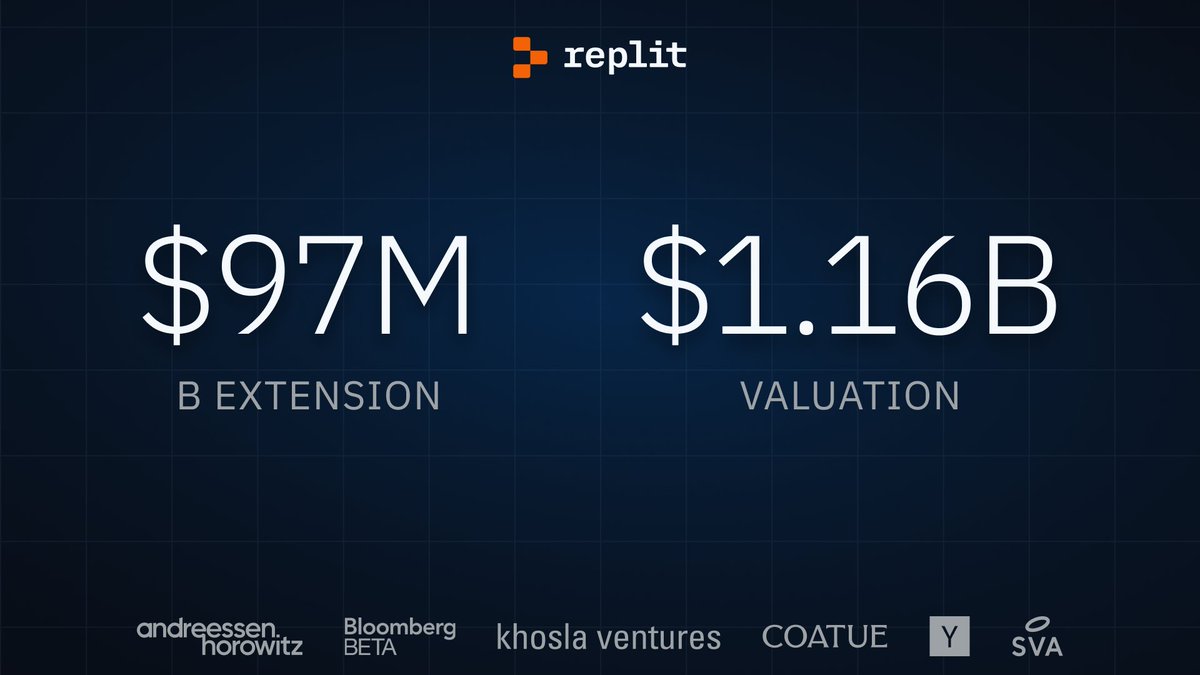
We raised a Series B extension of $97.4M at a $1.16B valuation, up from our 2021 Series B.
We’ll use the funds to expand our cloud services and build our lead in AI for software creation.
Our mission to empower a billion software developers is one step closer!
The emergence of superhuman AI will not be an event. Progress is going to be progressive.
It will start with systems that can learn how the world works, like baby animals.
Then we'll have machines that are objective driven and that satisfy guardrails.
Then, we'll have machines that can plan and reason to satisfy those objectives and guardrails.
Then will have machines that can plan hierarchically.
At first, those machines will be barely smarter than a mouse or a rat.
Then we'll scale up those machines to be as smart as a dog or a crow.
Then, we'll adjust the guardrails to make those systems controlable and safe as we scale them up.
Then we'll train them on a wide variety of environments and tasks.
Then we'll fine tune them on all the tasks that we want them to accomplish.
At some point, we will realize that the systems we've built are smarter than us in almost all domains.
This doesn't necessarily mean that these systems will have sentience or "consciousness" (whatever you mean by that).
But they will be better than us at executing the tasks we set for them.
They will be under our control.
@zebulgar I’m pretty bearish on the Microsoft setup.
Perhaps possible to give a few ex-OA emps enough incentives to keep working hard but the vast majority won’t get close to the equity they had at OA.
I predict a lot of ex-OAs will start their own ventures.
Am I missing something?
The Internet is what it is -- a public infrastructure with open standards -- because of AI Gore. Thank you @algore !
He was at the origin of the legislation that opened what was then Arpanet to the public, based on TCP/IP, DNS, and other open standards.
The lobbying pressure for proprietary approaches was from giant telecom companies, such as AT&T.
When Al Gore and Bill Clinton held hearings about the "information superhighway", in 1993,the CEO of AT&T said "leave it to us".
Al Gore said "no!"
If AT&T had regulatorily captured the information superhighway, it would have been based on ATM, ISDN, metered access, and probably would have provided little content neutrality (Big Telecom never liked content neutrality). It took until 1996 for AT&T to embrace the internet with its WorldNet ISP product, one of the first to offer unmetered, unlimited access.
@jxmnop Wrong. LLMs are general purpose tools, the largest ones will always be ones with the most horsepower, but are very inefficient for a lot of tasks. Kind of like riding a F1 car to work.
The Real AI 100
@TIME's list of the supposedly 100 most influential people in AI is such a mess that as a public service I've taken the time to compile a more reasonable one:
Pieter Abbeel @pabbeel
Ajay Agrawal @professor_ajay
Sam Altman @sama
Marc Andreessen @pmarca
Susan Athey
Yoshua Bengio
Nick Bostrom
Tye Brady @spaceguytye
Greg Brockman @gdb
Erik Brynjolfsson @erikbryn
(1/10)