@n3wscott@jonjonsonjr Ah, if you want `ko resolve`-like behaviour (rather than `ko apply`), then: `skaffold render --digest-source local --offline --output out.yaml`
@_ediri@ahmetb@mattomata@HelmPack@sabre1041 Yes, you can also run it as a container. However, this makes authenticating to a container image registry trickier. If you only need username+password (no credential helper), you can mount the Docker config file: https://t.co/Ko4IcZmnQP
@_ediri@ahmetb@mattomata@HelmPack@sabre1041 Not necessarily. The output of `helm template` would be the input of https://t.co/2axbq1QYRy. kpt and kustomize can orchestrate this (using https://t.co/KCT8ROnFNf), but you can also run the two commands in a script.
@mattomata But I agree that controllers aren’t the most ideal place to solve this. In an ideal world, it’d be part of hydration process like kpt/kustomize, like https://t.co/pIWx5v1wlb
Today, we're open sourcing a log4j JAR scanner. Throw it at a filesystem, detect vulnerable JARs, and even rewrite them in place.
Includes a Go API to import the JAR parsing for other applications.
https://t.co/TWC4SJFm3p
Aa far as I know, google/ko is undervalued or not well-known. This is pretty much useful tool for Go developers. Especially, in combination with Cloud Run, this is pretty neat!
https://t.co/RytrROIbec
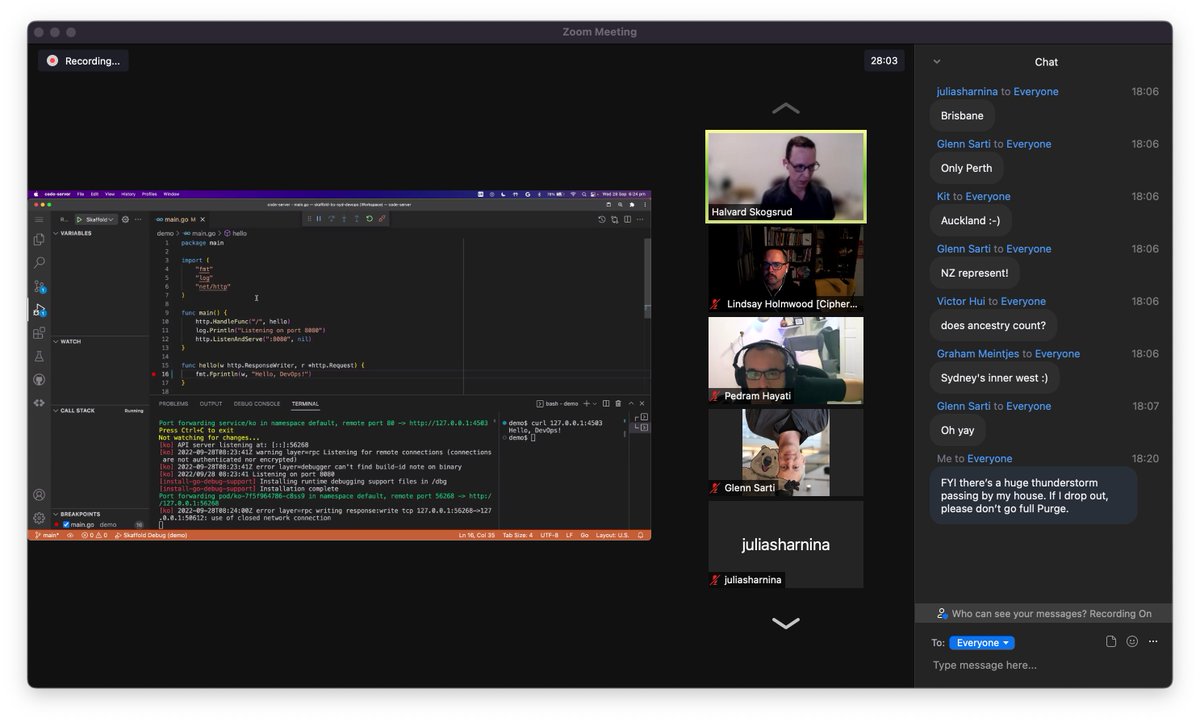
Do you want a blazing fast dev loop for your Go apps that you deploy to Kubernetes?
Want to ditch your Dockerfile and get best practices slim, secure Go images?
Check out Skaffold's new support for ko.
Amazing work by @halvard and the @skaffolddev team!