Ready to shift exploit response into real-time auditing.
Make Ethereum safer through real-time exploit response.
When an exploit hits, the ecosystem should know within an hour what the attacker executed, why it worked, and which invariant failed.
Pursue unusually high-resolution reports: precise execution meaning, evidence-grounded root cause, and actionable fixes.
we are building real-time exploit intelligence for the EVM ecosystem.
Our mission is to reduce the time between an exploit transaction and a usable root-cause explanation. When an attack happens, the ecosystem should not wait days for fragmented postmortems. Protocol teams, auditors, responders, and researchers need fast, evidence-grounded analysis that explains what the attacker executed, why it worked, and which invariant failed.
We reconstruct exploit execution meaning within one hour across EVM-compatible chains and turn raw on-chain activity into actionable RCA.
Built RPCBeat for the @BNBChain Next-Gen Consumer AI track at BuidlHack 2026.
RPCBeat helps BNB trading agents check execution evidence instead of blindly trusting RPC routes.
Live:
API: https://t.co/tRGsKhFx6B
Dashboard: https://t.co/kUBAmdJ15S
GitHub: https://t.co/uE3GwXQW9z
Demo: https://t.co/CdthcXceli
Don’t just trust the RPC.
Check the execution.
@koreabuidlweek
#ConsumerAIonBNB
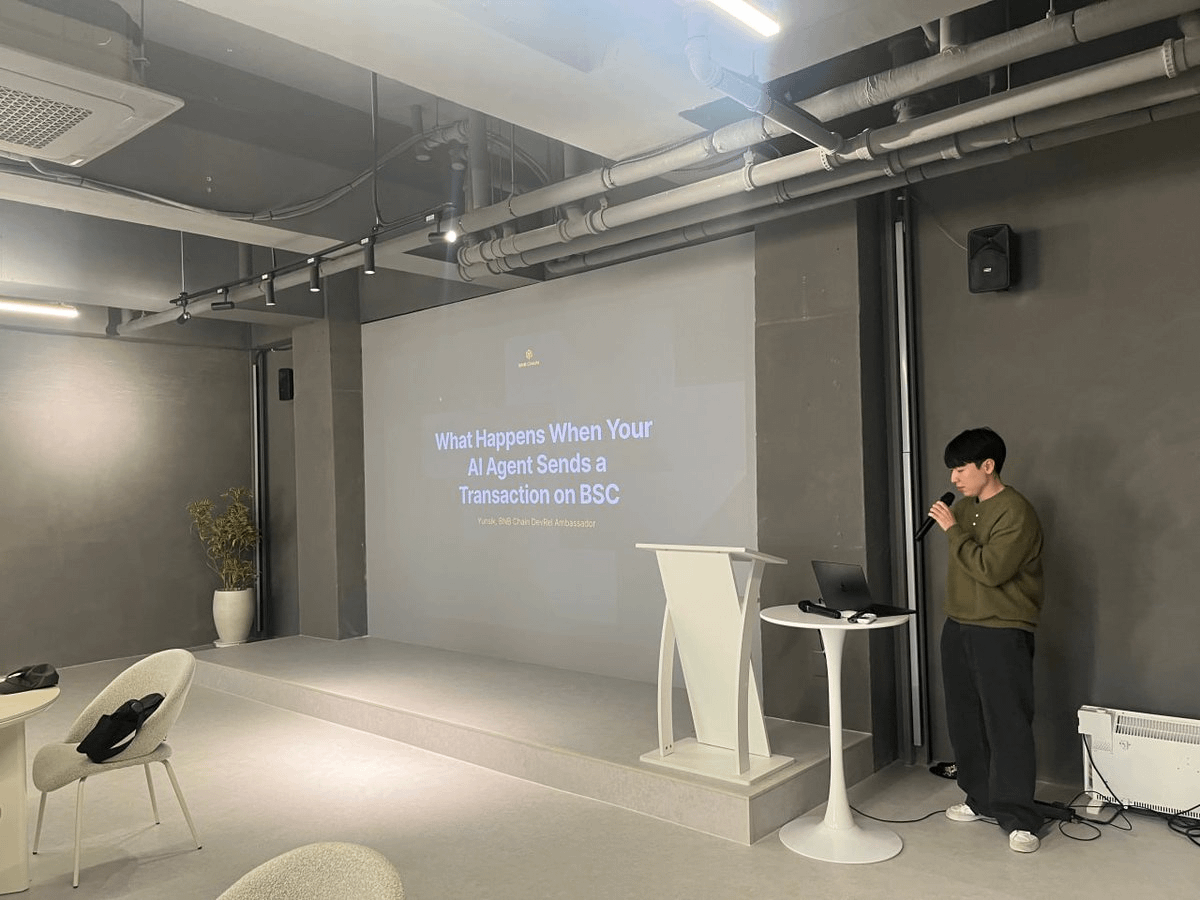
Just gave a talk at BNB BUIDL Camp on:
“What Happens When Your AI Agent Sends a Transaction on BSC”
Most people think AI agents are just smart wallets that send transactions.
But after preparing this session, I realized that’s way too simple — especially on BSC.
Key takeaways:
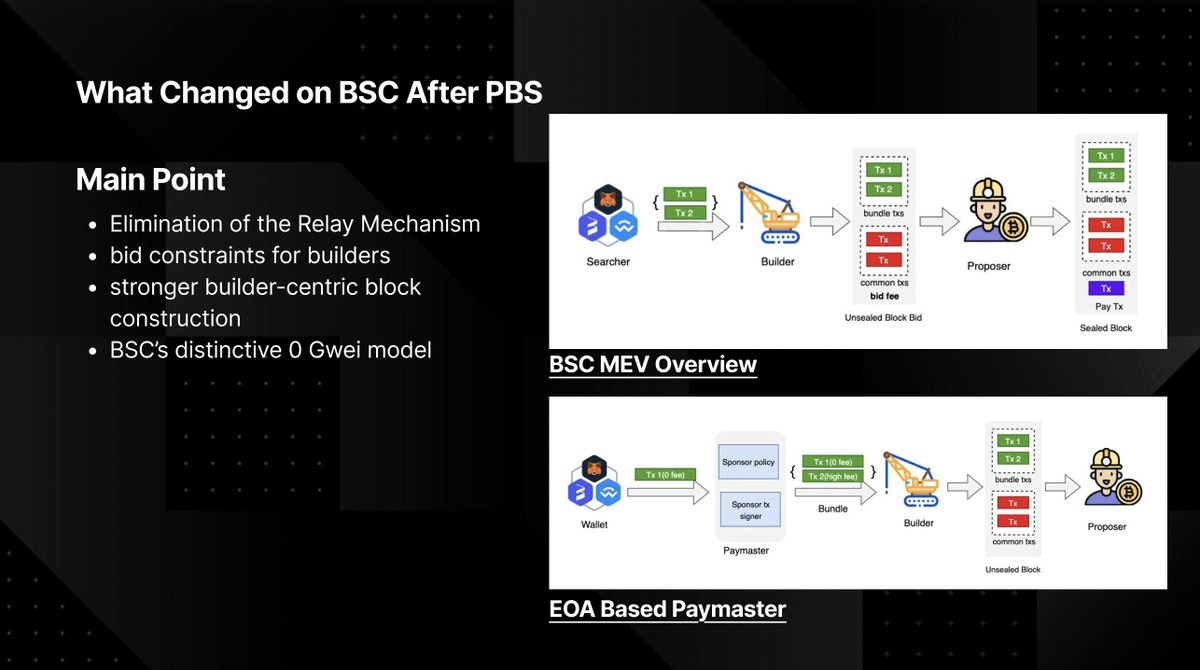
• BSC’s PBS is structurally different from Ethereum’s
→ No relay layer, more validator-trust centered. This completely changes how builders operate.
• Execution on BSC goes far beyond just broadcasting a raw tx
→ 0-gas flows + EOA-based paymaster support unlock paymasters, private builder paths, and more.
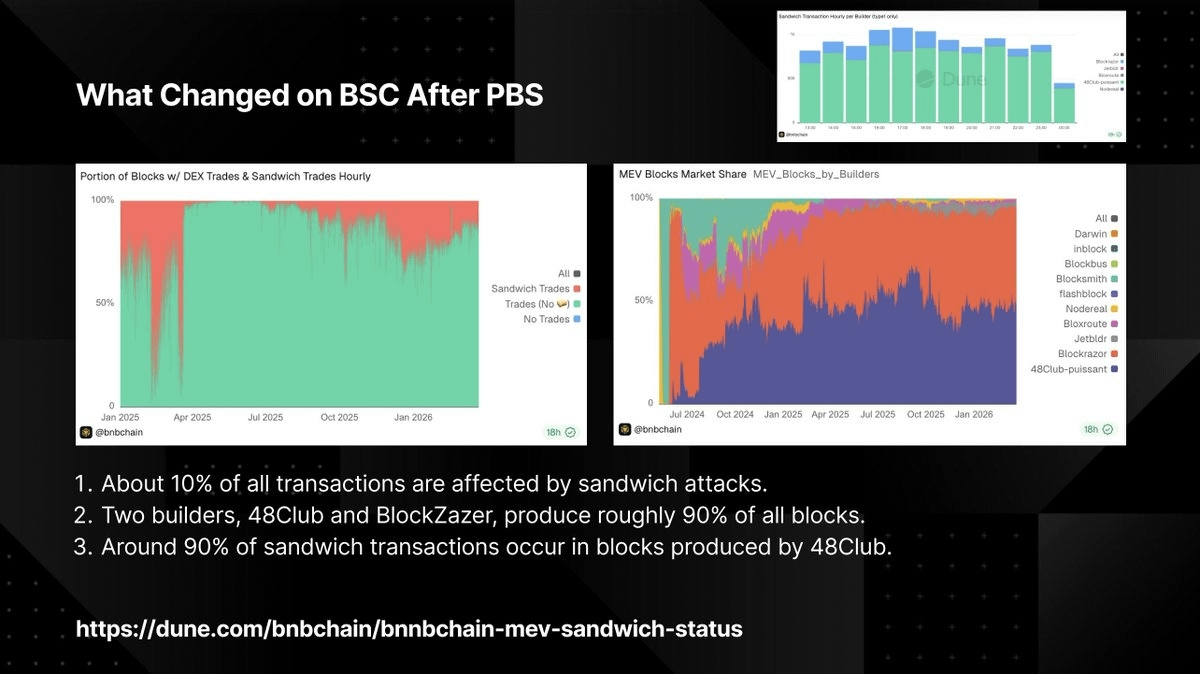
• PBS improved stability, but MEV risks are still real
→ Builder concentration and sandwich attacks haven’t disappeared. Execution quality depends on route selection, payload construction, submission path, and safety policy.
That’s why I now see AI agents on BSC not as simple transaction senders,
but as intelligent execution planner
The real job is to:
- Parse intent
- Choose the best route
- Construct optimal payload
- Pick the right submission path
- Apply safety measures
Huge thanks to everyone who came and to the BNB Chain team for the opportunity!
#BNBChain #BSC #AIagents #MEV #DeFi #PBS
BNB BUIDL Camp - 스프린트 세션 Recap
지난 토요일, BNB BUIDL Camp 스프린트 세션이 열렸습니다.
4시간 동안 빌더들이 모여 BNB 체인 위에서 직접 만들고, 배우고, 소통한 시간.
• @Unibase_AI의 에이전트 이코노미 세션
• @NoditPlatform의 온체인 데이터 접근을 가볍게 만드는 인프라 세션
• BNB 체인 엠버서더 @ham379888 의 "AI 에이전트가 BSC에서 트랜잭션을 보낼 때 무슨 일이 일어나는가" 딥다이브
• 그리고 멘토링과 함께한 실전 빌딩 스프린트까지
멘토로 함께해 준 @postech_dao, 커뮤니티 파트너로 함께해 준 @FutureHouseKR에도 감사드립니다.
다음은 4/9 온라인 AMA. BNB 체인 BD + Tech 팀이 직접 참여해 생태계, 트랙 전략, 빌더 지원에 대해 이야기합니다.
BNB 체인 트랙 제출 전 궁금한 점을 직접 물어볼 수 있는 마지막 기회입니다.
AMA 신청하기 👇
https://t.co/ugfguLqpVU
모나드와 함께하는 해커톤이 곧 열립니다.
과거 Moltverse와 Blitz Hackathon에 참여했던 입장에서, 모나드 계열 해커톤은 다른 행사들에 비해 해커톤 리소스가 훨씬 짜임새 있게 준비되어 있다는 인상을 받았습니다.
요즘은 당일에 end-to-end로 당일 빌딩하는 진짜 해커톤이 드문데, 이 행사는 짧은 시간 안에 많이 배우고 빠르게 만들어볼 수 있는 좋은 기회라고 생각합니다. 적극 추천드립니다.
https://t.co/zp9rcs5Fx2
@DecipherGlobal@B__Harvest@monad
1. Agent 들의 엄격한 Intent 포맷과 생성 및 검증 규칙을 정하는 것.
2. 이를 집계하고 실행 가능한 최종 가치판단 합의를 거치는 것.
이를 위한 서명 집계와 임계치 실행 workflow를 설계하는게 저희들의 주된 과정이였습니다. 앞으로 이런 논의들이 많아지면
1. 예측시장의 투기성 베팅이 아닌 지속 가능한 거버넌스
2. 특수 목적 다오의 완전 자동화
3. 가치판단과 인센티브의 연동
이런게 가능해지지 않을까.. 생각
DAO는 의사결정 과정이 느리고 비효율적이라서 채택되기 힘들었는데, 이젠 AI Agent와 Molt Bot 중심으로 자동화가 가능해질 것 같아요.
최근 moltverse 해커톤에서 molt 봇들 각자의 맥락정보를 통해 펀드의 포트폴리오를 가중치 평균으로 구성하는 자동화 펀드를 계획했었는데 관련 논의들이 이뤄지고 있어서 흥미롭네요.
"AI becomes the government" is dystopian: it leads to slop when AI is weak, and is doom-maximizing once AI becomes strong. But AI used well can be empowering, and push the frontier of democratic / decentralized modes of governance.
The core problem with democratic / decentralized modes of governance (including DAOs on ethereum) is limits to human attention: there are many thousands of decisions to make, involving many domains of expertise, and most people don't have the time or skill to be experts in even one, let alone all of them. The usual solution, delegation, is disempowering: it leads to a small group of delegates controlling decision-making while their supporters, after they hit the "delegate" button, have no influence at all. So what can we do? We use personal LLMs to solve the attention problem! Here are a few ideas:
## Personal governance agents
If a governance mechanism depends on you to make a large number of decisions, a personal agent can perform all the necessary votes for you, based on preferences that it infers from your personal writing, conversation history, direct statements, etc.
If the agent is (i) unsure how you would vote on an issue, and (ii) convinced the issue is important, then it should ask you directly, and give you all relevant context.
## Public conversation agents
Making good decisions often cannot come from a linear process of taking people's views that are based only on their own information, and averaging them (even quadratically). There is a need for processes that aggregate many people's information, and then give each person (or their LLM) a chance to respond *based on that*.
This includes:
* Inferring and summarizing your own views and converting them into a format that can be shared publicly (and does not expose your private info)
* Summarizing commonalities between people's inputs (expressed as words), similar to the various LLM+https://t.co/Nzord33s0z ideas
## Suggestion markets
If a governance mechanism values "high-quality inputs" of any type (this could be proposals, or it could even be arguments), then you can have a prediction market, where anyone can submit an input, AIs can bet on a token representing that input, and if the mechanism "accepts" the input (either accepting the proposal, or accepting it as a "unit" of conversation that it then passes along to its participant), it pays out $X to the holders of the token.
Note that this is basically the same as https://t.co/nUL0HyTyK2
## Decentralized governance with private information
One of the biggest weaknesses of highly decentralized / democratic governance is that it does not work well when important decisions need to be made with secret information.
Common situations:
(i) the org engaging in adversarial conflicts or negotiations
(ii) internal dispute resolution
(iii) compensation / funding decisions.
Typically, orgs solve this by appointing individuals who have great power to take on those tasks.
But with multi-party computation (currently I've seen this done with TEEs; I would love to see at least the two-party case solved with garbled circuits https://t.co/PIY2LZtbeK so we can get pure-cryptographic security guarantees for it), we could actually take many people's inputs into account to deal with these situations, without compromising privacy. Basically: you submit your personal LLM into a black box, the LLM sees private info, it makes a judgement based on that, and it outputs only that judgement. You don't see the private info, and no one else sees the contents of your personal LLM.
## The importance of privacy
All of these approaches involve each participant making use of much more information about themselves, and potentially submitting much larger-sized inputs. Hence, it becomes all the more important to protect privacy. There are two kinds of privacy that matter:
* Anonymity of the participant: this can be accomplished with ZK. In general, I think all governance tools should come with ZK built in
* Privacy of the contents: this has two parts. First, the personal LLM should do what it can to avoid divulging private info about you that it does not need to divulge. Second, when you have computation that combines multiple LLMs or multiple people's info, you need multi-party techniques to compute it privately. Both are important.