Most AI agencies are still charging 3,000 dollars a month to run basic Zapier zaps that break on the first edge case.
We stopped using single LLM prompts in production completely.
Here is the exact multi-agent architecture we use to run Claude, ChatGPT, and Gemini in parallel:
@DealsDhamaka Silicon fab capacity and energy grids are the real choke points now, having the best model weights means very little if you can't secure advanced packaging, power feeds, and domestic chip fabrication.
@jaouad2d@vangrid_io Synthetic simulation data only gets robotics so far before reality gap errors ruin deployment, crowdsourcing real-world phone photogrammetry with verifiable capture coordinates gives spatial models the messy edge cases they actually need.
@neo_logos_ Byte-level modeling without having to retrain from scratch is a big win for token-free architectures, eliminating tokenizer friction and out-of-vocabulary artifacts with minimal compute budget makes edge deployment much cleaner.
@TokenGremlin Safety commitments in frontier labs always get quietly recalibrated whenever cluster capacity expands, nobody is going to idle tens of thousands of accelerators just to prove a point about pacing.
@satohub@claudeai@grok@OpenAI Benchmarks on syntax and boilerplate are one thing, but handling asynchronous transaction confirmations, slippage edge cases, and RPC timeouts without hallucinating state is where agent models actually break down.
@FundaAI The shift from next-token guessing to formal verification engines like Lean and Isabelle changed everything, when models can search proof trees against deterministic checkers, hallucinated math stops being a blocker.
@Q_ACConx Using neural decoders for real-time quantum error correction makes a lot of sense, syndrome decoding gets intractable fast as physical qubit counts scale up, so neural models doing fast pattern inference can actually keep pace with coherence times.
@Mohd_Ainan17 Vision based agents navigating the UI directly is wild, it bypasses the need for fragile API integrations and just uses the app like a human does.
Jump Trading is using ChatGPT for quant research workflows.
they don't make moves based on hype. they use longer-running AI workflows combining multiple data sources with human review. secure boundaries and monitoring remain central.
#AI#QuantTrading#ChatGPT
the biggest AI problem right now isn't prediction accuracy, it's autonomous action.
if you still manually review every AI recommendation, you just built a dashboard, not an autonomous system. figuring out agentic execution is the next big step.
#AgenticAI#AI
Safeway shoppers can build grocery carts through a ChatGPT plugin, then check out at Safeway.
Albertsons is exploring AI with focused deployments by select teams. consumer-facing AI is growing fast in retail.
(Concept illustration)
#AI#RetailTech
MIT Tech Review points out AI agents don't lack data, they lack knowledge. data is rows and columns. knowledge is what those rows mean in your company.
if you just connect an agent to a data warehouse, it will make weird decisions. build knowledge infrastructure first.
#AI
Mistral's 1T model is huge, but running a 1T monster in a 10-step agent loop burns compute and kills latency. The winning architecture is a frontier supervisor routing tasks to a swarm of small 7B-27B local models.
#AIEngineering#MachineLearning
MIT Tech Review's latest piece on agentic AI nails the real issue: what you tell an AI to EXCLUDE matters more than what you tell it to target. Without deterministic code filters and hard budget caps in your host harness, agents drift fast.
#AIEngineering#DevOps
Akka tested spec-driven AI across 65 open-source repos and confirmed: conversational multi-agent chat loops fail fast. What works is strict specification contracts, isolated worker context, and automated compiler validation gates.
#AIEngineering#SoftwareEngineering
MIT Tech Review found enterprise AI agents struggle with actual domain knowledge despite massive RAG data. Stuffing prompts doesn't work, what you need is Anthropic-style isolated execution sandboxes and deterministic schema checks.
#AIEngineering#EnterpriseAI
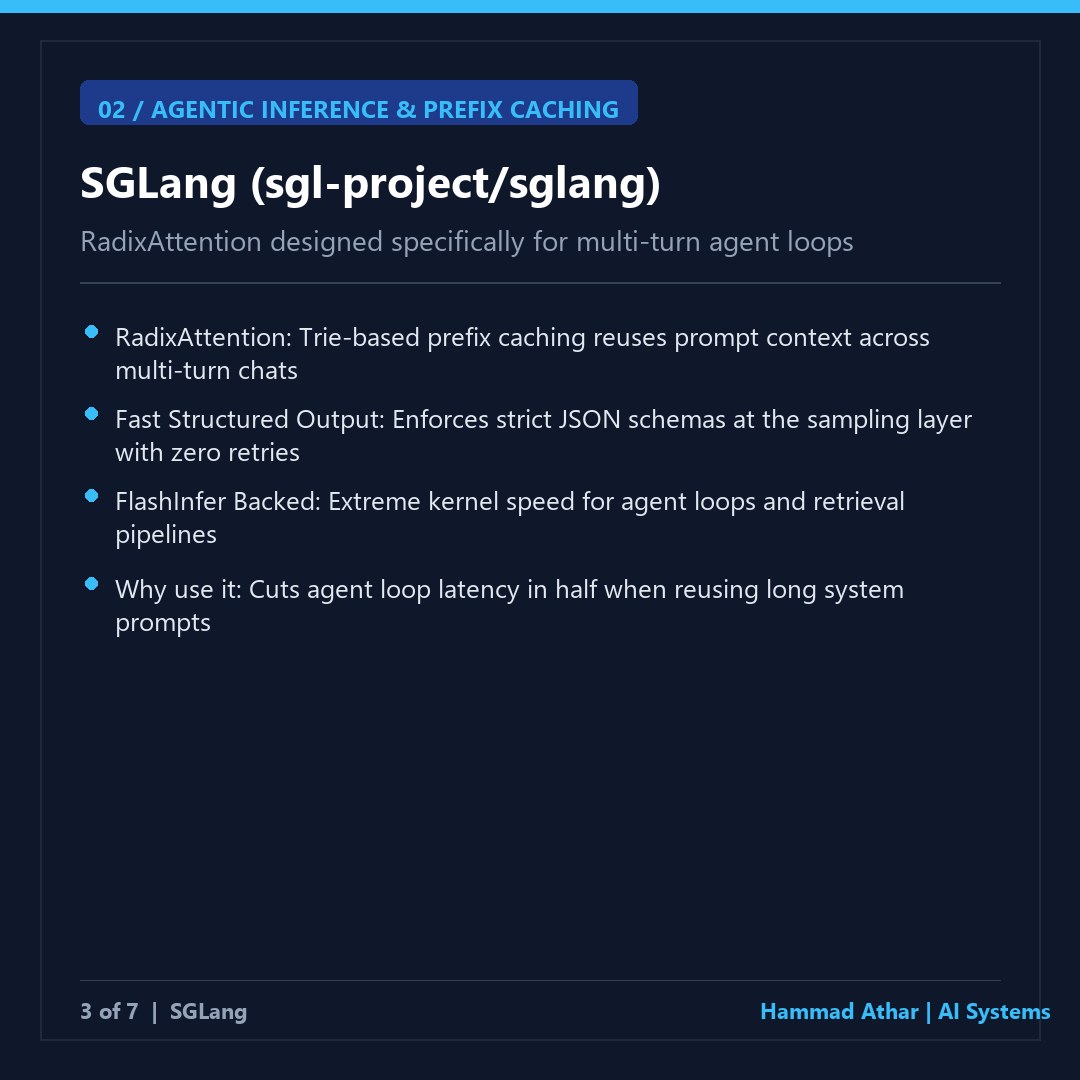
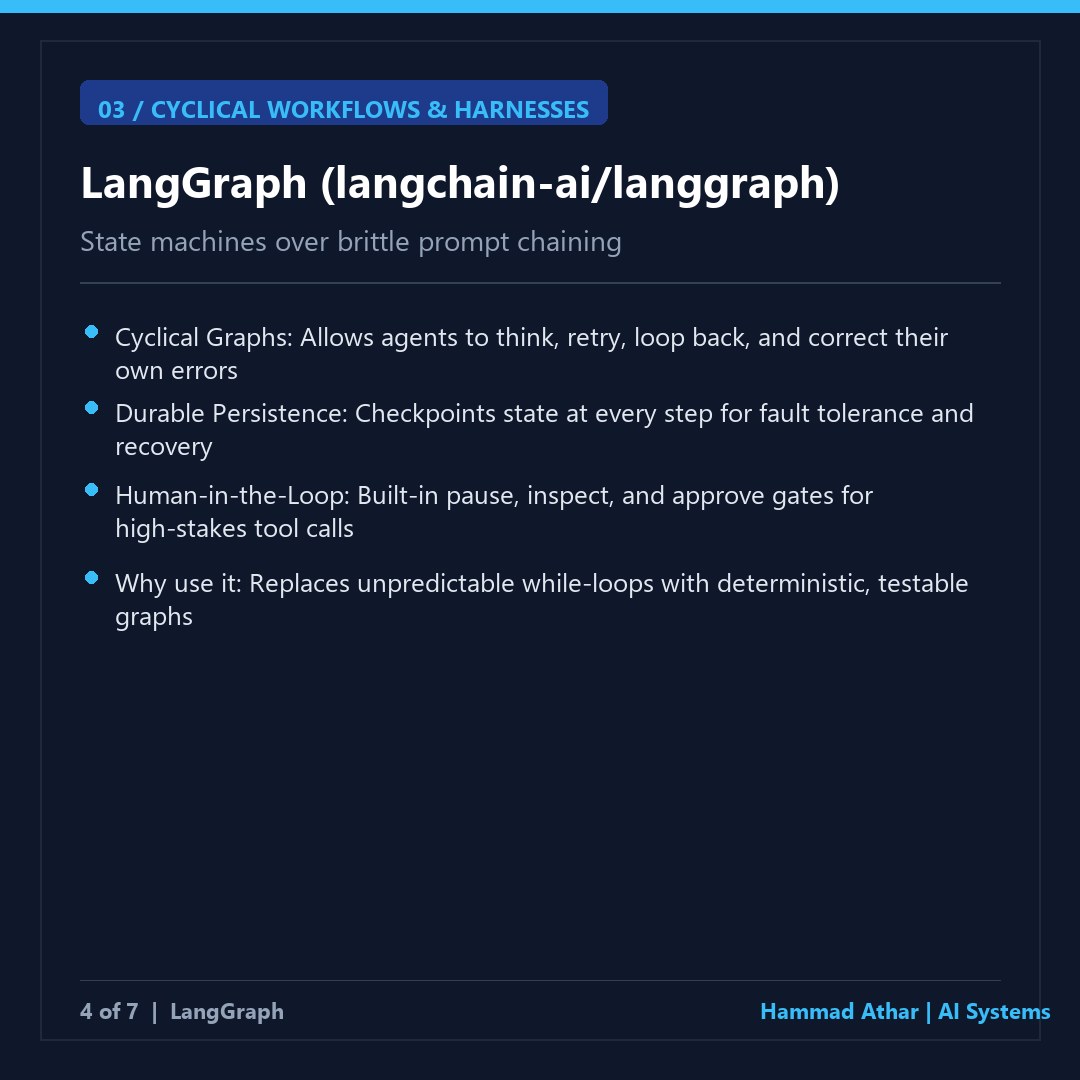
Building real AI agents in 2026 isn't about prompt tricks, it's about host harness engineering and fast inference. Here are the top 5 repos every engineer needs: vLLM, SGLang, LangGraph, MCP, and Mooncake.
Swipe the carousel for the breakdown 👇
#AIEngineering#DevCommunity
@Biiidin@dac_chain predictable fees are the make or break factor for AI on-chain, if gas spikes mid-task an autonomous agent can't just pause and wait for gas to drop, it needs deterministic cost ceilings or automated workflows break down fast.
@BiologyAIDaily verifiable 3D spatial constraints force the attention heads to model actual physical relationships instead of just surface token statistics, if that geometric grounding transfers to general logic tasks, it's a huge validation for synthetic physical training.
@Aurora0_L m2m agent commerce is going to run on stablecoins purely because credit card rails and banking APIs choke on sub-cent micro-transactions, if two agents need to settle frequent API calls every second, traditional payment rails won't even clear the fraud checks.