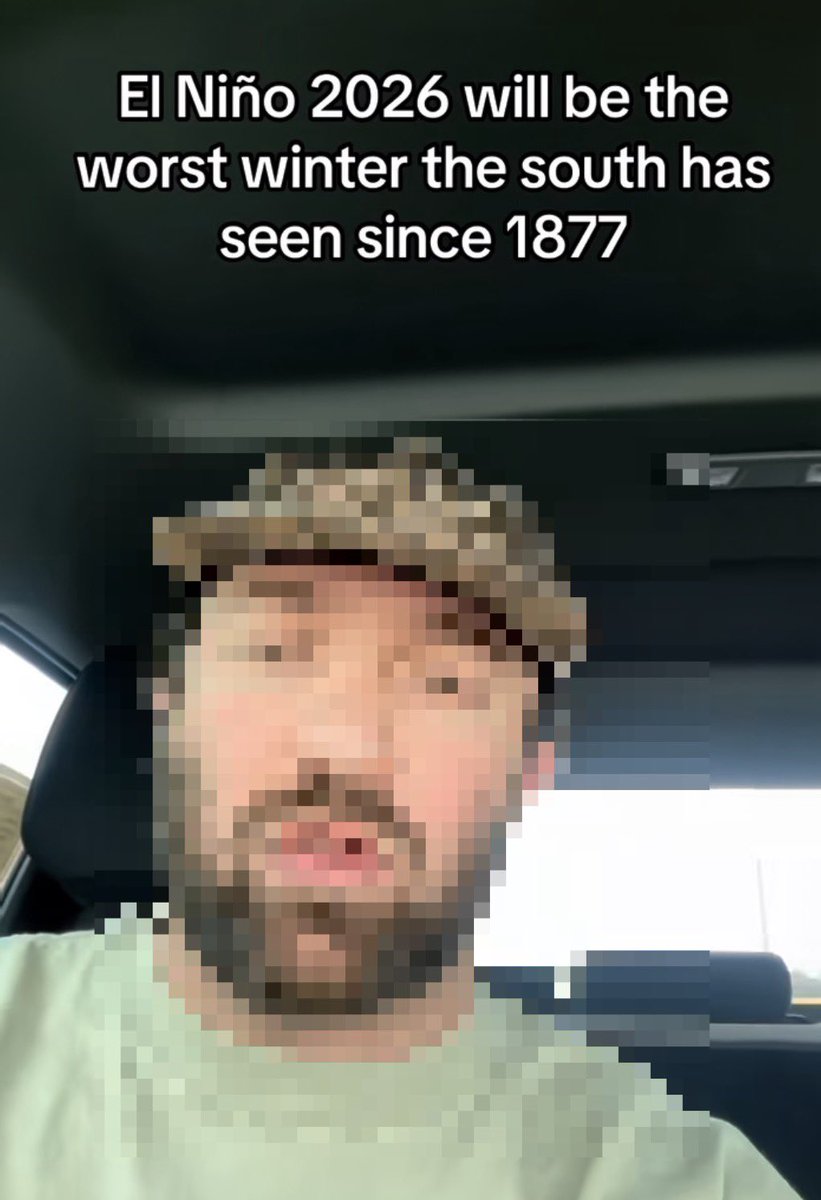
I have been bombarded by questions from people seeing this viral video on social platforms.
This is a great example of taking a legitimate weather signal and turning it into a forecast that the science does not support.
Yes, the developing El Niño is unusually strong, and it absolutely deserves attention.
But there is no scientific basis for saying “this will be the worst winter the South has seen since 1877.” El Niño changes the odds of certain weather patterns; it does not dictate the weather for an entire season.
Very strong El Niño events do not guarantee the expected impacts everywhere.
Don’t turn a seasonal climate signal into a 100% certain winter forecast. That’s not how meteorology works.
For Alabama, the most reliable signal is toward a wetter-than-average winter with a more active southern storm track. That can mean more opportunities for heavy rain, flooding, thunderstorms and severe weather. It can also occasionally produce winter storm threats when cold air happens to be in place.
But El Niño does not tell us how many tornadoes Alabama will have, how much snow we will get, or whether we will have some kind of historic winter. Those things depend on the individual weather patterns that develop week by week.
A strong El Niño changes the odds. It does not write the forecast. So yes — this winter deserves close attention. But anybody telling you in September that they already know this will be the worst Southern winter in 149 years is selling certainty that the atmosphere hasn't given us.
As always, please think before you share social media nonsense.
Internet billionaires famously restrict screen time for their own kids.
What's going to happen with the coming wave of AI pioneers?
Let me tell you how I think it will go down.
Skipping low-level mechanics in any sort of domain creates passengers.
To instead create drivers you need more... technical literacy is only half the equation.
In the next few years what will be vastly important is the blend of classical grounding and scientific leverage.
We won't all become Leonardo da Vinci of course, but that polymathic blend is in my view the exact direction we need to head.
Classical knowledge (eg, studying ancient Rome, Greek thought, history, architecture) has often been seen as academic luxury, but actually it is the ORIGINAL blueprint of human nature.
It gives you the elusive 'taste'.
What I mean by 'taste' is a sort of trained instinct, a "smell" for what endures vs what is superficial filler.
Today, AI lets technical builders query an LLM to simulate domain expertise and/or generate functional output instantly.
Without classical depth or lived experience, they end up building skeuomorphic applications nobody need/want.
These software engineers have massive speed, but 0 gusto. They don't understand what moves people because they have never studied the human record.
Tech knowledge gives you the leverage.
Classical knowledge gives you the direction.
3 suggestions:
1) Don't hide in an ultra-niche technical silo.
2) Stay broad.
3) Build hard technical foundations, but couple them with soft skills and classical inquiry.
Boys and girls, nobody is thinking anymore.
Entire enterprise departments have thousands of people who are spending their days interacting with the LLM, faking "being productive", consuming tokens because it's a highly regarded activity, shipping lines of code with Cursor or Amp or Claude or whatever (except their brain).
Even slides are not made thinking anymore!
The person that allegedly built the powerpoint deck you are reviewing right now cannot even answer a couple of intelligent questions on the very thing he's presenting to you.
He looks at you stuttering some nonsense, hoping you'll let him off the hook because he made it so obvious Copilot wrote the slides (of course, you already knew that within the first 6 seconds of glancing at them).
There is some sort of comical atmosphere to it all.
And an absurd satisfaction in watching this entire situation unfolding in front of your eyes.
There is also approximately ZERO chance this whole thing won't spectacularly backfire, and of course good old consulting firms will be there to pick up the pieces.
I wonder at what point we started to believe we could get away with doing valuable things without even thinking?!
How did this happen, wow.
BREAKING: OpenAI might have stolen another major proof.
In a detailed Mastodon post, which I report in full in the comments, Andreas Thom presents several pieces of evidence suggesting that OpenAI may have trained Astra on conversations in which he and Gábor Kun were working on Gromov’s soficity conjecture, one of the ten problems OpenAI later announced Astra had solved.
I know Andreas. We met several times early in our careers. He is an exceptional mathematician, a leading expert on sofic and hyperlinear groups, and one of the most respected scholars in the field. He has spent two decades working on this problem.
If his account is correct, this is not a minor dispute over attribution. It would mean that unpublished human work was absorbed into a model and then presented to the world as a breakthrough by the model itself.
And if the allegations raised by Levent Alpöge, Tristan Buckmaster, and now Andreas Thom are all substantiated, we are no longer looking at isolated incidents.
We may be looking at one of the greatest intellectual scandals in the history of science.
AI is not discovering new mathematics.
AI is stealing human discovery.
If you can't trust the in stadium clock that the players and coaches are looking at and we're just supposed to trust the conference behind the scenes and after the fact then what's even the point.
What am I doing wrong? I wrote an entire app and submitted 450 PRs on a single $200 MAX plan in a month.
What are people doing with thousands of dollars of tokens?
This is it, man. Telling kids how much they suck when you contributed to nearly everything that's making their lives worse – while producing a suspicious stock trading record – is not a winning message to say the least.
Water will find its way through cracks in walls and foundations in such a manner that even the most wondrously designed structure may collapse into pile of rubble.
Do not attribute agency to the water; rather, denounce the engineers and the builders and the maintainers who failed in their work.
i suspect that the developers who are still employed in a decade's time are the ones who:
- timebox their development in a specific workspace
- continue to read the code
- retain cognitive ownership
- transition from creator to responsible curator
- still interact with their toolset in a considered manner
- use remote access tooling sparingly but effectively
the danger today is that we can reasonably step back from many of these and see short term progress. but what is the long term effect of absolving ourselves of mental activity, cognitive ownership, and a clear division between work and rest?
Over the next few years you are going to have to fight with everything you’ve got to retain your humanity. They will try to convince you to give up connecting with each other, to give up truly being alive. It will be the most important fight of your whole life