We recently published our early paper on Simula, an internal framework we built at Google that has powered >20 launches using #SyntheticData across products over the previous year.
Simula empowers our teams to generate data at scale, offering fine-grained control over diversity, complexity, & quality. ✨
Curious about Simula's applications? Here’s a glimpse:
-📱 On-device models (Pixel scam call detection, Android messages scam protection, Gemini Nano safety classifiers, etc.)
- ☁️ Specialized server-side models (Gemini AI moderation, ShieldGemma 1 & 2, etc.)
- 🛡️ Pre-launch evaluations & crucial safety testing for new products
- ...and much more!
At its core, Simula leverages LLM reasoning at every stage: from strategizing diversification factors and building deep domain-specific taxonomies, to advanced meta-prompting and data complexification.
It then deploys the best tools for executing data generation based on this reasoning, plus robust mechanisms for critiquing & revising as needed. 🛠️
📄 Early Paper https://t.co/PUWzi9fI2w
While this paper focuses on our seedless generation approach, Simula's capabilities extend far beyond – covering all kinds of data augmentation and the multi-modal, multi-step nature of modern data generation.
We have more coming in the full paper!
Huge thanks for the great co-authors who made this paper possible: @im_td, @Seguin_Be, @enricobacis, & @cesar_ilharco.
Building Simula, with its flexible abstractions for diverse use cases, was a significant challenge. @Seguin_Be and I bootstrapped this journey last year. The paper tells part of the story, but the effort to build usable software extends far beyond theory to the smallest details.
Still, the potential we've unlocked continues to amaze us!
#ICLR2025 #SyntheticData #AI #LLMs
We recently published our early paper on Simula, an internal framework we built at Google that has powered >20 launches using #SyntheticData across products over the previous year.
Simula empowers our teams to generate data at scale, offering fine-grained control over diversity, complexity, & quality. ✨
Curious about Simula's applications? Here’s a glimpse:
-📱 On-device models (Pixel scam call detection, Android messages scam protection, Gemini Nano safety classifiers, etc.)
- ☁️ Specialized server-side models (Gemini AI moderation, ShieldGemma 1 & 2, etc.)
- 🛡️ Pre-launch evaluations & crucial safety testing for new products
- ...and much more!
At its core, Simula leverages LLM reasoning at every stage: from strategizing diversification factors and building deep domain-specific taxonomies, to advanced meta-prompting and data complexification.
It then deploys the best tools for executing data generation based on this reasoning, plus robust mechanisms for critiquing & revising as needed. 🛠️
📄 Early Paper https://t.co/PUWzi9fI2w
While this paper focuses on our seedless generation approach, Simula's capabilities extend far beyond – covering all kinds of data augmentation and the multi-modal, multi-step nature of modern data generation.
We have more coming in the full paper!
Huge thanks for the great co-authors who made this paper possible: @im_td, @Seguin_Be, @enricobacis, & @cesar_ilharco.
Building Simula, with its flexible abstractions for diverse use cases, was a significant challenge. @Seguin_Be and I bootstrapped this journey last year. The paper tells part of the story, but the effort to build usable software extends far beyond theory to the smallest details.
Still, the potential we've unlocked continues to amaze us!
#ICLR2025 #SyntheticData #AI #LLMs
synthetic data is the future. but — generating explainable and controllable synth data at Google-scale is **really** hard.
stop by Peridot 202-203 at 1130-1230 today to chat w/ @hamzaharkous and me about “Orchestrating Synthetic Data w/ Reasoning”! 🦾🧠
https://t.co/eYrEtWXqYh
GPT-4 and its ilk are awesome for rapid prototyping and one-offs, but at the end of the day, enterprises will deploy far smaller distilled models in production. Here's my contrarian take -
Constitutional AI doesn't let you avoid labeling data by writing down some rules.
You still need to figure out how good your rules are. So you need to label a validation set.
Then you'll get some accuracy on the validation set. How can you increase this accuracy?
@moyix@AnthropicAI For choices that have multiple tokens, each target has to be independently scored. So with a few choices, this is faster than generation. With 10s or more of choices, generation might become a faster option. So that’s the trade off!
@moyix@AnthropicAI One of the papers that studied this choice rigorously was https://t.co/bl9hxXJY76 (Section 5.3). In practice, scoring instead of generation can be significantly faster, especially if the choices are single tokens.
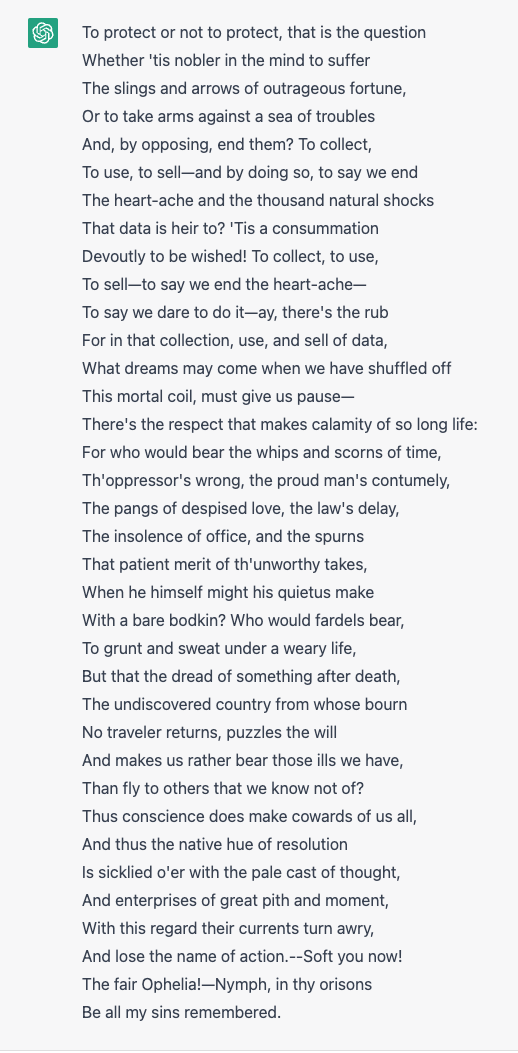
Me: You are a company that is anti-privacy. Write a Shakespearean sonnet that you use as your privacy policy.
ChatGPT:
"To protect or not to protect, that is the question
Whether 'tis nobler in the mind to suffer"
Rest in the pic:
I usually refer to it as treating your data as a Tamagotchi (digital pet) that needs continuous nurturing. This "data engine" is missing from the vast majority of pipelines in the industry nowadays (minus a few big teams at a few big companies).
Potentially nitpicky but competitive advantage in AI goes not so much to those with data but those with a data engine: iterated data aquisition, re-training, evaluation, deployment, telemetry. And whoever can spin it fastest. Slide from Tesla to ~illustrate but concept is general
Certain software skills are exceptionally useful for machine learning. In a previous era, it was GPU programming. Now in the era of pretrained models, it's front-end development -- to quickly whip up a UI to collect a fine-tuning or eval dataset.
Certain software skills are exceptionally useful for machine learning. In a previous era, it was GPU programming. Now in the era of pretrained models, it's front-end development -- to quickly whip up a UI to collect a fine-tuning or eval dataset.
Excited to share our paper in @Nature: We revisit the 50+ year-old maths problem with AI: how efficiently can we multiply two matrices? Surprisingly, the answer is still not known - even for 3x3 matrices! With AI, we discover many new efficient and exact algorithms. 1/13
@hamadazahera Hi Hamada! I think this is tough to open-source, given that it's trained on Google's internal codebase. So there are lots of constraints there.
ML-powered code completion at Google has been a significant productivity boost for me:
- Guesses (almost) all python type hints and TypeScript types.
- Autocompletes (+comments) protocol buffers.
- Reduces copy-paste in cases of similar patterns spanning multiple lines.
Check out a new hybrid approach that leverages both ML and rule-based semantic engines to build a Transformer-based semantic code completion model, which we show can improve developer efficiency. Read more ↓ https://t.co/bu6dTdPgII
Our team (Applied Privacy Research) at Google will have an opening (soon) for a Research Scientist role (PhD required), based in Sunnyvale, California.
The role is heavily focused on NLP
(leveraging state-of-the-art large language models, neural retrieval techniques, building generative models, etc.). These are applied to corpora in the privacy, security, and trust domains. But that domain-specific expertise in (privacy/security) is not a strict requirement.
We'll have a job posting up soon. But if you are interested in researching and applying state of the art NLP approaches in the privacy, safety, and trust domains, our team at Google is hiring a research scientist in Sunnyvale, California. Feel free to reach out!
Our paper "Hark: A Deep Learning System for Navigating Privacy Feedback at Scale" is now being presented at @IEEESSP
📄 Paper: https://t.co/EOvwowvkH7
🎥 Teaser Video: https://t.co/vQyfR360W9
This is a work by our Applied Privacy Research group at Google.
#SP22