@ColumbusTrades Somewhere between fixing my psychology and keeping it simple but still definitely working on the mind/emotion part. I was a member of Whale Room and really enjoyed your content, so thanks much.
We Aren't the Problem 🇨🇦
• < 1% of crime victims injured with a gun
• 95%+ of guns used in homicide are illegal
• Knives used as often as guns in homicides (97-2020)
• 2/3 of homicide accused known to police
• Gun owners 3x less likely to commit homicide than other Canadians
So let me get this straight...
Canada is in a recession—the only G7 country currently in one. Unemployment is up. Inflation is rising. Food insecurity is at a record high.
Yet the highest proportion of Canadians since 2017 now say the country is on the right track.
That's either a remarkable display of optimism—or a sign that many Canadians aren't getting the full economic story from the news they consume.
The testimony by Travis Dhanraj regarding the inner workings of CBC is shocking.
It should launch investigations.
Sadly, despite you can hear below, I believe the Liberals will protect CBC.
The Liberals on the committee weren't interested in Dhanraj's testimony.
Canada leans harder on personal income taxes than any other G7 country.
This heavy tilt toward income taxation comes at a global competitiveness cost. Canadians deserve a growth-friendly tax reform. Learn more: https://t.co/8Y8sU7NM6O
Poilievre will be the first prominent Canadian politician interviewed on TRIGGERnometry, a very well-known European podcast.
Poilievre is clearly trying to bypass Canadian legacy media to reach a broader global conservative audience.
Will watch.
To my X followers,
I’ve worked with the media for nearly 25 years. For most of that time, the relationship was professional and balanced. But in recent years, something has shifted.
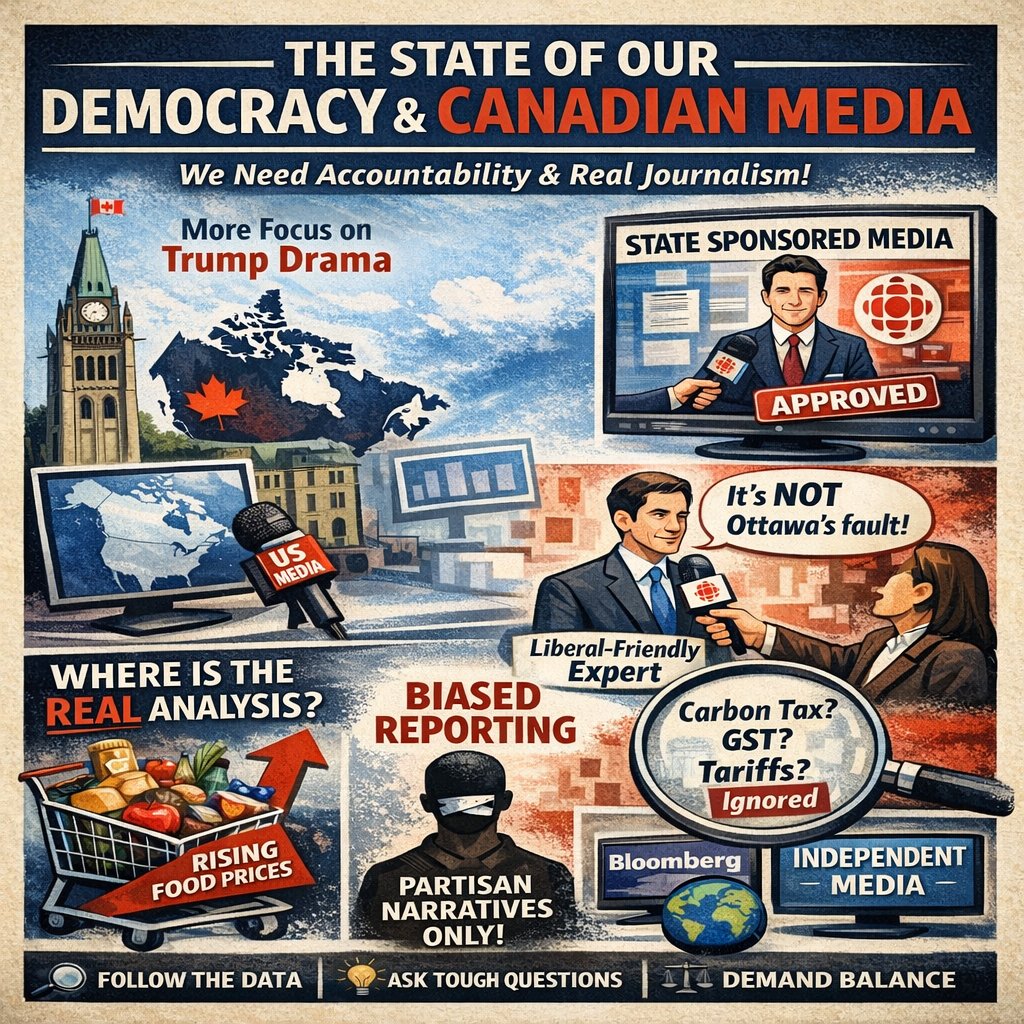
I am increasingly concerned about the state of our democracy — particularly how media, in general, are informing Canadians about food policy, food inflation, and economic policy.
I now find myself learning more about Canada’s economy and policy changes from American outlets than from Canadian ones. Much of our national coverage feels reactive, shallow, or overly fixated on partisan narratives rather than substantive policy analysis.
What troubles me most is the lack of scrutiny applied evenly across governments and institutions.
For example, when the Bank of Canada suggested that Ottawa’s counter-tariffs contributed to food inflation, only one major outlet — Bloomberg — gave it meaningful coverage. The grocery benefit program received very little examination regarding how it would be financed. It took days before anyone pressed for clarity.
During the latest spike in food inflation, several outlets turned to the same small circle of commentators who dismissed any potential role of federal policy — carbon pricing, GST holidays, counter-tariffs — despite mounting evidence that policy decisions can and do affect food prices.
Instead of investigating structural drivers of inflation, much of the coverage focuses on fact-checking opposition rhetoric, even though the opposition has not governed since 2015. Scrutiny should be applied equally — not selectively.
Quebec media, while imperfect, appear to have maintained a broader range of debate. In much of the rest of Canada, I see increasing concentration of voices — often from the same region, Ontario, often reflecting similar policy perspectives — and less diversity of thought grounded in empirical research.
This isn’t about partisan politics. It’s about accountability, transparency, and healthy democratic discourse.
Media are under financial pressure — that’s real. But public trust depends on independence and depth. Subsidy structures, incentives, and newsroom economics all matter.
Canada deserves stronger policy journalism — especially on food affordability, supply chains, and economic resilience.
We need more data-driven analysis, more intellectual diversity, and more courage to ask uncomfortable questions — regardless of which party is in power.
Until that happens, Canadians would be wise to diversify their news sources and think critically about what they’re being told — and what they’re not.
Heritage Minister Marc Miller is warning Canadians about so-called “illegitimate” media sources, suggesting that Canadians should listen to the CBC. “When there is lack of support for a public broadcaster," he said, "I think that contributes to the spread of disinformation, and social cohesion is therefore affected.” It is not the government’s role to decide what counts as a legitimate media source. What makes a media source trusted and legitimate is not how it is funded or how closely it is aligned with Ottawa.
Trust and legitimacy arise from telling the truth.
These remarks from Minister Miller signal Ottawa's appetite for interfering with a free press - expressly protected by the Canadian Charter of Rights and Freedoms.
https://t.co/yaP0l08CCF
From the mainstream media summit this weekend. This clip has been scrubbed from CPAC.
It would be a shame if this was shared endlessly as to expose the extreme media bias we in our Country. https://t.co/EebUz4GAvx
This is the Heritage Minute that was deleted from YouTube by people who want to erase Sir John A. Macdonald from our history.
Let’s make sure as many people as possible see this. Make this go viral.
Carney said Canada thrives because we are Canadian 😆
Somebody is lying to Canadians because almost every metric shows otherwise
BUT, propaganda surely works, for many
New food inflation data released this morning for December place Canada at the top of the G7 for food inflation.
Latest available figures:
🇨🇦 Canada — 6.2%
🇯🇵 Japan — 6.1%
🇬🇧 United Kingdom — 4.2%
🇺🇸 United States — 3.1%
🇮🇹 Italy — 2.6%
🇫🇷 France — 1.7%
🇩🇪 Germany — 1.4%
Source: (Trading Economics.)
44% of Canadian YOUTH showed up and voted last election
76% of 60 years and older VOTED
Canada’s YOUTH need to OUTNUMBER the 60+ crowd
If youth want a future, they have to outvote the people protecting the Liberals
"Diplomacy is necessary, grinning is optional and looking like a supplicant is undignified," said former Canadian diplomat Michael Kovrig about some of Prime Minister Mark Carney's actions and statements while in China. "That's not a good look."