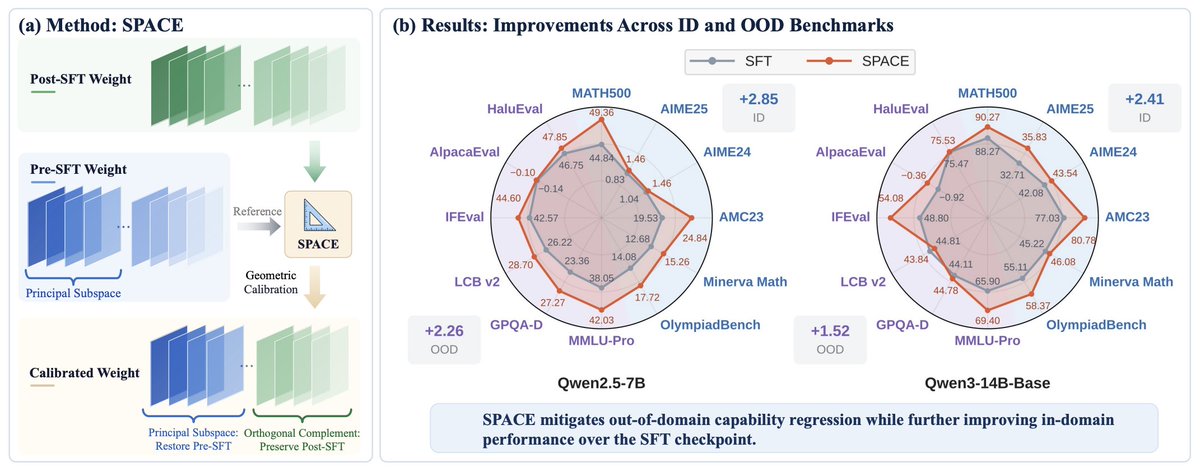
Fine-tuning can improve a target skill while weakening others. Can we improve a fine-tuned LLM by undoing part of its fine-tuning?
Introducing 🚀SPACE🚀: a post-hoc method that improves average performance both within and beyond the training domain.
No extra training. No data. Just the pre- and post-SFT checkpoints for calibration with one single step of code.
1/n
Trace2Env
What if the environment itself were an agent?
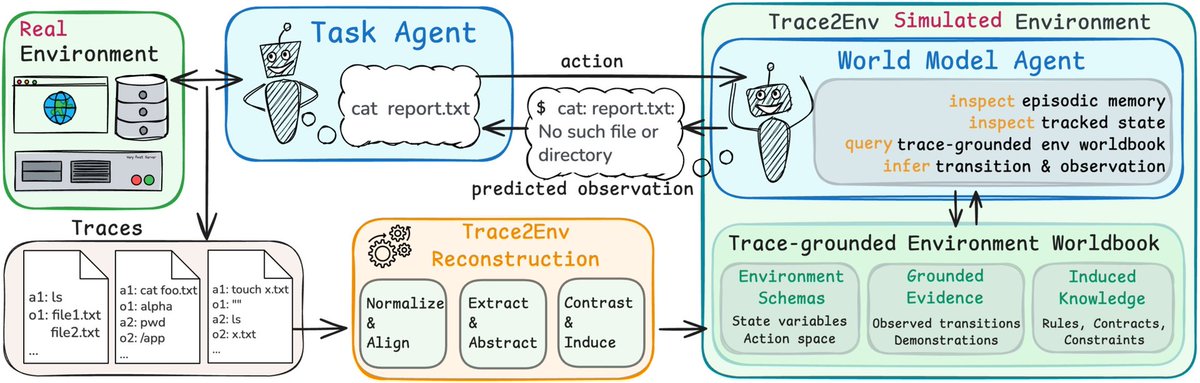
A training-free framework that reconstructs historical interaction traces into a worldbook, so a world-model agent can act as a faithful, stateful simulated environment for another agent.
🚀 Introducing Trace2Env, a framework for agentic language world modeling, aiming to provide faithful, stateful, and long-horizon simulated environments for other task agents.
🧠 • Trace2Env does not just predict the environment's next observation, it operates agentically, the consequences of earlier actions persist and affect what happens later.
📈 • Trace2Env achieves better next-observation fidelity and stronger multi-turn consistency than Qwen-AgentWorld language-world-model baselines. Actions produced inside the simulated environment also transfer well when replayed in the real environment.
❗ • Trace2Env is fully training-free. It does not require environment-specific fine-tuning, a hand-written simulator, or recovery of the original executable system. Instead, it reconstructs environment knowledge directly from historical action–observation trajectories.
🤖 • The world model itself is an LLM agent. It can actively inspect reconstructed environment knowledge, maintain episode state and episodic memory, and reason about both the next observation and the state changes that should persist.
🌍 • As long as historical action–observation behavior is available, the Trace2Env can be applied to different textual environments.
🚀 This opens up a range of potential applications:
• train agents without real environment
• test agent at lower cost
• stateful API/MCP mocks
• reconstruction of private or legacy environments
Find out more in our:
📄 Paper: https://t.co/VJkqQXB5oN
⭐ GitHub: https://t.co/h0SeB6dUbC
🌐 Project: https://t.co/lxlwkGflsL
🕹️ Demo: https://t.co/IZTT5CgB5K
#AIAgents #WorldModels
🚀 Introducing Trace2Env, a framework for agentic language world modeling, aiming to provide faithful, stateful, and long-horizon simulated environments for other task agents.
🧠 • Trace2Env does not just predict the environment's next observation, it operates agentically, the consequences of earlier actions persist and affect what happens later.
📈 • Trace2Env achieves better next-observation fidelity and stronger multi-turn consistency than Qwen-AgentWorld language-world-model baselines. Actions produced inside the simulated environment also transfer well when replayed in the real environment.
❗ • Trace2Env is fully training-free. It does not require environment-specific fine-tuning, a hand-written simulator, or recovery of the original executable system. Instead, it reconstructs environment knowledge directly from historical action–observation trajectories.
🤖 • The world model itself is an LLM agent. It can actively inspect reconstructed environment knowledge, maintain episode state and episodic memory, and reason about both the next observation and the state changes that should persist.
🌍 • As long as historical action–observation behavior is available, the Trace2Env can be applied to different textual environments.
🚀 This opens up a range of potential applications:
• train agents without real environment
• test agent at lower cost
• stateful API/MCP mocks
• reconstruction of private or legacy environments
Find out more in our:
📄 Paper: https://t.co/VJkqQXB5oN
⭐ GitHub: https://t.co/h0SeB6dUbC
🌐 Project: https://t.co/lxlwkGflsL
🕹️ Demo: https://t.co/IZTT5CgB5K
#AIAgents #WorldModels
🧠 Introducing BudgetMem: Runtime Agent Memory with explicit performance–cost control.
Runtime memory utilization is powerful but often expensive, and most systems offer little control beyond fixed pipelines.
BudgetMem turns memory extraction into budget-tier routing across modular memory operations, so you can trade off quality vs cost on demand.
📄 Paper: https://t.co/zKR1GjqvwD
💻 Code: https://t.co/mf0JxPdqSS
#LLM #Agents #AgentMemory #LongContext #ReinforcementLearning #EfficientAI
Memory is the bottleneck for LLM agents.
Fixed memory pipelines waste compute on irrelevant information while potentially discarding what a specific query actually needs.
This new research introduces BudgetMem, a runtime agent memory framework that extracts memory on-demand with explicit, controllable performance-cost trade-offs.
As agents scale to longer interactions and more complex tasks, memory cost becomes a first-class concern. BudgetMem provides a systematic framework for explicit performance-cost control in runtime agent memory.
Instead of treating memory as a monolithic pipeline, BudgetMem structures extraction into modular stages, each offered in three budget tiers (Low/Mid/High).
A lightweight neural router, trained with reinforcement learning, selects the right tier per module based on the current query and intermediate context.
They study three complementary strategies for realizing budget tiers: implementation tiering (varying method complexity), reasoning tiering (varying inference behavior like direct vs. reflection), and capacity tiering (varying model size).
On LongMemEval with LLaMA-3.3-70B, BudgetMem-CAP achieves a Judge score of 60.50, surpassing the strongest baseline LightMem (48.51) by a wide margin. On HotpotQA with Qwen3-Next-80B, BudgetMem-CAP scores 72.08 at just $0.22 cost, while BudgetMem-REA reaches 70.83 at an even lower $0.17. The trained router also transfers across model backbones without retraining.
The analysis reveals that implementation and capacity tiering span broader cost ranges for exploring budget extremes, while reasoning tiering acts as a fine-grained quality knob within a tighter cost band.
Paper: https://t.co/qkKmawVNrk
Learn to build effective AI agents in our academy: https://t.co/LRnpZN7deE
📚 Introducing MemSkill, turning static memory pipelines into a trainable, upgradable capability for more reliable long-horizon agents.
❓Handcrafted memory operations are often brittle and hard to scale.
✨Inspired by agent skills, we rethink memory construction as skill-conditioned generation over an evolving skill bank, learning skill selection with RL and evolving skills from failures over time.
📄 Paper: https://t.co/4TvdeSi39n
💻 Code: https://t.co/GcZ8a9AvaO
#LLM #Agents #AgentMemory #AgentSkill #ClaudeSkills #ReinforcementLearning
🎉 We’re thrilled to announce SSNLP 2024!🎉Next Wed, 6 Nov for the ✨ 7 Keynotes /🎤10 Orals /📊45 Posters. Open to ALL passionate about NLP! 🌐https://t.co/hXXqJoatHU #NLP#Research#SingaporeSymposium