Don't get caught up in fixating on the distance remaining—just keep pushing ahead. Acknowledge and savor each small milestone you hit, and have faith that your steady, everyday dedication will ultimately bring you to the goal you truly long for.🧳Turn today into a moment you'll
In the afternoon, she attended a cooking workshop where she mastered the art of crafting beignets entirely by hand. She kneaded the dough, allowed it to proof, then fried it to a perfect golden crisp, finishing with a generous coating of confectioner's sugar. The result was airy
They grabbed a pizza, settled in for a film, and dove into conversations about their aspirations. Lila opened up about her vision to grow her blog, and her buddies cheered her on, insisting she had a natural talent for fashion and narrative flair. ⌨Factory worker: equipment all
Took 2 hours again today to reach from Thane to Kalina via Eastern EXPRESS highway, thank you for digging up entire 23km in one go between thane-ghatkopar 🙏🏼 Great planning to make us suffer for next 5 yaars everyday for the sake of development @Dev_Fadnavis@mieknathshinde
This normal looking uncle sitting besides me on a local station in Mumbai has 9cr stock portfolio.
People will amaze you in all shapes and forms at different places
A lot of traders still think algo trading is only for institutions or people with coding backgrounds.
I don't think that's going to be the case for much longer.
If you've been trading actively for a few years, you've probably experienced this yourself. You spot an opportunity, decide your entry and exit, but by the time you place the order, the market has already moved.
The challenge today isn't just finding opportunities. It's executing them consistently.
And that's where algorithms have a clear advantage.
An algo doesn't get distracted, hesitate or change its mind because of a red candle on the screen. It simply follows the rules you've defined.
In many ways, algo trading isn't about removing the trader from the equation. It's about removing the avoidable mistakes.
I believe the next wave of retail traders will spend less time manually placing trades and more time building, testing and refining strategies.
The focus will shift from "What should I trade today?" to "What process can I create that works repeatedly over time?"
That's a much more scalable approach.
As algo adoption grows, traders will naturally start paying attention to things they may have ignored earlier - API speed, execution quality, uptime and reliability.
At Kotak Neo, we've invested heavily in this area. Independent comparisons on OpenBroker show our APIs among the fastest in the industry. And to make algo trading more accessible, we also offer zero brokerage for algo traders.
Technology won't replace traders. But traders who use technology effectively will have a significant edge over those who don't.
Here are some of the comparisons of #KotakNeo Trade API’s with other discount brokers.
Next time SEBI releases its F&O study, it should split loss making traders into two groups:
- Before STT
- After STT
That will clear up if STT is protecting traders or just adding to their losses.
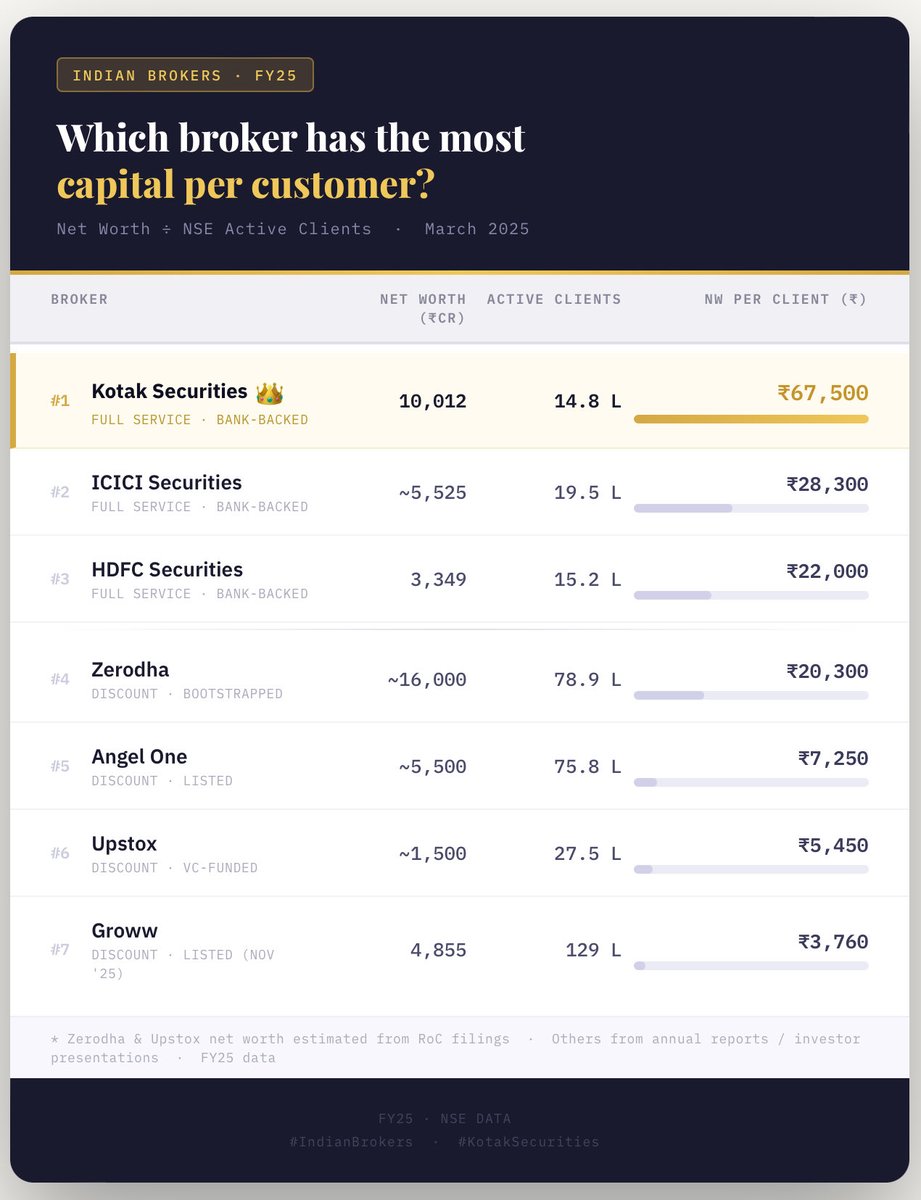
What SEBI is largely implying with the consultation paper is that net worth has to be in line with how many active clients a broker services.
Whatever the safeguards, net worth can never be ignored when it comes to safety of investor capital.
At ₹67,500 net worth per active client, #KotakNeo continues to be on top and by far.
Full-service. Bank-backed. Digital. Built for the long run.
SEBI has released a consultation paper proposing a revised Net Worth framework for Stock Brokers. Let me break this down simply.
Why is SEBI doing this?
The old framework calculated net worth as 10% of client cash balances held by the broker. But after SEBI’s upstreaming framework came in, most client funds now go directly to clearing corporations. Brokers hold almost nothing. So the old metric became irrelevant.
What’s the new framework?
Net worth will now be calculated as three things added together.
First, 10% of average client credit balances over the last 6 months.
Second, a graded slab based on number of direct active clients ₹50 lakhs for up to 50,000 clients, and an additional ₹50 lakhs for every 50,000 after that.
Third, another graded slab for clients onboarded through Authorised Persons starting at ₹5 lakhs for up to 2,500 clients, scaling up from there.
The key word here is graded. Requirement grows with size. Smaller brokers with smaller client bases face a proportionately smaller burden. This is not a one-size-fits-all mandate.
Will this hurt small brokers?
Less than people think. Most small and mid-sized brokers already maintain adequate net worth. The slabs are calibrated. A broker with 5,000 clients through APs needs ₹25 lakhs additional net worth. That’s not an existential burden.
What about large brokers?
Larger brokers will carry a higher requirement, but they also have the balance sheet to support it. The logic is simple: if you’re managing the finances of crores of clients, your financial cushion must reflect that responsibility.
What does this really mean?
Net worth is a second line of defence. Margins come first. But markets have tail risks that margins don’t fully cover. A broker with millions of clients and thin net worth is a systemic risk. This framework simply makes the second line of defence proportionate to the risk being carried.
This is directionally right. Appropriately Networth matters.
If you evaluate revenue per basis point of market share across all discount brokers, the value proposition becomes very clear and, frankly, quite striking.
Most investors and traders would be surprised at how much they stand to save with Kotak Neo.
•50% lower brokerage in F&O and Intraday
•Zero brokerage on APIs — a full 100% discount
•Under 30 segment: 50–80% lower blended brokerage
•30–50% lower interest spreads (often even more in practice)
•~50% lower pricing in Commodity and Currency
•No minimum brokerage floor (₹5, etc.), unlike many peers
•Multiple other areas where we continue to be structurally lower, including zero interest on Intraday.
Now here’s the key point:
The segments where we are relatively higher AMC and Delivery charges etc are not the primary revenue drivers for most discount brokers.
•For Kotak Neo: <25% of revenue
•For most peers: ~10–15% (or even lower)
Which means the core segments where customers actually incur most costs are significantly discounted with us.
And on the product side:
Our app is continuously improving. It may not claim to be perfect yet, but it is already among the better platforms in the market and getting stronger by the day.
So it’s worth going back to the opening point:
When you look at revenue per basis point of volume market share, the savings with Kotak Neo aren’t just meaningful, they’re hard to ignore.
Feels like Hindi commentary in the IPL has gone from stories and insights to a bunch of friends on a couch, casually watching the match over drinks. Where’s the depth gone? 🏏