My salute to the Indian pilot Captain Smit Machchhar for his extraordinary bravery.
Despite being stabbed and seriously injured, he fought back, resisted, opened the cockpit door, and enabled passengers and crew to overpower the attacker — preventing a catastrophic mid-air disaster.
He saved the lives of 174 people, including Israeli citizens and other nationals.
I wish Captain Machchhar a speedy and full recovery.
He is a true hero.
@fifamedia Worth checking if that camera's own footage is actually stable. A wire-mounted cam can pick up strong vibration that its stabilization (hardware or software) doesn't fully compensate for.
A historic day for Indian Swimming as #AryanNehra becomes the first Indian Swimmer to go below the 8 minute mark in the 800 Freestyle 🇮🇳🇮🇳
Aryan swam 7:59.36
✅National Record
✅Best Indian Time
✅Qualifies for Asian Games
✅Qualifies for CWG
✅8 min barrier broken
#Swimming
Minimizing GPU burn while maximizing output is key. I still see agentic workflows, involving MoEs, being built for tasks that could be accomplished with a few greps."
With current AI, any form of traditional SDLC means creating tech debt.
AI should be used to upgrade legacy codebases because they already have test harness and all the code changes are easy to verify with their existing and proven tests.
Enterprises today are running single-player AI in a multiplayer business.
One engineer plus one IDE plus one agent ships lines of code faster. It does not ship coordinated software.
Two desks over, another engineer's agent is shipping a change that contradicts last quarter's architecture decision.
Neither agent knows.
Compliance assembles the audit trail from screenshots after the fact.
We built Software Factory to turn that into a team.
Requirements captures the business intent in plain English.
Blueprints maps the architecture as it actually exists.
Work Orders translates that into structured tasks agents execute through MCP in Cursor, VS Code, or Claude Code.
Tests validates the deployed code against the Requirement that started it.
The Knowledge Graph wires it all together.
Your engineers conduct the agents.
The agents share state.
The audit trail is part of the build, not a quarterly forensics exercise.
EY's deployment: +70% productivity, 95%+ automated test coverage, months of roadmap compressed to days.
https://t.co/0abR6SVkjb
@karpathy My experience is LLMs need nudge to explore all possible arguments but once we ask to justify and prompt it “show me the reference and the text” for every direction, it will start refining and converging to something solid comparing different directions of arguments.
Unpopular Opinion: We aren't building the future 10x faster with AI. We are just generating legacy code 10x faster.
Everyone is currently bragging about developer velocity. "I built this entire backend in a weekend!" "AI wrote 80% of my codebase!"
But here is the reality check we are ignoring: Code is a liability, not an asset.
If an AI tool spits out 1,000 lines of functional boilerplate in five seconds, that is still 1,000 lines that a human being has to read, review, secure, and maintain when the dependencies inevitably break next year.
We are treating code generation like a pure productivity win, but we are optimizing for the wrong metric. The bottleneck in software engineering was never how fast we could type. The bottleneck has always been comprehension, architecture, and maintenance.
If we don't shift our focus from "generation speed" to "architectural sanity," the tech debt of the next five years is going to be an absolute, unmaintainable nightmare.
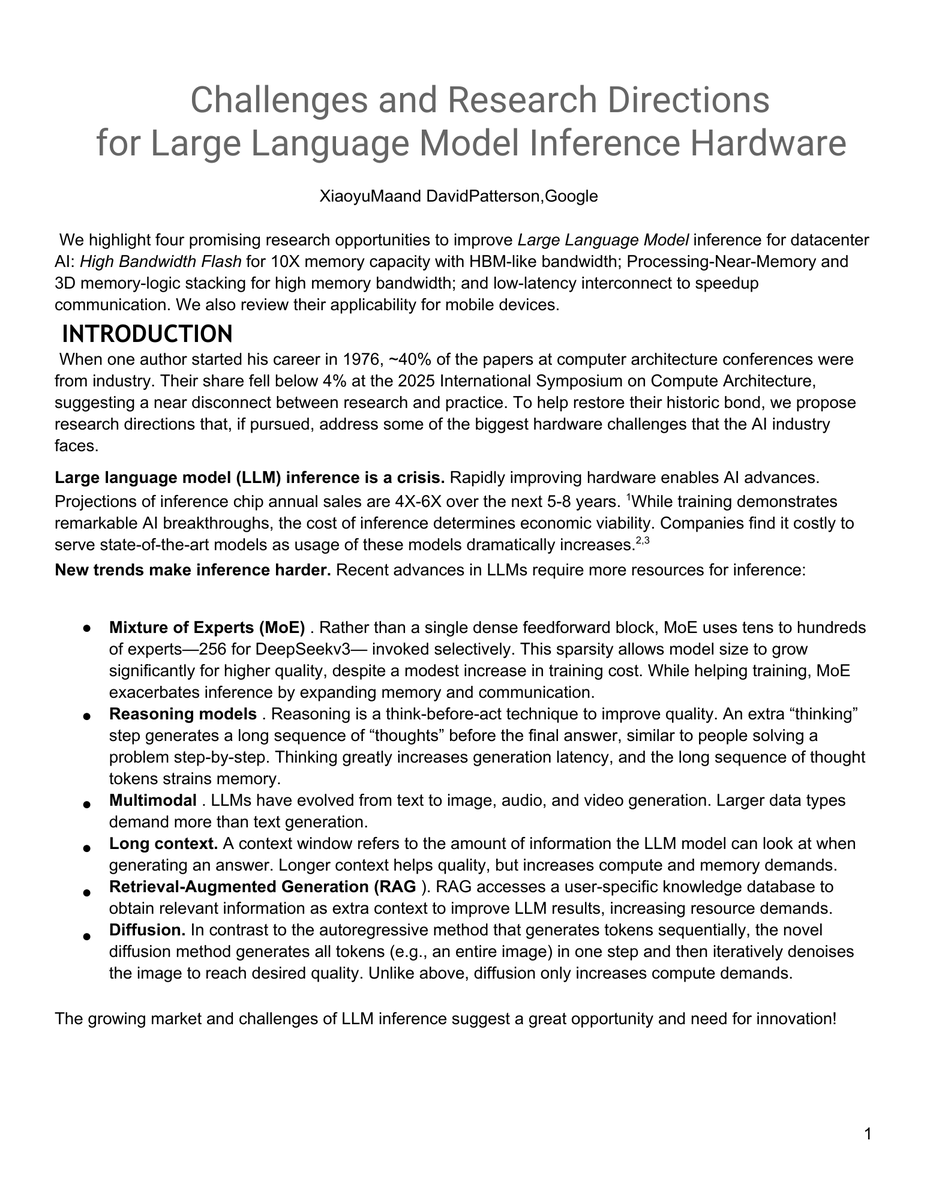
🚨 BREAKING: A Google researcher and a Turing Award winner just published a paper that exposes the real crisis in AI.
It's not training. It's inference. And the hardware we're using was never designed for it.
The paper is by Xiaoyu Ma and David Patterson. Accepted by IEEE Computer, 2026.
No hype. No product launch. Just a cold breakdown of why serving LLMs is fundamentally broken at the hardware level.
The core argument is brutal:
→ GPU FLOPS grew 80X from 2012 to 2022
→ Memory bandwidth grew only 17X in that same period
→ HBM costs per GB are going UP, not down
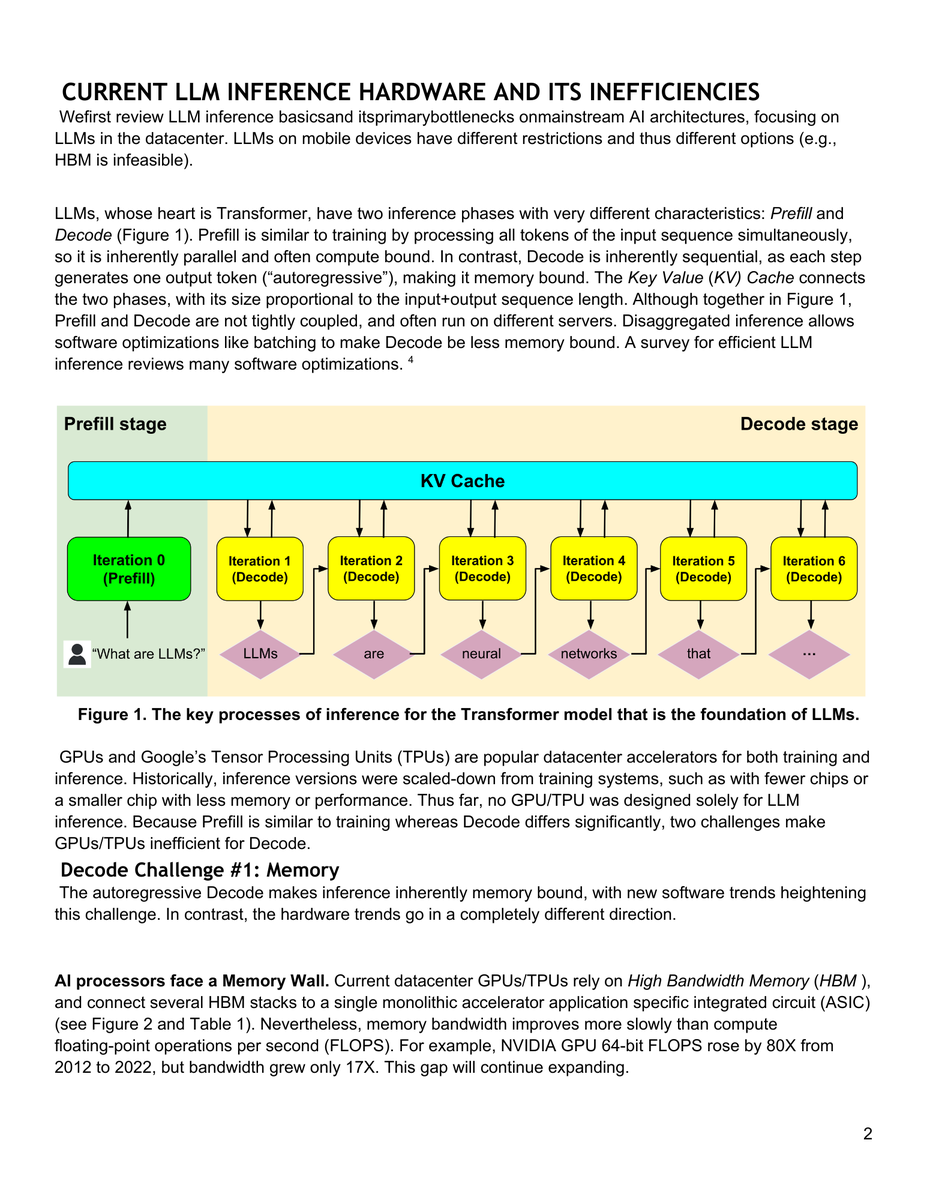
→ The Decode phase is memory-bound, not compute-bound
→ We're building inference on chips designed for training
Here's the wildest part:
OpenAI lost roughly $5B on $3.7B in revenue. The bottleneck isn't model quality. It's the cost of serving every single token to every single user. Inference is bleeding these companies dry.
And five trends are making it worse simultaneously:
→ MoE models like DeepSeek-V3 with 256 experts exploding memory
→ Reasoning models generating massive thought chains before answering
→ Multimodal inputs (image, audio, video) dwarfing text
→ Long-context windows straining KV caches
→ RAG pipelines injecting more context per request
Their four proposed hardware shifts:
→ High Bandwidth Flash: 512GB stacks at HBM-level bandwidth, 10X more memory per node
→ Processing-Near-Memory: logic dies placed next to memory, not on the same chip
→ 3D Memory-Logic Stacking: vertical connections delivering 2-3X lower power than HBM
→ Low-Latency Interconnect: fewer hops, in-network compute, SRAM packet buffers
Companies that tried SRAM-only chips like Cerebras and Groq already failed and had to add DRAM back.
This paper doesn't sell a product. It maps the entire hardware bottleneck and says: the industry is solving the wrong problem.
Paper dropped January 2026. Link in the first comment 👇
📢 Open-sourcing the Sarvam 30B and 105B models! Trained from scratch with all data, model research and inference optimisation done in-house, these models punch above their weight in most global benchmarks plus excel in Indian languages.
Get the weights at Hugging Face and AIKosh. Thanks to the good folks at SGLang for day 0 support, vLLM support coming soon. Links, benchmark scores, examples, and more in our blog - https://t.co/DcCG3zlN8p
Verification is a cornerstone for reasoning. Recent progress in mathematical reasoning and theorem proving has relied on LLMs + formal verification in Lean. But so far, Lean has focused on pure math, and lacks support for verification involving neural nets themselves.
Applications include:
1. Certified robustness in neural networks, crucial in safety critical applications such as neural control.
2. Physics informed neural networks, which have been used to prove singularity problems related to the Millennium prize problem in fluid dynamics.
3. Theory related to neural networks such as approximation bounds, effect of quantization etc.
India’s AI leadership reaches the global stage! Professor Balaraman Ravindran of IIT Madras has been appointed to the UN’s inaugural Independent International Scientific Panel on AI. Out of 2,600+ applicants, he is one of 40 experts guiding the General Assembly on AI safety and innovation. This prestigious role highlights India’s tech influence and IIT Madras’s world-class research. Congratulations, Prof. Balaraman Ravindran! @ravi_iitm
#IndiaAI #UnitedNations #IITMadras
The German magazine 'Autobild' drives various cars for 100,000 kilometers and then disassembles them down to the last screw to find signs of wear and weak points
@elonmusk If @Tesla gives a Roadster and Model S with track package to Hockenheimring, it would allow people to try on RacenRoll days.
https://t.co/AuBkfedn51
2 of our papers were accepted for the Eurosys’26 spring deadline. https://t.co/nK7GftRDiU
*AdaGen: Workload-Adaptive Cluster Scheduler for Latency-Optimal LLM Inference Serving
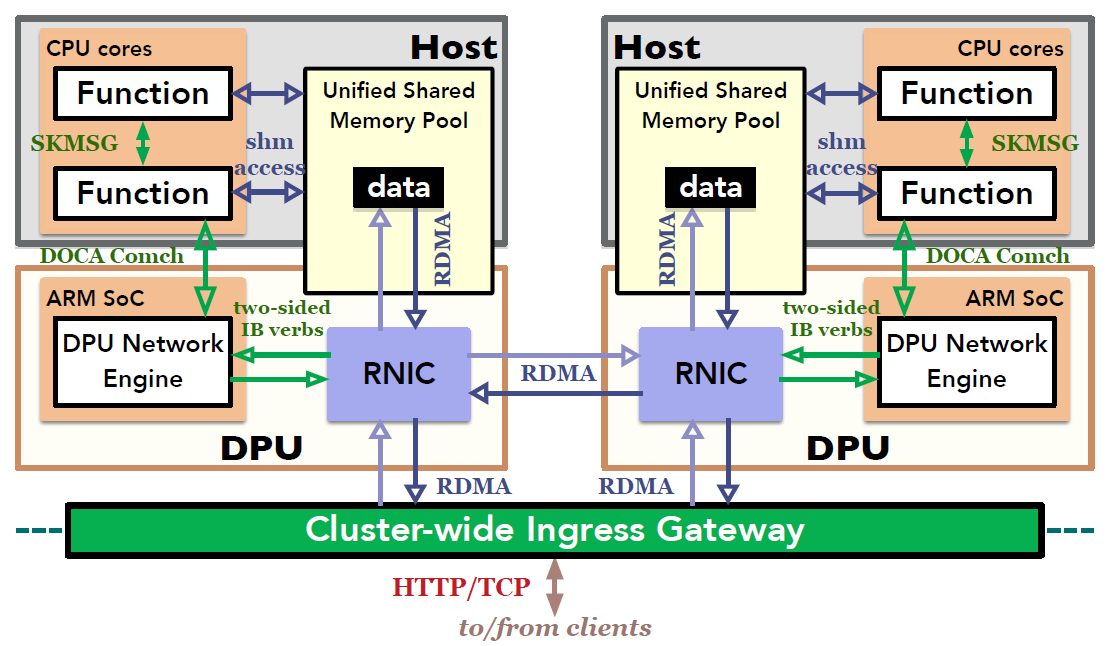
*Not A DPU in Name Only! Unleashing RDMA-capable DPUs in Multi-Tenant Serverless Clouds with NADINO