Comparison of AI and primary care physicians for 100 patients in a prospective real-world assessment
—The physicians outperformed AI [AIME] for practicality and cost-effectiveness
—AI was comparable for diagnosis, management plan, appropriateness and safety
@AdamRodmanMD@alan_karthi@PeterBrodeurMD@googledeepmind https://t.co/FNWYoHVkkw
At Google I/O 2026, we shared major breakthroughs. From accelerating scientific discovery with Gemini for Science to transforming everyday experiences with Google Search, we’re catalyzing a new era of innovation. Read the blog to learn more: https://t.co/qJaN94NWvc
The Iso team has cooked something incredible: our new technical report unveils the latest results from our drug design engine, the IsoDDE, progressing far beyond AlphaFold 3. This breaks new ground compared to AF and other similar methods by a significant degree across all key benchmarks. 1/7
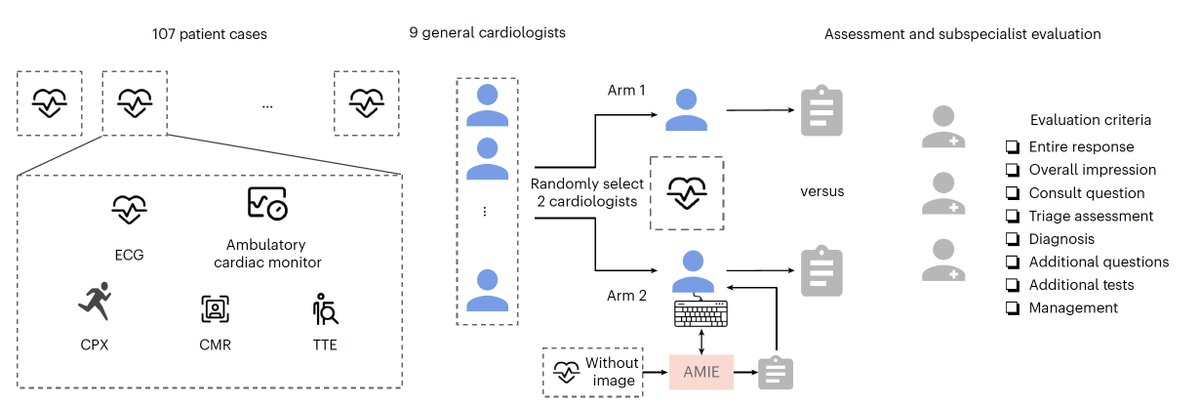
Improving complex cardiology care with a large language model: a randomized trial (not real world) shows support with AI led to substantial improvement in accuracy and less time
https://t.co/lVkWwIQ1qg
Excited to share our latest research published today in @NatureMedicine, demonstrating how Large Language Models (LLMs) can help bridge the critical shortage of subspecialist medical expertise. https://t.co/5OE5tYw3dE
🚨 Today, @Google is announcing a strategic partnership with Included Health on a nationwide randomized study of AI in virtual care.
📢 Official announcement: https://t.co/PTEIntZzQQ
✨ With a stellar team across Included Health @GoogleResearch@GoogleDeepMind@GoogleForHealth
Does medical AI really work in the real-world? It needs to be assessed carefully and responsibly.
We will be launching a first-of-its-kind nationwide randomized study with Included Health to evaluate AI in real-world virtual care to better understand its capabilities & limitations. This study is informed by years of foundational research across Google, investigating the capabilities required for a helpful & safe medical AI.
This study builds on years of foundational research on conversational AI for health @Google
AMIE: https://t.co/w5aEXX2OgU (Nature papers: https://t.co/WBxD5xYjMa + https://t.co/vvA7yyRqpw)
Personal Health Agent: https://t.co/8bpL7pd63y
Wayfinding AI: https://t.co/lN9kdDGZWX
This work is incredibly close to my heart. So grateful to our team @GoogleDeepMind@GoogleResearch & @Yale collaborators.
It's been a hard road and a hard-won milestone, and this is just the beginning.
The path from a finding like this to the clinic is very long, requiring extensive preclinical and clinical validation. But the potential is what drives us. We hope that as these AI models scale, they can help researchers overcome fundamental challenges in cancer treatment like therapeutic adaptation or discover new pathways to re-energize our immune cells.
A long way to go, but a hopeful first step.
An exciting milestone for AI in science: Our C2S-Scale 27B foundation model, built with @Yale and based on Gemma, generated a novel hypothesis about cancer cellular behavior, which scientists experimentally validated in living cells.
With more preclinical and clinical tests, this discovery may reveal a promising new pathway for developing therapies to fight cancer.
Learn about user insights from a novel AI agent — “Wayfinding AI”, an early-stage research prototype — that helps find the way to better health information through proactive conversational guidance, goal understanding, and tailored conversations. More →https://t.co/MrjAzt6s6u
The global health workforce is projected to face a shortage of 11 million workers by 2030. We’re exploring how @Google’s AI models could help address this challenge by serving as helpful tools in medical learning environments. More from @GoogleResearch ⬇️ https://t.co/3CviXx0PjD
Check out today’s blog post, where we highlight two studies that explore how Google’s AI models can be used as helpful tools in medical learning environments, reimagining the future of education for health professionals. Learn more: https://t.co/qhCf9VvE05
🚨New research from @GoogleResearch@GoogleDeepMind: Towards physician-centered oversight of conversational diagnostic AI. Conversational AI holds promise for improving diagnostic workflows, but safe use must ensure that licensed physicians stay accountable for clinical decisions
Today, Google Research & @GoogleDeepMind introduce g-AMIE, an extension of our diagnostic AI system based on #Gemini 2.0 Flash. It uses a guardrail that prohibits medical advice sharing & instead provides a summary for a physician to review. Learn more: https://t.co/zXc2yWRWLn




![EricTopol's tweet photo. Comparison of AI and primary care physicians for 100 patients in a prospective real-world assessment
—The physicians outperformed AI [AIME] for practicality and cost-effectiveness
—AI was comparable for diagnosis, management plan, appropriateness and safety
@AdamRodmanMD @alan_karthi @PeterBrodeurMD @googledeepmind https://t.co/FNWYoHVkkw](https://pbs.twimg.com/media/HDD0xXWbAAA00ec.jpg)