Postdoc in ME@PSU | Insect Flight Control | Aspiring Polymath | Controls Engineer | Interested in Dynamical Systems and its application to Robotics/Biology
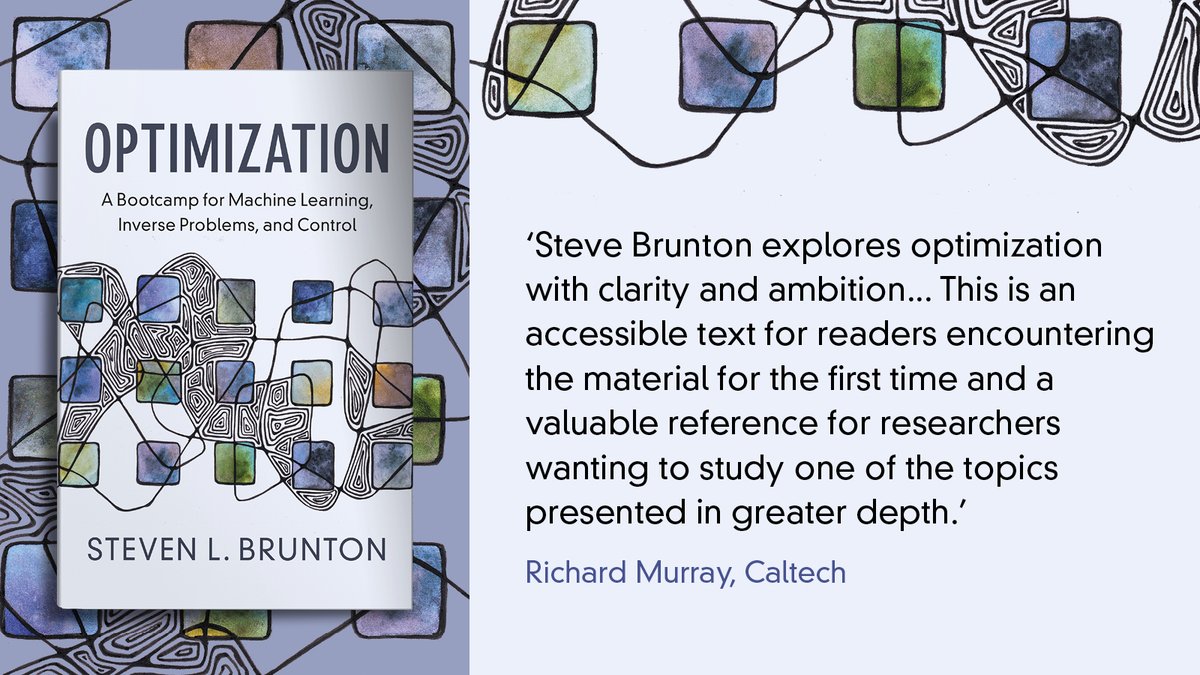
'Optimization: A Bootcamp for Machine Learning, Inverse Problems, and Control' by Steven Brunton @eigensteve
A broad and practical overview of how optimization can be applied, especially to machine learning, inverse problems, and control.
https://t.co/wxxASt5cmN
This will surprise you: sine and cosine are orthogonal to each other.
What does orthogonality even mean for functions? In this thread, we'll use the superpower of abstraction to go far beyond our intuition.
We'll also revolutionize science on the way.
As a first demonstration for applying neural networks to problems in dynamics, I show a simple application of how they can be used to forecast data into the future: https://t.co/mei0JqS64B
New Graduate Certificate in Data-Driven Dynamical Systems & Controls!
Come join us, Fall 2025!
Topics include: Data-driven dynamics, control, & sensing with modern machine learning
Stacks towards Masters degree at UW
https://t.co/b02mEwQ4vN
Application deadline: July 1, 2025
🎙️ New episode! Anders Rantzer (@lunduniversity) walks us through robust control, IQCs, the KYP lemma, nonlinear and hybrid systems, scalability and positivity, and dual (adaptive) control. A journey shaped by the dialogue between Western and Russian control traditions — don’t miss it! 🧠🚀
A Complete Course to Learn Robotics and Perception
Notebook-based book "Introduction to Robotics and Perception" by Frank Dellaert and Seth Hutchinson
https://t.co/6nZSqp5akJ
https://t.co/irV8XeQ9jZ
In 1945, six women pulled off a computing miracle.
They programmed the world’s first computer—with no manuals, no training.
Then, a SINGLE assumption erased them from tech history for decades.
The story of how ONE photo nearly deleted computing’s female founders: 🧵
I'm about to start a mini-suite of video lectures on finding Lyapunov functions in data (and other related problems). Here we start with the theory: https://t.co/KtQ3DzkomH
Finally starting to appreciate the ability of simple models to make prose explanations clearer and more concrete. Here, a model of cortical control of gait modification via phase-dependent gating of sensory input.
My new @WIRED piece about arXiv: either 1) the most important website you've never heard of or 2) the platform your entire field depends on
Also had the pleasure of hanging out with its creator, Paul Ginsparg—the Forrest Gump of the Internet age
Researchers at Berkeley, have developed a squirrel-inspired robot capable of leaping from branch to branch with remarkable ease.
By studying the biomechanics of squirrels, the team modified a one-legged robot, named Salto, to execute jumps and landings on narrow perches.
This advancement could lead to robots adept at navigating complex environments, such as construction sites or dense forests, enhancing their utility in monitoring and exploration tasks.
Averaging is one of my favourite techniques in dynamical systems. Here I will show you how to do it without governing equations: https://t.co/CQt276djhv
Flapping-wing drones have been around for years... but the X-Fly Bionic Bird takes a different approach.
Designed to mimic the motion of a real bird, it combines mechanical wing flapping with onboard stabilization for controlled flight.
A six-axis gyro and G-sensors help counteract the vibrations caused by flapping, keeping it steady even in windy conditions. It has a 150-meter range, a replaceable battery for extended use, and a flexible frame designed to withstand crashes.
Whether it’s a novelty or a step forward for bio-inspired flight remains to be seen!
I keep repeating myself over the same comments when revising the overview figure in a paper.
TL;DR: When you visualize your overview figure as a computational graph, it's instantly 10x clearer!
Scientists have developed a #springtail-inspired, centimeter-scale robot that can jump up to 1.4 meters.
Learn more in Science #Robotics: https://t.co/xCWS8k9318
Our lab has 2 (!) open postdoc positions🥳
We're looking for creative and curious scientists to lead new projects: one on deep-sea biological rhythms and another on the evolution of biological communication🐚🦗🦋🐙🦉
If you know someone who'd be a good fit, please share!