가우시안 스플래팅 : 여러 각도에서 찍은 사진이나 영상으로 3D 장면을 만들고, 실제 카메라가 없던 위치에서도 그 장면을 보여주는 기술.
영상의 가장자리를 흐릿한 반투명으로 처리하고 이것을 화면에 겹쳐 재생성한다. 하지만 영상이 없는 공간의 영상도 실시간으로 생성해서 한 화면으로 보여주는 거는 어케했누...?
이 리얼리티뷰가 탑승 경험에 중요한 이유는 차가 움직이기 전에 운전의 의도를 읽을 수 있기 때문이다.
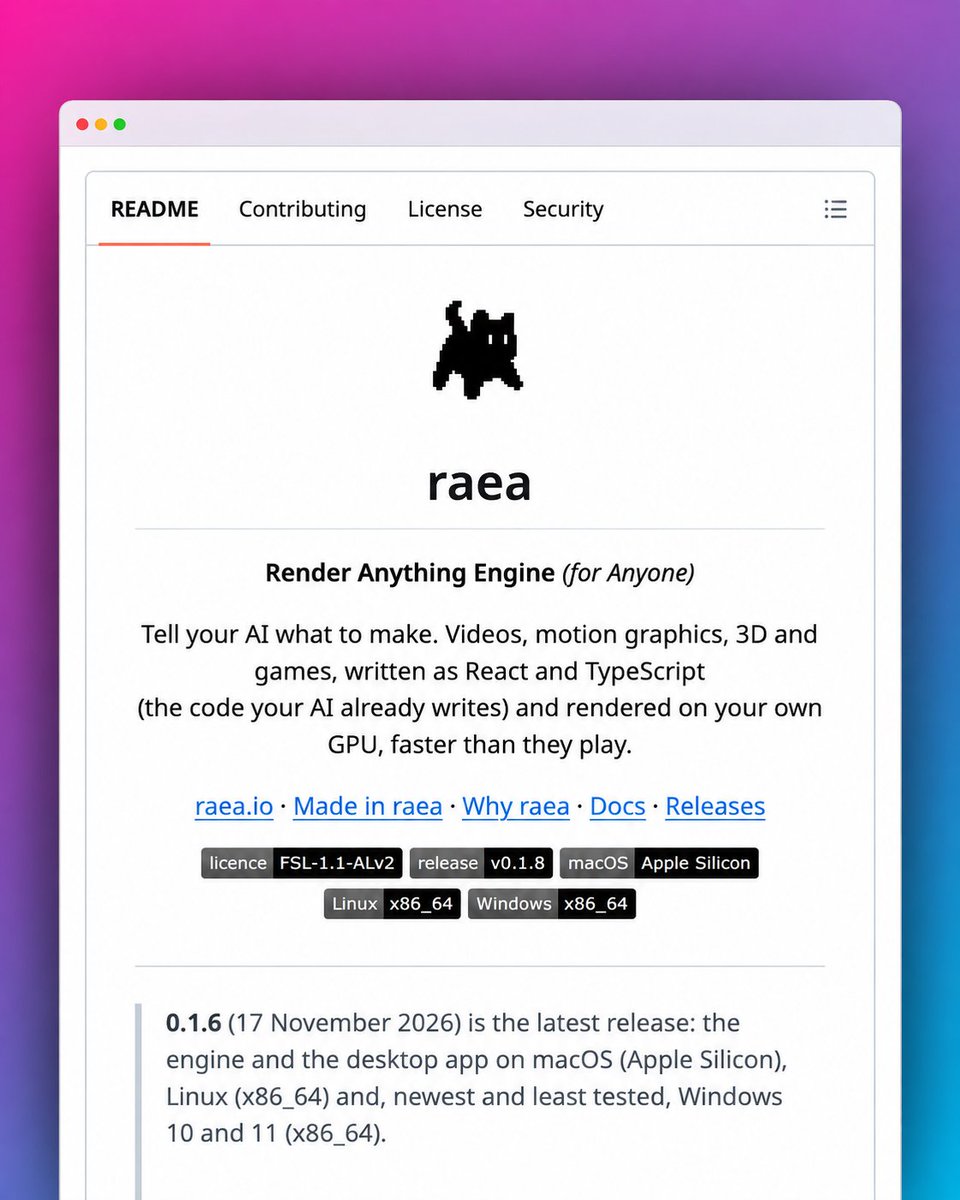
No f*ckin wayyy... now we got RAEA after REA. 🥵🔥
RAEA lets you create videos, motion graphics, 3D scenes and even games using React and TypeScript.
~ Create videos with code.
~ Build 3D scenes and animations.
~ Make playable games.
~ Render on your own GPU.
~ Let AI agents create and inspect their work.
~ Export videos and games.
Basically, your AI coding agent can now help create videos, animations and games from code.
Imagine being alive to witness all this... 🥹
Follow me for more amazing AI, Coding & Web Dev insights 💎
Teleoperating an OpenYAM using AR
It’s very satisfying to see the overlay match the physical motion.
Hand tracking on @specs feeds the IK solver from @dimensionalos which drives the physical arm.
🚨 KARPATHY ACABA DE FIRMAR EL CERTIFICADO DE DEFUNCIÓN DE CLAUDE PRO, CHATGPT PRO Y GEMINI PRO
Y lo ha hecho con una sola frase:
"Todos están alquilando modelos de vanguardia para trabajos que un modelo local de 3B podría hacer. Los LLM locales pequeños son el futuro."
Este PDF de 18 páginas explica su idea: ejecutar la IA en tu propia máquina.
Sin suscripción.
Sin pagar por cada token.
La verdadera pregunta no es "¿el modelo local es igual de inteligente?"
Es "¿cuántas de mis 1000 llamadas necesitaban de verdad al inteligente?"
Te dejo el PDF abajo 👇
Turn any phone, drone/action camera into a real 3D scanner.
Accord: builds accurate metric maps live at 18fps, no tuning required.
-Zero tweaking
- Clever self-correction
- True physical measurements
- No LiDAR needed:!
https://t.co/aBHIUr2JRW
Animated SOG (.asog): a compressed format for 4D Gaussian splat clips.
About 11x smaller than the TRiGS files, full spherical harmonics, sound in the file, streams in the browser.
Open source, MIT.
Try it: https://t.co/VCiCORx2ix
Code: https://t.co/Zgyd17g72H
New article out: 𝗡𝗶𝗻𝗲 𝗽𝗹𝗮𝗰𝗲𝘀 𝘁𝗼 𝘂𝘀𝗲 𝗗𝗲𝗰𝗶𝘀𝗶𝗼𝗻 𝗠𝗼𝗱𝗲𝗹𝘀 𝗶𝗻 𝗔𝗴𝗲𝗻𝘁𝗶𝗰 𝗥𝗔𝗚 𝘀𝘆𝘀𝘁𝗲𝗺. Code examples included.
Here are the nine use cases at a glance:
𝟭. 𝗠𝗼𝗱𝗲𝗹 𝗿𝗼𝘂𝘁𝗶𝗻𝗴. The prompt goes to a decision model, it picks the tier. Cheap models for lookups, expensive for what you cannot afford to get wrong.
𝟮. 𝗚𝘂𝗮𝗿𝗱𝗿𝗮𝗶𝗹𝘀. A separate yes-or-no per potential hazard. Before the LLM sees the input or on the answer that has been produced.
𝟯. 𝗥𝗲𝘁𝗿𝗶𝗲𝘃𝗮𝗹 𝘀𝘂𝗳𝗳𝗶𝗰𝗶𝗲𝗻𝗰𝘆. Is what came back enough to answer, or should we search again.
𝟰. 𝗣𝗮𝘀𝘀𝗮𝗴𝗲 𝗳𝗶𝗹𝘁𝗲𝗿𝗶𝗻𝗴 𝗮𝗻𝗱 𝗿𝗲𝗿𝗮𝗻𝗸𝗶𝗻𝗴. Does this passage answer the question or is it only keyword-adjacent. Apply per candidate and sort by probability.
𝟱. 𝗖𝗶𝘁𝗮𝘁𝗶𝗼𝗻 𝗰𝗵𝗲𝗰𝗸𝗶𝗻𝗴. Does this source support the claim, contradict it, or fail to address it.
𝟲. 𝗧𝗼𝗼𝗹-𝗰𝗮𝗹𝗹 𝗴𝗮𝘁𝗶𝗻𝗴. Allow, ask or deny per call, with the bands in your code.
𝟳. 𝗟𝗼𝗼𝗽 𝘁𝗲𝗿𝗺𝗶𝗻𝗮𝘁𝗶𝗼𝗻. Does the result actually satisfy the acceptance criteria?
𝟴. 𝗖𝗼𝗻𝘁𝗲𝘅𝘁 𝗰𝗼𝗺𝗽𝗮𝗰𝘁𝗶𝗼𝗻. Score each piece of context and drop the stale ones instead of summarising them.
𝟵. 𝗘𝘃𝗮𝗹𝘀 𝗮𝘁 𝗳𝘂𝗹𝗹 𝗰𝗼𝘃𝗲𝗿𝗮𝗴𝗲. Significantly cheaper per verdict than an LLM judge. Potentially unlocks the ability to grade every trace instead of sampling.
Explore them in detail in my latest article: https://t.co/MOOnkLgY9l
Runnable notebooks in my AI Engineer's Handbook: https://t.co/E1JX283U8D
Let me know what you think! Also, if you found it useful, leave a like and repost so that others can benefit as well.
What if a robot could map its surroundings while tracking its own movement using just cameras and an IMU?
This is the idea behind stereo-inertial SLAM.
The system combines two cameras for depth estimation with IMU measurements to improve motion tracking, reduce drift and build a 3D map of the environment.
Useful for autonomous robots, drones and navigation in GPS-denied environments.
Source codeine replies
just being able to figure out the *precise* 3d location of your real world captures unlocks so damn much - from change detection to ar/vr and robotics.
The job changed. Technology changed.
We are using every tool to help train our officers to respond to any call.
Virtual reality is built into our new, in-service program, providing recurring training for our officers.
This is the future of the NYPD.
SpatialLM converts 3D point clouds into structured scene representations, identifying walls, doors, windows and furniture with 3D bounding boxes.
It works with data from LiDAR, RGB-D cameras and even monocular video, making it interesting for robot navigation, spatial mapping and embodied AI.
Could this be a key building block for robots that understand indoor spaces like humans do?
Proud to share what the team at Valem Studio built over the past weeks for the Meta Start Competition!
Meet TouchSurface, a mixed reality productivity app that turns your desk into a touch screen.
Instead of poking at panels floating in the air, you touch a real surface and the app shows three tools built around it:
-An infinite whiteboard to draw on
-A web viewer you can scroll right on your desk
-A trackpad that connects to your computer
Huge shoutout to Xavier Dussart and Quentin Decharneux for their work!
TouchSurface should be released soon, stay tuned!