Instead of watching an hour of Netflix, watch this 2 hour hour Stanford lecture will teach you more about how LLMs like ChatGPT and Claude are built than most people working at top AI companies learn in their entire careers.
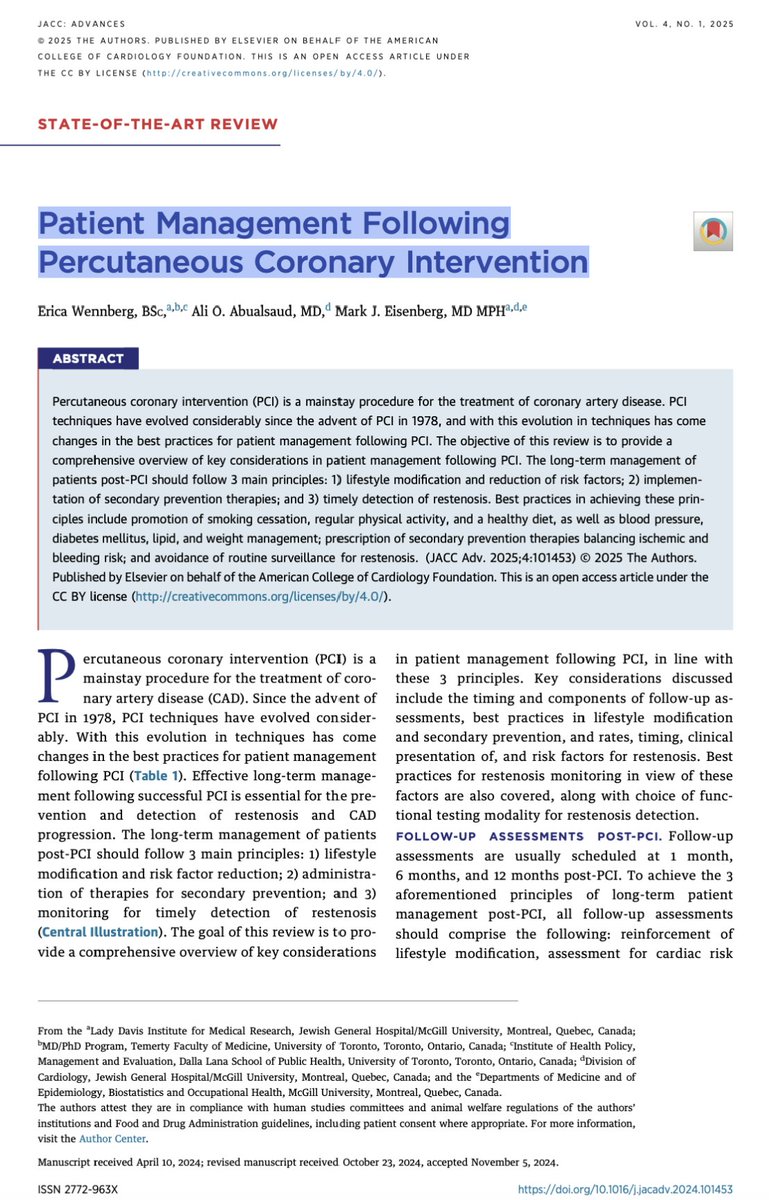
🫀🩺 Life after PCI: what really matters once the stent is in
This 2025 JACC: Advances state-of-the-art review reframes post–PCI care around a simple but powerful message: the procedure is only the beginning. Long-term outcomes depend far more on patient management than on the stent itself .
🔑 Three pillars of post-PCI care
The authors organize optimal management around three core principles:
1️⃣ Lifestyle modification & risk factor control
2️⃣ Secondary prevention pharmacotherapy
3️⃣ Selective—not routine—monitoring for restenosis
🏃♂️🥗 Lifestyle first (and forever)
Post-PCI care must aggressively target:
smoking cessation 🚭 (initiate in hospital, not later)
regular physical activity (≥150 min/week)
heart-healthy diets (Mediterranean-style favored)
blood pressure, diabetes, lipid, and weight control
Cardiac rehabilitation is strongly recommended—it improves survival, quality of life, and adherence, yet remains underused.
💊 Medical therapy: balance ischemia vs bleeding
Modern PCI management has shifted toward simpler, safer antithrombotic strategies:
Stable CAD: short DAPT (1–3 months) → single antiplatelet therapy
ACS: 12 months DAPT, with growing support for de-escalation
AF or anticoagulation needs: dual therapy beats triple therapy
High-intensity statins are mandatory, with LDL-C targets <55 mg/dL in very high-risk patients. Adjuncts like ezetimibe, PCSK9 inhibitors, GLP-1 agonists, and even low-dose colchicine may play expanding roles.
🔍 Restenosis: don’t hunt what isn’t there
With modern drug-eluting stents, restenosis rates are <5%. Evidence is clear:
❌ Routine stress testing or angiography in asymptomatic patients
✅ Symptom-driven, risk-based evaluation only
Trials like POST-PCI show routine surveillance increases procedures—not outcomes.
🧠 The real takeaway
PCI fixes a lesion.
Outcomes are driven by prevention, not metal.
📌 The stent treats the artery. Long-term care treats the patient.
🫀🔥 Post–Cardiac Injury Syndrome (PCIS): a true paradigm shift in care
This 2025 JACC: Advances State-of-the-Art Review reframes post–cardiac injury syndrome (PCIS) as a modern, increasingly relevant inflammatory disease—no longer a rare post-MI curiosity, but a frequent consequence of today’s cardiac procedures .
🧩 What is PCIS today?
PCIS includes:
🫀 Post–myocardial infarction syndrome (Dressler)
🩺 Post-pericardiotomy syndrome (PPS)
🧷 Post-traumatic / iatrogenic pericarditis
With the explosion of cardiac surgery, PCI, device implantation, and ablation, PPS and post-traumatic pericarditis now dominate—while classic Dressler syndrome has become rare.
🧠 Pathophysiology: inflammation at the core
PCIS is driven by an autoinflammatory immune response triggered by myocardial or pericardial injury:
DAMPs → NF-κB activation
NLRP3 inflammasome → IL-1α / IL-1β releaseThis explains why targeted anti–IL-1 therapies work in refractory disease.
🖥️ Diagnosis: imaging changes everything
Symptoms and biomarkers are nonspecific. The real shift is multimodality imaging:
🩻 Echo → effusions, hemodynamics
🖥️ CT → pericardial thickness, effusion characterization
🧲 CMR (game-changer) → edema + LGE = active inflammation
CMR enables diagnostic confidence, phenotyping, and therapy guidance.
💊 Treatment: from empiric to precision
First line: NSAIDs + colchicine
Steroids: selective use only
🚀 Refractory cases: IL-1 inhibitors (anakinra, rilonacept)
Emerging oral agents targeting NLRP3 are on the horizon
⚠️ Key limitations
Access to CMR and biologics is uneven; costs and equity remain major barriers.
🔮 Bottom line
PCIS care is shifting from symptom-based treatment to imaging-guided, mechanism-based precision medicine.
Less guessing. More biology. Better outcomes.
💬 Viewpoint: New H-1B visa restrictions could mean longer patient wait times and fewer clinicians in critical shortage areas, with international medical graduates playing a crucial role in rural and safety-net clinics.
https://t.co/5o9Bs51rP3
Two observations from a cardiologist who has always believed in the physical exam:
1. Residents and fellows will sometimes look at you as if you’re doing a party trick.
2. Even when I do a focused, cursory exam of a patient, patients tell me that it is the most thorough physical examination that they have had in years.
Brain injury biomarkers in critical care
GFAP
Glial Fibrillary Acidic Protein
Marker of astrocyte activation
Studied in both CSF and serum in severe TBI
Serum levels in severe and moderate TBI with GCS<12 have an unfavorable outcome at 6 months
UCH-L1
Ubiquitin C-terminal Hydrolase-1
Marker of neuronal injury
CSF and serum levels elevated in severe TBI, correlating with severity and outcome
Tau
Intracellular Microtubule-Associated Protein
Marker of axonal injury
c-tau is associated with disruption of BBB and post-injury cleavage of tau protein
S100B
Glia-specific calcium-binding protein.
Reflects TBI or neurodegenerative pathology related to axonal injury
Levels are reported to rise before any detectable changes in examination or imaging
Prognostic marker of BBB permeability and CNS injury
Lacks specificity for brain trauma
Alpha-II-spectrin
Cytoskeletal protein enriched in axons and pre-synaptic terminals.
Broken down in TBI by calpain and caspase into Spectin Break Down Products.
SBDP 150 and 145- indicates calpain activation and is associated with acute neuronal cell death
SBDP 120 indicates caspase-3 action and is associated with delayed apoptotic death
MBP
Myelin Basic Protein
30% of myelin protein
Potential marker of pediatric TBI
Decreased sensitivity because of extensive degradation post TBI, complicating its detection by ELISA
NSE
Neuron-Specific Enolase
Released in extracellular space during cell destruction
Acute levels of NSE and MBP were correlated with outcome in children, particularly under 4 years of age
High false positive as NSE is also present at high levels in RBCs.
NF-H and NF-L
Neurofilament proteins- Heavy and Light
Major component of axonal cytoskeleton
Levels of different isoforms found to elevated in adult and paediatric severe TBI
NF-L and phosphorylated NF-H are elevated in amateur boxers.
This is an ever-growing list, with others being:
Neurite degeneration markers Neuroinflammatory markers
Biofluid levels of neurotropic markers
and also autoimmune markers, like autoantibodies to brain antigens such as GFAP, reported as potential biomarkers for subacute or chronic phases of TBI.
Reference and further reading:
Textbook of Critical Care. 8th Edition. Chapter 44.
Jean-Louis Vincent, Frederick Moore, Rinaldo Bellomo, John J Marini
Great debate: the universal definition of myocardial infarction is flawed and should be put to rest: @ESC_Journals
🥸 - "should be put to rest" is an interesting title!
😱Let's summarize article that wants to silence the UDMI!
👇👇👇
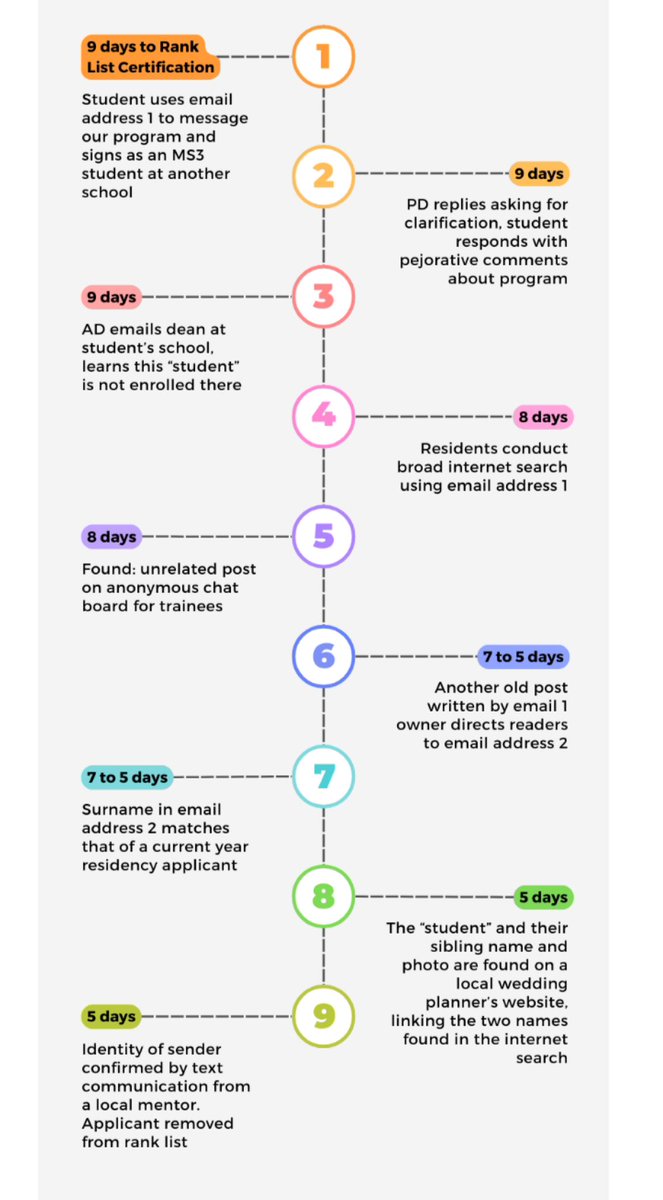
Why an applicant would use a pseudonym to send a complaining email, 9 days before rank lists were due, to a residency program at which they’d done an away rotation and a research project (and at which they were ranked highly) is beyond me.
But anyhow, now they’re on PubMed.
For anyone interested in learning more about angiography, come check out my introductory guide!
Come see my annotated diagrams like the one shown below.
https://t.co/IJTDAMNPfU