INSTEAD OF WATCHING AN HOUR OF NETFLIX TONIGHT.
This 1 hour Stanford lecture by Joel Peterson will teach you more about negotiation and getting what you want than most people learn in years.
Bookmark it and give it an hour, no matter what.
In 2008, Malcolm Gladwell explained why some people succeed and some don't in a single 1-hour talk.
This will permanently change the way you think about talent, effort, and success.
Bookmark & watch today, no matter what.
Everyone who has stood on a Greek island in August has thought the same thing. I could live here.
You couldn't. Not that island, not the way it was that day.
The island you fall for in August is a different place in February. Half the tavernas shut, the fast ferry cancelled three days running, the nearest real hospital a helicopter ride away.
I'm Italian, and Greece has been my second country for years, summer and winter. So I asked the only question that matters if you want to move and not just visit: which Greek islands are real towns all year round?
8 islands where you can actually live all year. Work, raise kids, retire, and not feel trapped when the boats stop.
Parents always ask me one thing first: can any of them school the kids in English? That answer surprised me too.
Thread 🧵
Elon Musk just put a price tag on obedience. It costs $200,000.
Musk: “You don’t need college to learn stuff. Everything is available basically for free. You can learn anything you want for free.”
Every lecture. Every textbook. Every framework ever written. Free on any screen in any country right now. The entire knowledge monopoly collapsed in a decade. Nobody updated the price tag.
Musk: “Colleges are basically for fun and to prove you can do your chores. But they’re not for learning.”
Strip the ivy and the branding. What’s underneath is a four-year obedience trial. Can this person follow instructions on a schedule without asking why.
Musk: “There is a value that colleges have, which is seeing whether somebody can work hard at something, including a bunch of annoying homework assignments, and still do their homework assignments.”
That is the entire six-figure value proposition. Not what you know. Not what you can build. Whether you can be managed. The establishment doesn’t need you educated. It needs you domesticated.
Musk: “If you’re trying to do something exceptional, you must have evidence of exceptional ability. I don’t consider going to college evidence of exceptional ability.”
The system doesn’t produce exceptional. It produces manageable. It takes the most creative years of your life and teaches you to wait for instructions. That is not education. That is containment.
Musk: “Gates is a pretty smart guy, he dropped out. Jobs is pretty smart, he dropped out. Larry Ellison, smart guy, he dropped out.”
They didn’t leave because they couldn’t keep up. They left because the ceiling was underground.
8 billion people now carry the same library in their pocket. The one these institutions charged a lifetime of debt to access.
The only product the university still sells is the belief that you need one.
Malcolm Gladwell revealed why you shouldn't go to Harvard:
1. America does not have a shortage of students who want science and math degrees. It has a shortage of students who finish them. Half of all high school seniors who intend to study STEM drop out by the end of their second year. The problem is not interest. It is persistence.
2. The obvious assumption is that smarter students persist longer. So Gladwell tested it. At Hartwick College, a small liberal arts school in New York, the top third of math SAT scorers took the majority of STEM degrees. The bottom third dropped out in large numbers. The data seemed to confirm it. Smarter kids stick around longer.
3. Then he looked at Harvard. The bottom third of Harvard's math SAT scores are equal to the top third at Hartwick. By the logic above, everyone at Harvard should graduate with a STEM degree. They are all brilliant. Nobody should be dropping out.
4. Harvard showed the exact same pattern as Hartwick. Top students graduated. Bottom students dropped out like flies. Even though the bottom Harvard students were objectively brilliant by any global standard. Something else entirely was driving the dropout rate.
5. That something is called relative deprivation theory. Human beings do not measure themselves against the world. They measure themselves against the people immediately around them. A Harvard student in the bottom third does not think I am in the top one percent of all students globally. They think that kid next to me keeps getting everything right and I keep getting it wrong. So they quit.
6. The research from UCLA puts a specific number on it. Your odds of graduating with a STEM degree fall by two percentage points for every ten point increase in the average SAT score of your peers. Choose Harvard over the University of Maryland and your chance of finishing a STEM degree drops by thirty percent. Thirty percent. Just to put a brand name on your resume.
7. Relative position matters more than absolute position when it comes to confidence, motivation, and self belief. The eightieth percentile student at Harvard looks up at the people above them and feels like they cannot compete. The number one student at a state school feels like they can conquer the world. That feeling drives everything.
8. The practical hiring implication is radical. Class rank matters more than institution name. Gladwell argues companies should have a don't ask don't tell policy for where someone went to college. Hiring only from top schools means missing the top students from every other school. That is not smart hiring. That is brand worship.
9. When choosing a college, never go to the best school you get into. Go to the school where you are guaranteed to be near the top of your class. Being a big fish in a smaller pond does not just feel better. It statistically produces better outcomes than being a small fish in the most prestigious pond available.
10. So why do we keep choosing Harvard over Maryland? Because we are flattered. Because the acceptance letter feels like validation. Because we make an irrational decision in a moment of enormous flattery and call it ambition. Gladwell's conclusion is simple and brutal. When we have the chance to join an elite institution we do things that are genuinely against our own interest and we feel great about it the whole time.
Warren Buffett and Berkshire Hathaway $BRK.B now fully own Bell Laboratories, a rodent-control company based in Wisconsin
Earlier this month it was reported by industry website, Pest Management Professional that the deal had happened - SeekingAlpha
Now the company has shown up on Berkshire's list of fully owned subsidiaries
Mercedez-Benz Stadium in Atlanta — the host of tonight's CFP National Championship Game — has the cheapest concessions in sports:
• $2 sodas
• $2 pretzels
• $3 pizza slices
• $5 cheeseburgers
The idea was inspired by the concessions at Augusta National Golf Club, but while other owners thought Arthur Blank was crazy, the idea was actually genius.
The Atlanta Falcons consistently rank first in the NFL’s annual internal survey for food quality, price-to-value ratio, speed of service, and variety.
The Falcons say that the price decrease led to an 88% increase in merchandise sales in the first year.
Fans are now spending 16% more money on concessions than they did a few years ago, and an average of 6,000 more fans enter the stadium two hours before each game.
However, the best indicator that the new model works is that several other professional sports teams have copied it.
From Ryan Smith and the Utah Jazz to Mat Ishbia and the Phoenix Suns, owners across North American professional sports are lowering concession prices for fans.
The idea is that a better gameday experience keeps fans coming back and often leads to the eventual purchase of higher-margin items, like merchandise.
Everyone on the planet should be lifting weights.
But most don't know how to start.
I've been training for the last 17 years...
If I was starting from scratch, this is the exact workout plan I would follow to get in the best shape of my life:
(Videos of every exercise included)
= Thread =
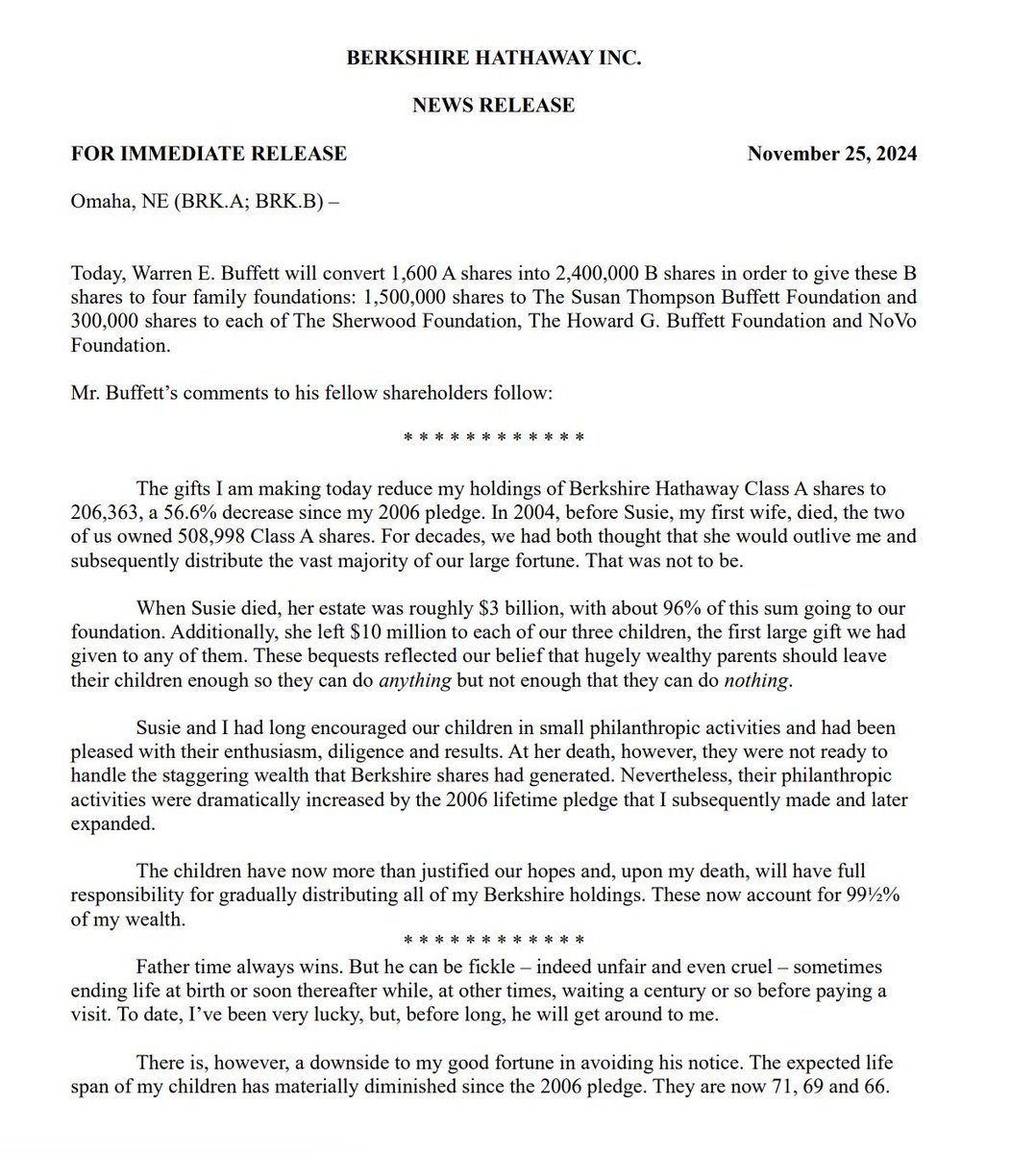
Warren Buffett who is currently the 7th richest person in the world worth $150,000,000,000.00 just sent out this letter explaining his thoughts on distributing his wealth after he passes away
A thread 🧵⬇️
Note who’s next to whom, who’s relaxed, who’s not, who’s standing, and who’s sitting. Look at their facial expressions, posture, and body language. Then try to make sense of what you’ve observed. https://t.co/7LxmuHbo7x