One of the best tweet, I have ever read-
"Learning isn't just about having fun; it's about putting in the work to grow. Instead of settling for quick and easy content, choose the path of challenge and depth. " - Andrej Karpathy
# on shortification of "learning"
There are a lot of videos on YouTube/TikTok etc. that give the appearance of education, but if you look closely they are really just entertainment. This is very convenient for everyone involved : the people watching enjoy thinking they are learning (but actually they are just having fun). The people creating this content also enjoy it because fun has a much larger audience, fame and revenue. But as far as learning goes, this is a trap. This content is an epsilon away from watching the Bachelorette. It's like snacking on those "Garden Veggie Straws", which feel like you're eating healthy vegetables until you look at the ingredients.
Learning is not supposed to be fun. It doesn't have to be actively not fun either, but the primary feeling should be that of effort. It should look a lot less like that "10 minute full body" workout from your local digital media creator and a lot more like a serious session at the gym. You want the mental equivalent of sweating. It's not that the quickie doesn't do anything, it's just that it is wildly suboptimal if you actually care to learn.
I find it helpful to explicitly declare your intent up front as a sharp, binary variable in your mind. If you are consuming content: are you trying to be entertained or are you trying to learn? And if you are creating content: are you trying to entertain or are you trying to teach? You'll go down a different path in each case. Attempts to seek the stuff in between actually clamp to zero.
So for those who actually want to learn. Unless you are trying to learn something narrow and specific, close those tabs with quick blog posts. Close those tabs of "Learn XYZ in 10 minutes". Consider the opportunity cost of snacking and seek the meal - the textbooks, docs, papers, manuals, longform. Allocate a 4 hour window. Don't just read, take notes, re-read, re-phrase, process, manipulate, learn.
And for those actually trying to educate, please consider writing/recording longform, designed for someone to get "sweaty", especially in today's era of quantity over quality. Give someone a real workout. This is what I aspire to in my own educational work too. My audience will decrease. The ones that remain might not even like it. But at least we'll learn something.
We’re releasing a broad range of new mathematical results produced by an internal frontier model.
We’ve been consulting with the independent Advisory Group on Mathematics and Artificial Intelligence at the Institute for Advanced Study, and we have drawn on their advice and public recommendations to inform how we release these results.
https://t.co/7N6TPlft1P
The Omacom Foundation has another awesome set of announcements for you all on Monday. We're taking this malleable computer system for the age of agents to the moon (or Mars, if I can persuade @elonmusk to give it a ride 😄).
The first Vera Rubin clusters are here!
Yesterday, @IneffableLabs took delivery of their Vera Rubin NVL72 cluster from @googlecloud@nvidia
The AI frontier jumps forward by yet another generation of hardware. Acceleration continues.
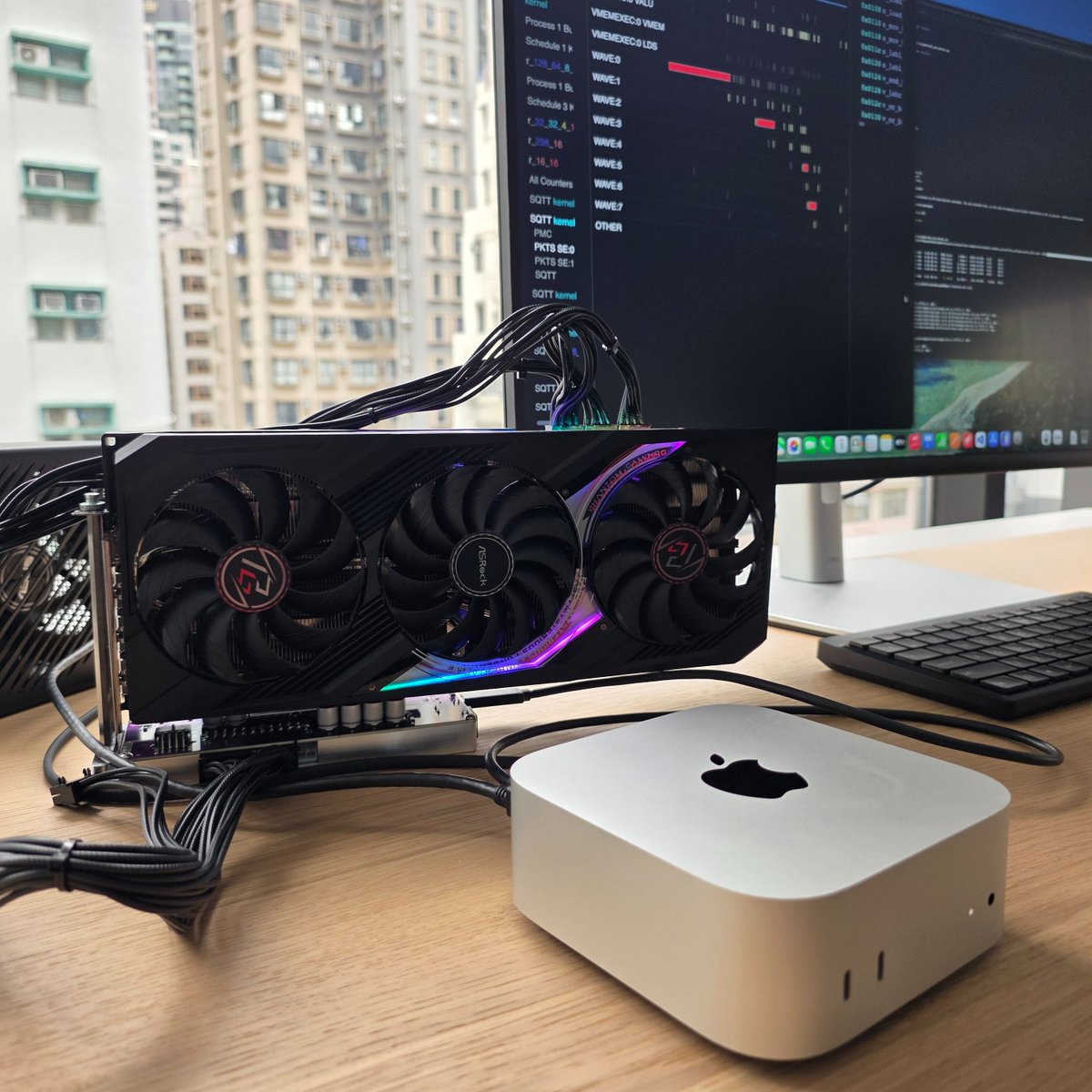
If you have a Thunderbolt or USB4 eGPU and a Mac, today is the day you've been waiting for! Apple finally approved our driver for both AMD and NVIDIA. It's so easy to install now a Qwen could do it, then it can run that Qwen...
You can learn anything in 2 weeks.
You can't master it, obviously, but if you obsess over it, you can become better at it than most people ever will. You'd be surprised how fast your life can change when you understand this.
Caught up with @karpathy for a new @NoPriorsPod: on the phase shift in engineering, AI psychosis, claws, AutoResearch, the opportunity for a SETI-at-Home like movement in AI, the model landscape, and second order effects
02:55 - What Capability Limits Remain?
06:15 - What Mastery of Coding Agents Looks Like
11:16 - Second Order Effects of Coding Agents
15:51 - Why AutoResearch
22:45 - Relevant Skills in the AI Era
28:25 - Model Speciation
32:30 - Collaboration Surfaces for Humans and AI
37:28 - Analysis of Jobs Market Data
48:25 - Open vs. Closed Source Models
53:51 - Autonomous Robotics and Atoms
1:00:59 - MicroGPT and Agentic Education
1:05:40 - End Thoughts