Postdoctoral Researcher at Uni. of Zurich. Previously @NCBS_Bangalore. Just pursuing FUNdamental research. Curious about biology with plants as favourites!
We are delighted to share our work on the role of small-peptide signalling in rice wound responses, now published in @cellrep.
We have uncovered the involvement of signal relay between PEPs and PSK peptide hormones.
Happy to share a fantastic work from @harshithcy part I of his PhD thesis, now in @CellReports. We report a stepwise signalling cascade involving two different peptides in rice wound-responses. Rice activates growth very quickly post-wounding unlike dicots https://t.co/om5pR50knJ
Spatial Decoupling of the Endodermal Functions Establishes the Innermost Cortex as the Gravity Sensor in Rice Stems https://t.co/GRLDRpTgoS
Our recent study uncovered that the innermost cortical layer functions as ‘statocytes’ for gravity response. @rohn_kshyp@SRY_PlantRoot
🌱 Can synthetic plant volatiles recruit nature’s own pest-control agents?
Our latest study identifies key maize volatiles that attract parasitoid wasp and explores their potential for sustainable biological control. Pest Management Science: https://t.co/R7ZIIojOhW
Happy to share this review in COPB, a favorite topic of @aravindmadhu41, a PhD student in the lab. As Reviewers mentioned, this can be the next key topic in epigenetics. Surprising regulatory roles of histone tail residues adjacent to histone marks https://t.co/4vMCsqWsKz
Happy to join hands with @HallanVipin Abhisha, @rajusteffi1 and team to find out how seaweed extract enhances RNA silencing to protect plants against viruses. Surprisingly, extract seems to enhance dsRNA generation and/or Dicing. | J. Applied Phycology https://t.co/UfhVjlf4jv
Our collaboration with @wc_ratcliff and @YunkerLab has resulted in a first paper to show how traits such as fluid stirring and associated exponential growth emerges "for free" in this system
https://t.co/wMUuVSivZW
Our invited review is now online in Plant Physiology Reports. Congratulations, Akash & @VedPrakash60611! Highlighting the power of plant microbiomes for climate-resilient crops and sustainable agriculture. 🦠 🌱
@sbslab_IISERM@DBS_IISERM@IiserMohali
https://t.co/afZdAW51QA
Our new paper is out! AS109 enables transient gene expression across diverse crops, expanding the toolkit for studying gene function and plant immunity @AdamWu9527@lderevnina@Freddie_King00
https://t.co/wHoqs9WwpZ
The multiomics landscape of small peptides encoded by long noncoding RNA-derived small open reading frames in rice (Zhipeng Chen , Haocheng Lin , Lirong Wei , et al) https://t.co/INgvOAImb6 @ASPB#PlantSci
The #NobelPrize in Chemistry 2026 recognises discoveries that have enabled chemists to drive chemical reactions that lead to homochirality.
Life’s chemistry is what chemists call homochiral, after the Greek words for “same” and “hand”. Like hands, all amino acids exist as two mirrored variants, but only one of them is found in the proteins in your cells. The other is rarely found in nature.
For a long time, chemists wondered how homochirality can emerge. When they began to experiment with chemical reactions that can form two mirrored molecules, they always obtained equal proportions of both in their test tubes. However, chemists strived to produce only one of these mirror images, because in the development of molecules that will interact with living beings – such as in pharmaceuticals – only one mirror image will have the desired effect.
Thanks to laureates Henri Kagan and Kenso Soai, we now know how homochirality can emerge. Their discoveries have been decisive for chemists who design reactions for the manufacture of pharmaceuticals.
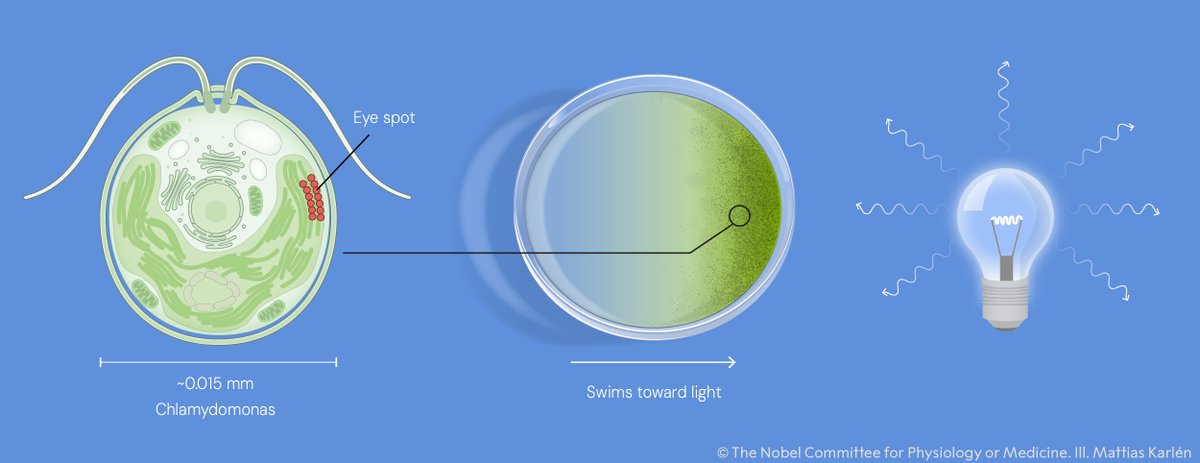
Peter Hegemann and Georg Nagel – awarded the 2026 medicine prize – discovered a remarkable protein, channelrhodopsin, in a single-celled alga.
Hegemann wondered how Chlamydomonas, a single-celled alga, is able to swim towards a light source. In the early 2000s, he and Georg Nagel discovered channelrhodopsin, an algal protein with unique properties, found on the surface of the cell. When it is illuminated by blue light, a channel opens through the protein. Charged ions then flow into the cell, creating an electrical impulse. They found that regardless of which cell they put the protein in, those cells became light sensitive.
#NobelPrize
How do plants turn local wounding response into a whole-plant defense?
Our work identifies CNGC13, a vasculature localized Ca²⁺ channel that helps propagate systemic Ca²⁺ waves and activate jasmonate & glucosinolate defenses in Arabidopsis.
A new piece of the puzzle in long-distance plant immunity and wound signalling and acts in parallel to well known GLR channels
First PNAS from my lab and is combined efforts of a great team : Misha @MishaKu16647918 and Ramgopal as first authors. Supported by Bhawana @BhawanaSha17 and Mahendra @MahiPawar12 from lab
We thank Alex Costa @lab_costa for his constant support and collaboration ; Yong-Fei Wang for electrophysiology
A huge shout out to @DBTIndia@NIPGRsocial for funding and encouraging basic plant science in India and Arabidopsis research
https://t.co/gleTA1D8WI
Thrilled to share our new work combining single-molecule imaging in living plants with biophysical and biochemical assays to link receptor dynamics to function-guiding precise engineering for stronger, sustained immunity with preserved receptor turnover🥬.
https://t.co/ddo7NZBn8T
Happy to share this work where we report the role of BBX28 in regulating temperature sensitive growth, now published in Science Advances @ScienceAdvances . Congratulations all authors. Thank you @DBTIndia, @iiserbhopal for funding and support.
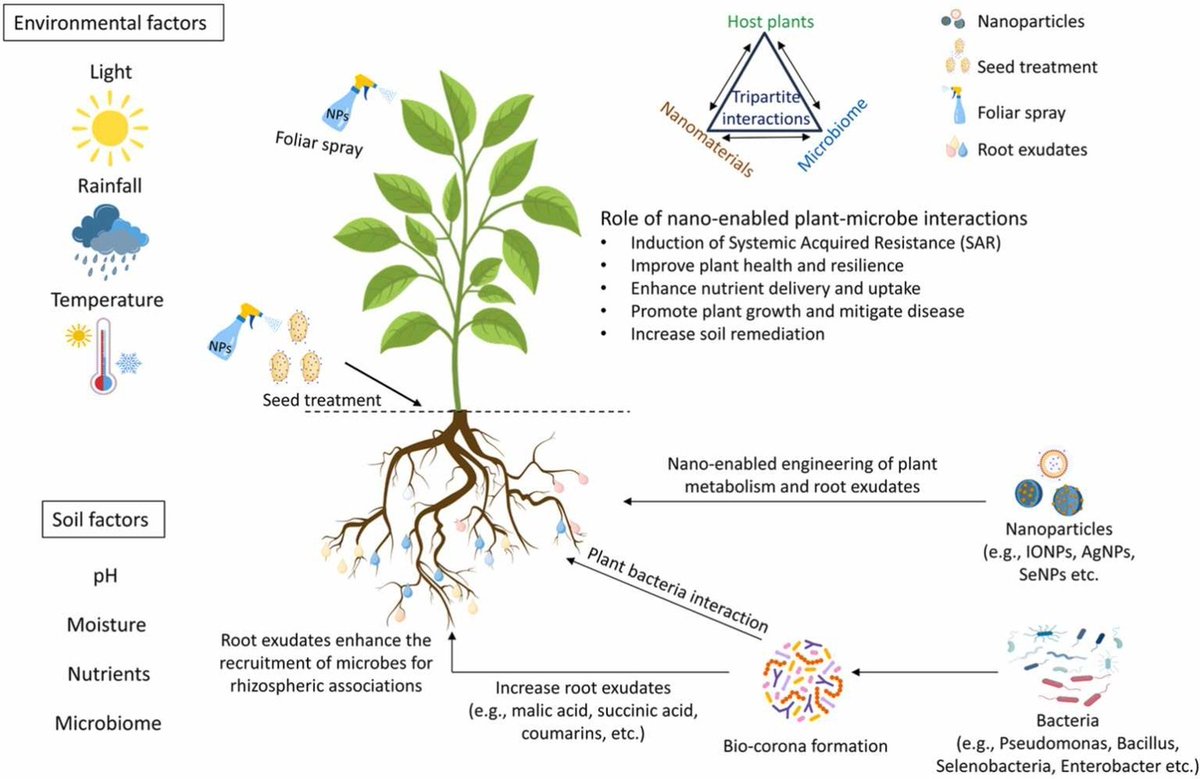
Happy share our latest review in Plant Nano Biology journal! We explored d potential of nano-enabled microbiome engineering for climate-smart agriculture & global food security. Congrats to Ved Giri, @ANKIT__K__YADAV@sbslab_IISERM@IiserMohali https://t.co/Gv1rX1uiTI
I am proud to share my No-AI-assisted perspective review "Plant Peptide Hormones: Three Decades of Discovery and Emerging Paradigms" for the Centennial issue of @PlantPhys🌱🍅. It's OA, so everyone can access! 1/
https://t.co/svAuZ7erDK
Thanks NCBS communications team for posting. Huge thanks to @NCBS_Bangalore@TIFRScience , @ANRFIndia, past and current lab members who believed in our lab, past and present NCBS leadership, Facilities at NCBS, Collaborators and friends🙏
🌱 New preprint!
We identify HY5 as a key regulator of coumarin-mediated iron acquisition, coordinating coumarin biosynthesis, activation, and secretion under alkaline conditions.
📄 https://t.co/bCiDuoDcRh
@sbslab_IISERM@DBS_IISERM@IiserMohali