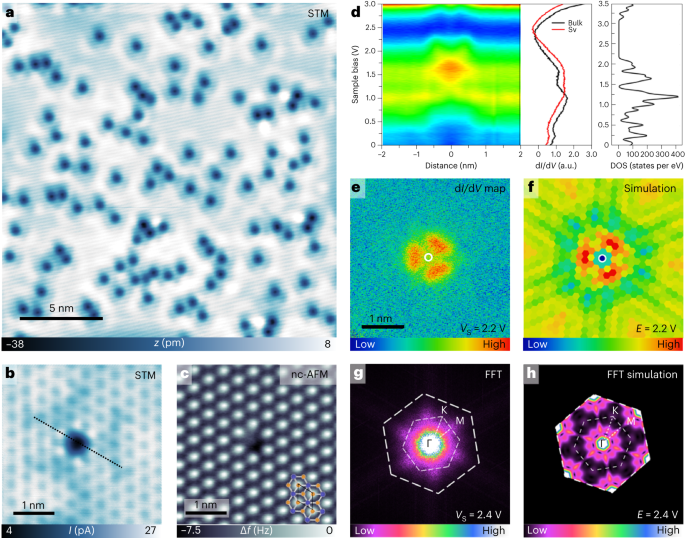
NUS scientists demonstrated a conceptual breakthrough by fabricating atomically precise quantum antidots using self-assembled single vacancies in a two-dimensional transition metal dichalcogenide.
https://t.co/Ku2QWD9xTc
Quantum Antidots Assembled by "atomic Lego"! Thrilled to share our latest work in @NatureNano https://t.co/RMUWo4oinY. A great collaboration with @RodinAleksandr team ! Congrats Hanyan Fang, @harshitra_m et al..
New paper with @drlightx and @RodinAleksandr! We explore how thermal vibrations affect ionic transport in 1D solids, and show how lower drag at high speeds leads to non-Fickian diffusion and improved ion mobility at high T @PhysRevResearch https://t.co/2jfZQRp3yz
In recent months I have been collaborating with Matthew Baird and team to investigate the retention of women in STEM in the US. Our findings were published in a white paper and working paper (linked in the comments).
Our early findings reveal a clear dis…https://t.co/2RiQQZWtOL
I often hear that companies struggle to hire women and minorities in Tech because there are very few qualified candidates.
My latest work with Nikhil analysing LinkedIn data reveals that when hiring managers do not just consider what title a candidate h…https://t.co/LqsVCuDYyv
It turns out that you don’t need that many ingredients to simulate thermalization! Our work with @drlightx provides insight into ionic transport in solids and suggests several exciting ways of realizing thermalization using cold atoms.
Interesting behaviors of defects in BP. Our latest work out in @PhysRevLett "Electronic Self-Passivation of Single Vacancy in Black Phosphorus via Ionization" A nice collaboration with @nanosurflab@RodinAleksandr. Congrats Hanyan, Aurelio, Dikshant et al! https://t.co/wP9dZAyeIQ
For more examples, take a look at the documentation, available at https://t.co/knFqzmu3cR. We look forward to seeing exciting defect systems in graphene being explored, as well as comments and suggestions!
New paper with @hbhillol and @RodinAleksandr! We introduce GrapheneQFT.jl, a #julialang numerical package for QFT calculations in graphene systems with defects. Paper: https://t.co/Gx8L3i8OGB. . Repository: https://t.co/70m4JJ5eon. .🧵:
What if we wanted to calculate the change in the system's free energy in the presence of a defect with variable coupling strength? We can tune the system's chemical potential as well to understand the bigger picture.
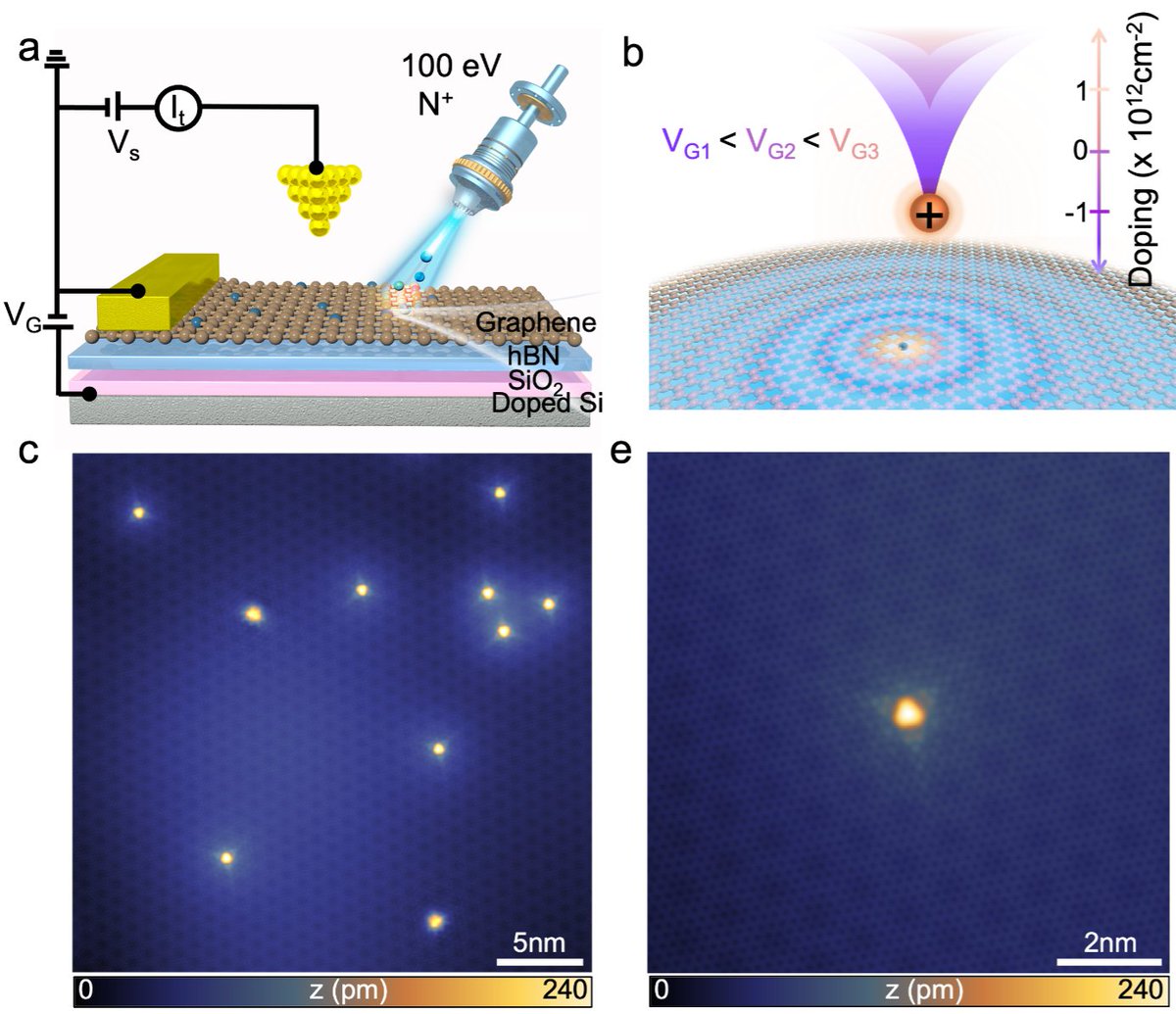
Our latest work "gate-tunable artificial nucleus in graphene" by @Kolya49673659, Keian et al. https://t.co/PQ027kPYJc, in collaboration with @RodinAleksandr et al. Implanting single N atom in graphene!
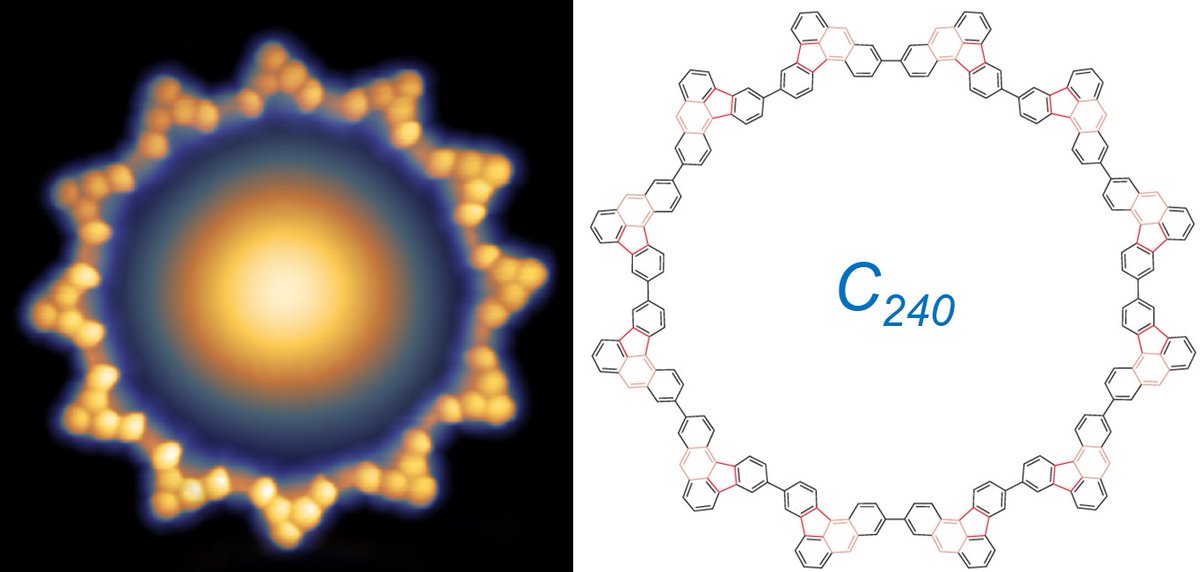
NUS scientists have devised an on-surface synthetic protocol to construct atomically-precise stable organic quantum corrals (OQCs), with the formation of a series of new quantum resonance states.
https://t.co/T7YdZzdLqu
Macrocycle Quantum corral with 240 carbon is online! A great collaboration with my colleagues @CChiGroup, Alex Rodin and Pavel. Congratulation to Xinnan, Harshitra, @shqdong, Pingo etc! https://t.co/eKJjcohnhk